10th Trip to Uganda: The Countdown Begins

September 4, 2016

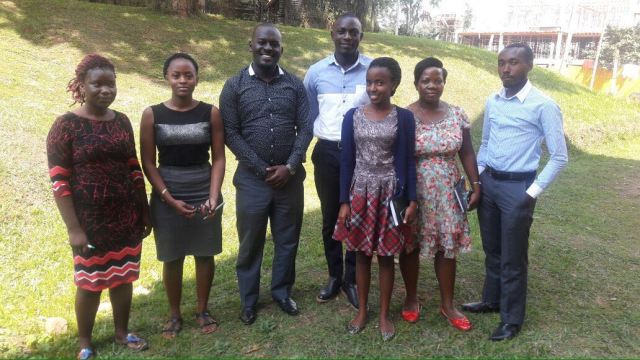
Pharmacy Intern Class Grads 7-16

Gonsha’s Pharmacy Intern Graduates from Mulago Hospital, Kampala August 2016

It’s been months since you’ve heard from me but lots of Uganda-related work has been going on and progressing towards the upcoming trip.  13 days from now, 4 Wilkes University students and I head off to Uganda to learn while serving my partners during their Global Health Advanced Pharmacy Practice Experiential rotation. (APPE) I’ll be introducing you to the participants over the next 2 weeks but before that, I’d like to catch you up with what’s new with me since returning to the States from Uganda on May 3, 2016. I’ve been super busy and it is hard to believe that was just 4 months ago!

BU-Landscape

The beautiful landscape around Binghamton University in the Southern Tier of Upstate New York where I am now Professor and Founding Chair of the Department of Pharmacy Practice.

First of all, I have a new job as Professor and Founding Chair of Pharmacy Practice at Binghamton University School of Pharmacy and Pharmaceutical Sciences (SOPPS) in the state of New York.  I am helping to develop a brand new school of pharmacy which will open with our first class of students 1 year from now in Fall 2017.  The SOPPS is part of the SUNY System (State University of New York) and the first degree program will be the Doctor of Pharmacy Degree (Pharm.D.) but PhD programs are in the plans.  Although I have loved every minute of my time as a professor at Wilkes University and I will miss my old colleagues, this new job opportunity was one I couldn’t pass up. It is challenging me to use my God-given talents and skills in different ways and it is helping me to grow professionally.  I was really attracted to the Mission Statement of the SOPPS: “To develop outstanding leaders in pharmacy and pharmaceutical sciences using contemporary medication management and innovative research in order to transform human health locally and globally.”  This fits perfectly with my goals for my work in Uganda – to help advance pharmacy practice and safe medication use in Uganda so patient care health outcomes are improved.  In addition, the Binghamton University SOPPS is dedicated to providing care to “diverse groups of patients, especially those who are under-served or living in rural communities” (from the Vision Statement), which also is aligned with my work in Uganda. Since Wilkes students had already been chosen for 2 Global Health APPE trips for the academic year 16-17 and I also intend to continue my research in Uganda and even grow my programs with Binghamton University students, my new Dean is fully supportive of keeping these 2 trips on track.

Second, the upcoming trip will have a slight but wonderful twist to my usual activities. I, along with the pharmacy students, have been invited to present a 2-day Seminar on Pharmaceutical Care to pharmacy students at Mbarara University of Science and Technology (MUST) and pharmacists and other healthcare professionals at Mbarara Regional Referral Hospital (MRRH)!!!  This project has been more than 1 year in the making due to the efforts, persistence, and enthusiasm of two pharmacy students at MUST, Noah and Derrick. I met Noah at the Joint International Scientific Students Conference in April 2015 that was organized by all of the health professions students at Makerere University. See blog post on April 3, 2015 for more information. I believe it was at that conference when he heard about my work with Makerere University Pharmacy School and the development of the Pharmaceutical Care Skills Lab course (PCSL) and expressed a sincere interest in having that course started at MUST. He informally invited me to visit MUST and talk to the students and professors at that time but to make this happen, a formal invitation from the faculty and/or Dean would be necessary.  I gave him my contacts and we have gone back and forth with emails numerous times.  Finally, Derrick and Noah successfully gained the support of the Administration and have planned an excellent conference – the 7th Annual Mbarara University Pharmacy Student Association (MBUPSA). This conference will take place September 26-27 so be sure to check out the blog at that time to hear more about our adventures.

A common question I’ve received during recent trips to Uganda is “Why do you only work with Makerere and Mulago Hospital? How can we get involved?” The answer is simple but not easy. First of all, you need to ASK. But, the difficulty is that I am only 1 person and trips to Uganda from the USA are very expensive.  It has always been my goal to help Uganda develop a program of training for the practice of pharmaceutical care that is shared across the country. Every project has a starting point, though, and Professor Richard Odoi at Makerere University has been my starting point. It was through his support that I was able to be awarded the Fulbright Specialist Grant that helped me to be in Uganda for 3 months developing and teaching the PCSL.  This grant required institutional support from Makerere University, meaning I was partially funded by the Pharmacy Department (to cover lodging and in-country expenses; the US Government covered international travel). This work now has a really good foundation in Kampala. I not only work with Mulago National Referral Hospital but also Mengo Hospital. I have trained a good number of pharmacy interns and pharmacy students who are now pharmacy interns and they ARE making a difference.  Gonsha Rehema, one of the the Ugandan Pharmacists who spent 8 weeks training with me in the USA in summer 2015, has taken her new skills and has shared them with a couple of classes of interns. She recently sent me the photos in this blog.  Kudos to Gonsha! I am so proud of her efforts to improve patient care through education!
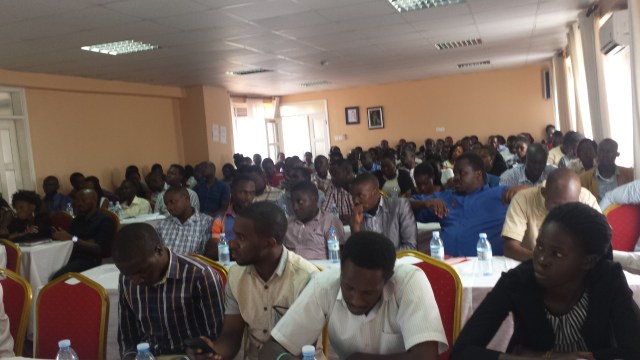
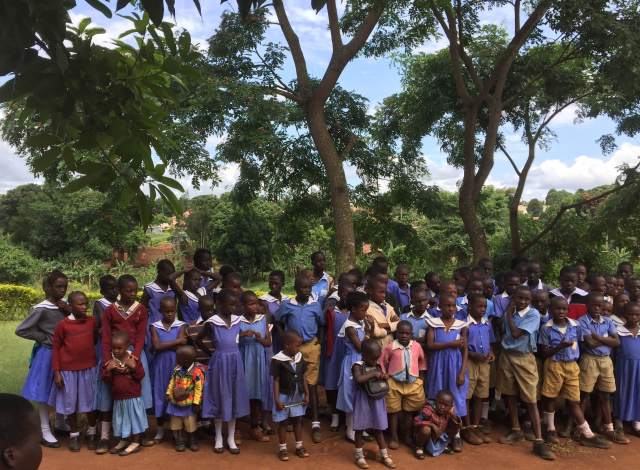
New Pharmacy Interns 16-17-Kampala

The incoming group of Pharmacy Interns who will work in and around Kampala with Gonsha. (I recognize most of the interns in the foreground because they were students I worked with at Makerere University- can’t wait to see them as Interns!)

When Noah and Derrick from MUST asked me to come to Mbarara (which is about 4 – 5 hours southwest of Kampala) I was very enthusiastic but financial support had to be arranged. I was willing to tack this presentation onto my normal trip to Uganda to save the extra travel costs, but the fees the American students pay didn’t account for a side trip to Mbarara. Fortunately Noah and Derrick were able to persuade their Administration to support this conference.  This is actually a really good sign to me that the Pharmacy School at MUST is serious about considering the inclusion of new curriculum teaching pharmaceutical care skills.  I’m really looking forward to seeing a new University in Uganda and to discussing the possibilities…


Posted in Beginnings, Pharmacuetical Care Training Program, Uncategorized | Tagged , , , , , | 4 Comments

Ponderings at the End of My 9th Trip To Uganda

May 2, 2016

Since 2011, I’ve been coming to Uganda to help advance pharmacy practice for the purpose of improving safe medication use by for teaching the pharmacy students, pharmacy interns, and pharmacists clinical skills. This is my 9th trip and each one brings me a greater understanding of the challenges the Ugandans face as they strive to improve healthcare.  The issues are so multifactorial that one can get really overwhelmed and depressed just thinking about it. But, I’ve chosen not to do that and instead I try to focus on one piece at a time while keeping in mind the others because they are intertwined.

For example, you might think that if they just had enough drugs, all would be fine. But, no, you have to consider where the drugs come from and if they are actually of quality and not counterfeit or adulterated.

Then you might think, if only the medical doctors were trained better at diagnosis and what to use for treatment. Actually, there has been a lot of money and efforts put towards training medical doctors and I do think it is helping. But, those funding medical training, need to include ALL healthcare workers. Even if the physicians are the best-trained in the world, they won’t make a dent in patient deaths and bad outcomes IF there are no drugs to be dispensed and nurses to administer the drugs.

If there aren’t trained pharmacists to watch over the patient’s whole medication regimen to make sure that the drugs don’t interact and are given in the correct dose for that size patient and take into account their kidney function, then it doesn’t matter if the physician ordered the correct drug for the patient because it might cause a bad reaction with their other drugs or be in a dose that could harm the patient or not work.

Wound infections from trauma, especially boda-boda (motorcycle taxis) accidents are very common. But, antibiotics alone won’t cure the infection. If the absolutely perfect antibiotic is given in the correct dose and doesn’t cause any bad interactions with other drugs, it still won’t work if the nurses aren’t trained or are too few to change the dressing so the wound keeps clean.

Then consider the non-drug or medical issues that interfere with good healthcare like Drug-Supply Chain Management. If the drugs aren’t available in the hospital, they can’t be used to help patients. If the system is computerized and the printer ink or paper runs out and the budget for the month is finished, then within a few days, the whole inventory control can become entirely disorganized. You won’t be able to rely on knowing what is available in which units and soon you are out of stock in one unit and no one knows where to go to find more drug.

These are just a few of the multiple factors that need to be addressed if healthcare is truly going to be improved in Uganda. But another BIG one I want to point out, is that most of the Guidelines for Treatment Protocols are written based off of studies in Western Populations (North American and Europe). The Ugandans (and those in the rest of the developing world) currently rely on these but many of the drugs they recommend aren’t even available here. Or they are so expensive they might as well not be here.  Plus, as we learn more about the human genome we have learned that a person’s genetics may have a lot to say about whether or not a drug will work for them. I’m going out on a limb here, but I daresay, that the African population likely has some differences in genetics to the North American and European populations. So, how do we know our guidelines really will work here in Uganda, Africa?

Throughout our time in Uganda, I have been trying to teach my Wilkes pharmacy students along with the Ugandan pharmacy students and interns, to think out-of-the-box. Don’t immediately judge a patient’s treatment regimen as sub-par just because it may not be what we do in the USA. Look a little deeper and consider what options are available here and consider the fact that they have been using drug regimens that may look “odd” to us but seem to actually be working for them.

An example is the duration of antibiotic therapy. In the USA and Europe, we tend to use longer courses of antibiotics for many infections but here in Uganda, therapy is often much shorter. This is in part due to limited availability of drugs, the expense, and the general thought that patients will not be able to adhere to longer treatments. But, it does appear that most patients do get better. There could potentially be a harm we are unaware of due to the shorter antibiotic courses such as promotion of antimicrobial resistance, but I am not aware of anyone studying this in the developing world. What if there is no induction of resistance but the patients still improve? If this was studied and published, maybe we in the Western World would benefit. Or, if there if resistance being developed or treatment failures greater than we know, then studying this could help to improve care for Ugandans.

I have found that for Ugandans, the concept of “preventative medicine” is new and often unheard of. Most of the poor live a day-to-day existence and are not aware that they should be thinking about what will happen in the future if they don’t treat their high blood pressure with daily medications. But, I think this can be addressed with education. I believe that Ugandans will begin to understand how they can improve their quality and quantity of life with better management of chronic conditions if they are given the right education.

Consider how dismal the outlook for the HIV and AIDS epidemic in Africa was less than 20 years ago. Antiretroviral drugs were not readily available and the disease was rapidly spreading. To get this under control, beside getting drugs to Africa, patients had to be convinced that taking daily medications for the rest of their lives was worth it and they are doing it! And, when treating HIV, it is critical that adherence be 100%. Missing just a few doses of medication can cause the virus to mutate and the patient’s disease state to worsen. And, although there are still challenges in the treatment of HIV in Africa, the outlook has much improved and many patients are living fruitful and quality lives. What great improvements in the health of Ugandans would occur if we could approach the treatment of the newly arising challenge of chronic illnesses like Hypertension, Diabetes, and Heart Disease in Uganda and the developing world in general, the way we tackled the HIV crisis.

If you’ve reached the end of this extremely long post, I hope that you have a better understanding of the many issues affecting health outcomes in Uganda. If you are in a position to do something about this, I urge you to act. All it takes is one step at a time to make forward progress. But, we need to work together and as you tackle your piece of the puzzle, don’t forget about how what you do affects others. Researchers need to work with Clinicians; Clinicians need to consult IT and Business experts; don’t forget to include Educators and Communications experts to convey ideas, etc (you get the idea). Together the puzzle comes together and we see a brighter future.

Posted in Uncategorized | 2 Comments

On Safari: An Early Morning Game Drive & An Afternoon Boat Ride at Queen Elizabeth National Park!!

May 1, 2016

Wilkes students and Arthur, our tour guide


 Morning came early today- we had to rise at about 5:30am to get ready for our early morning game drive. We were all surprised at how cold it was when we started out.  This was especially so because not only was the weather cool, but the top of the Safari jeep was open and the wind whipped through the vehicle.  But as soon as we started seeing the animals, the cold was less prominent on our minds.   


 We saw tons of the Ugandan Kob, an antelope which is also the National amimal.  We saw Forest and Cape buffalo, many birds, and LIONS!!  The first group of lions we saw was way in the distance and then we saw another group a tad bit closer.  Both those groups could be seen only with the ranger guide’s binoculars. But then we saw lions up in a Cactus tree!! I couldn’t get a good picture but we could see them with our own eyes, especially the tails hanging down and wagging.  Then one of the further group of lions ambled over to the ones in the tree and climbed up to join them!  

  Later we were able to see another group of 3 lions up really close.  It was close enough to get a decent picture with my iPhone.  I have some even better ones, though, with my camera. When we got back we had a huge “American” type breakfast. The food is great here. After only a couple of hours of free time, which I used to re-pack my suitcases for the flight tomorrow, we ate another up yummy meal- lunch.  I was hardly hungry enough to eat it, but of course I did.  


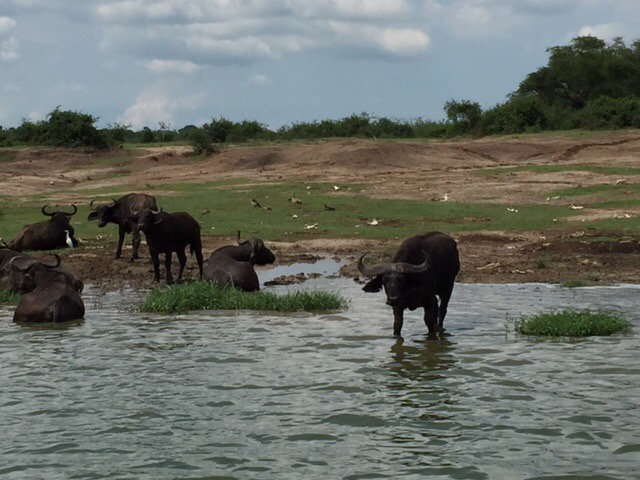
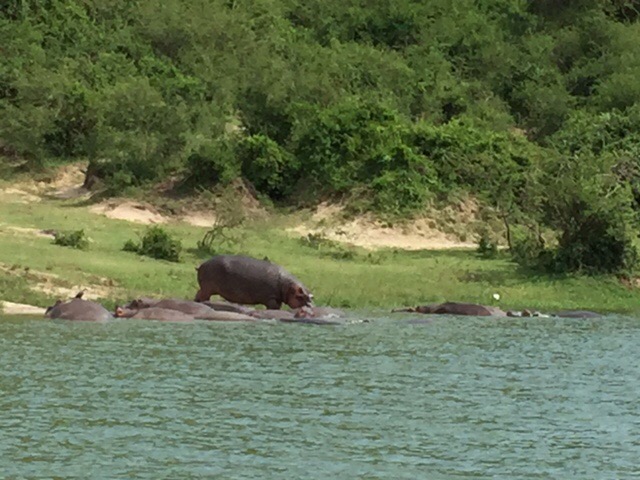
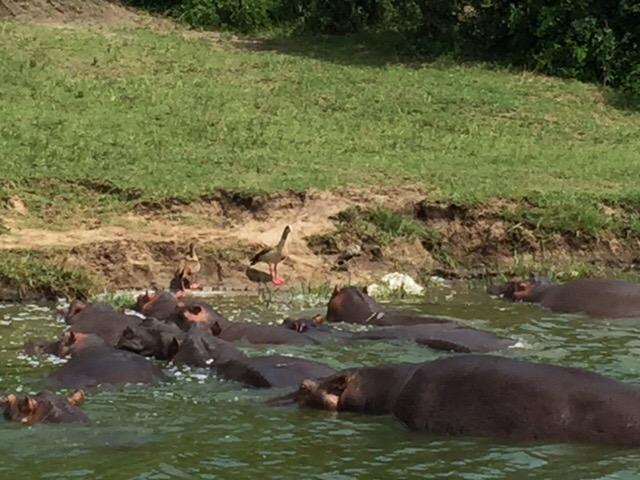
 In the afternoon we took a double-decker boat ride on the Kazinga Chanel, a natural body of water than connects 2 lakes, Lake George and Lake Edward. We hit the jackpot on the boat ride in terms of Amimal sightings. We saw many, many Cape Buffalo in the water surrounded by numerous species of birds, and  even more hippos all over the place.  We saw 2 crocodile and a huge old elephant that let us take his picture from many angles for about 15 – 20 minutes before he decided to go on the land and we had to head back.  Most of the hippos were in the water laying on top of each other but we also saw some on land- how huge they are!  We even saw adorable baby hippos.  It’s hard to think about how dangerous they are when they look so cute.  We passed by a native fishing village and were horrified to see 2 teenage boys swimming in the water where we had just seen crocodiles and hippos. When I asked the ranger guide about how safe this was he said that he didn’t recommend it and it was 10% safe. We all took this to mean a 90% chance of a bad outcome.  We agreed those weren’t good odds.  The fishermen were getting their boats ready to go out for the night.  Apparently their routine is to fish all night long and come back in the morning.  They have long narrow wooden boats and I don’t know how they would be able to see, but I suppose they fish by moonlight. Tilapia and catfish are the main fish they catch.  


 Now we are back at the beautiful lodge relaxing and some are swimming in the pool. Tomorrow morning we head to Lake Mboro National Park for another game drive then onto the airport for our flight home. 

Posted in Uncategorized | 1 Comment

Journey to Queen Elizabeth National Park, Uganda: We Have Arrived!

April 30, 2016

All ready to go- some luggage on the roof

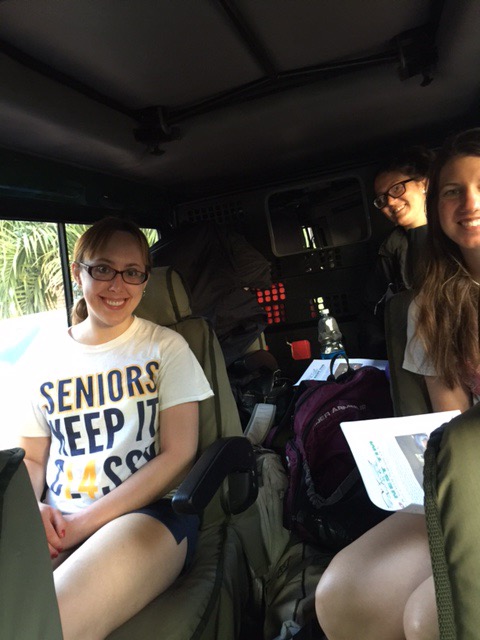
The inside of the vehicle is really roomy but you can’t tell because we have so much “stuff”

We finally got a tarp to cover up the luggage and protect from the rains

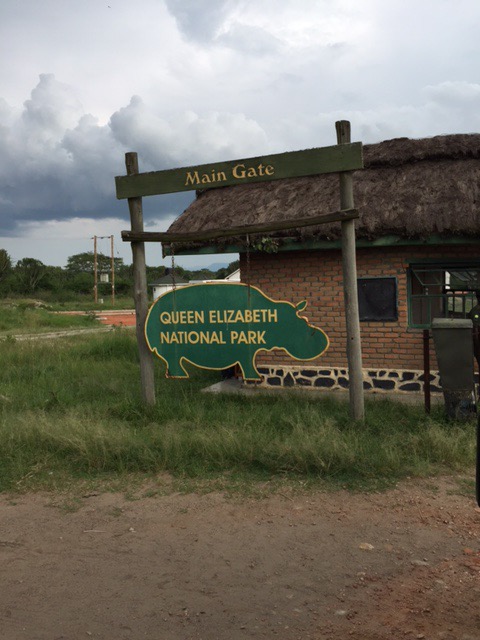
 Today we got up bright and early, actually it wasn’t bring at all- it was still pitch black- to eat breakfast at the New Court View Hotel before getting picked up at 6:30am to go on our Safari to Queen Elizabeth National Park, Uganda. This park is in the southwest of the country, an area I haven’t traveled to yet.  Our tour director and guide is Arthur Fadison and he has a company called Econestim Tours and Travel Uganda.  I’ve known Arthur for several years now and he’s taken my student groups to Jinja in the past. He’s been telling me lots of good things about Queen Elizabeth so this year, I decided to try a different game park.


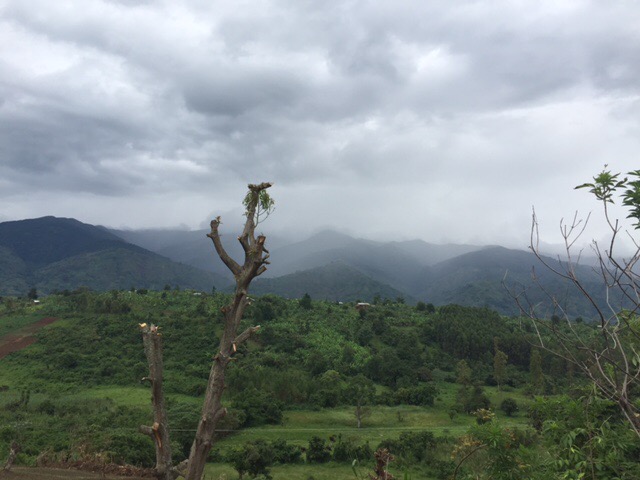
The Rwenzori Moutains in the distance

 The drive from Masindi is quite long. After loading up his Land Cruiser and realizing that we had too many bags and some had to be tied to the roof, we took off at 7am. Initially it wasn’t raining but soon the drops began to fall. There wasn’t a store open in Masindi that sold a tarp to cover the suitcases on the roof, so we had to drive on to the next town. Just as we were able to get a tarp, the sun came out. But Arthur said we’d need it anyway, and boy was he right! It rained off and on the whole day and at times was really hard. The first half of the trip was extremely bumpy on a red dirt road that got really slippery when it got muddy. But Arthur’s vehicle is great and he really knows how to handle these roads. At one point, we had to cross through a completely submerged road. The water was so deep that a motorcycle that was trying to pass was halfway covered in water. The passenger and the driver’s feet and lower legs were in the water. But Arthur’s Land Cruiser had no problem!  We all were happy when we finally got to a paved road. 

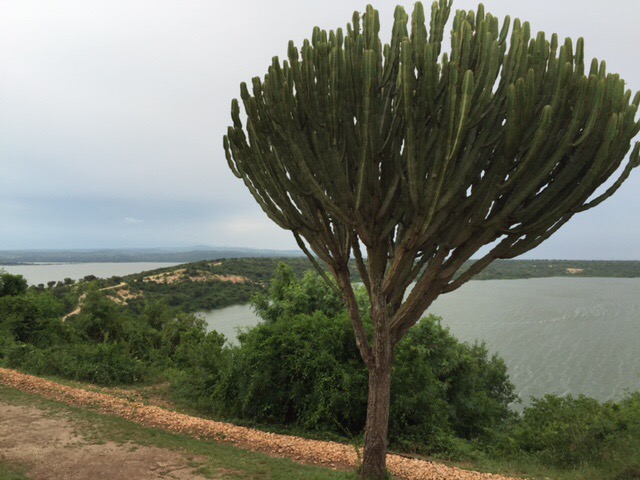
The scenery and landscape along this drive south was very different than in other parts of Uganda. There were more trees and forests along the way and it was also much hillier. At one point the hills had lots of huge rocks on them.  As we got near Fort Portal and beyond we could see the Rwenzori Mountains in the distance- it was beautiful!  We all tried to get pictures but they just can’t do the real scenery justice.

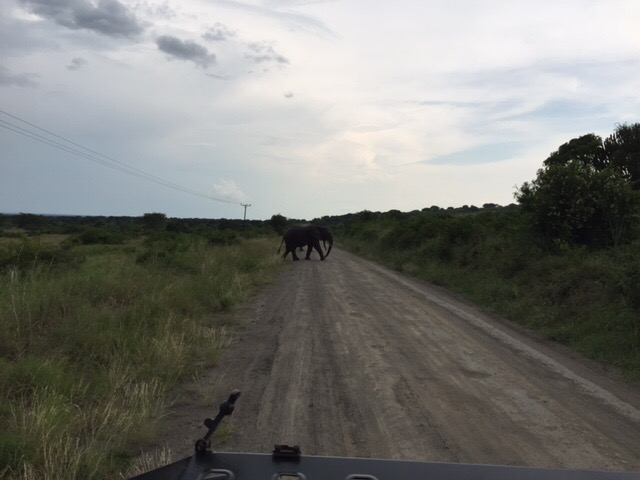
  Then as we entered Queen Elizabeth National Park, we started to see animals, even though we weren’t officially on a game drive yet.  You have to drive about an hour into the park to get to the Mweya Lodge, which by the way is also beautiful.  We finally arrived at the lodge at 5pm- so a 10hour day of driving. All we had to do was relax but I’m sure Arthur is tired out.  The students were really impressed to be able to already see some animals- a Uganda Kob (an antelope), and a bunch of Elephants, including a baby one, and to see the accommodations here.  Right now they are relaxing by the pool and in the pool. Dinner is a 7pm and then tomorrow morning we will rise really early for a morning game drive. 

We saw a small herd of elephants cross the road in front of the vehicle


The view from our hotel room!


Posted in Uncategorized | 1 Comment

A Fond Farewell to Masindi

April 29, 2016

IMG_7189

Dr. Godson, in the middle, with Casey, Lauren, Kassi, Dr. Bohan, Dr. Nicol, and Makenzie from Left to Right.

Our time in Uganda has drawn to a close. It is hard to believe we’ve been here for 4 weeks already- 2 in Kampala and 2 in Masindi. The work in each location is very different but both are equally rewarding.  For me, the farewell is temporary because I already have my 10th and 11th trips planned for Sept 2016 and April 2017.  The students may not return but you never know. Perhaps they will be interested in being Preceptors on a future trip to Uganda for their own students.

IMG_7196

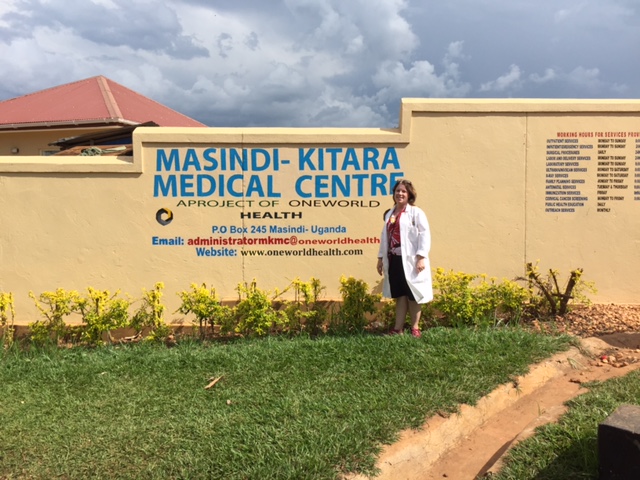
Dr.Melanie Nicol in front of the MKMC entrance sign

IMG_7197

Patrick, Dr. Bohan, and Baluku, two of the Administrative Team at MKMC. These men are really dedicated to the project and I love working with them.

Today’s activities included the Baby Immunization Clinic again, which is clearly a highlight of the student’s trip. IMG_5358

On Wednesday, the students and I presented more CME topics (continuing medical education) to the staff at Masindi-Kitara Medical Center (MKMC).  Makenzie and Kassi had prepared an Antibiotic Quiz to teach clinical pearls regarding antibiotic use. Lauren and Casey prepared a talk on management of Antepartum Hemmorhage (bleeding during pregnancy). This is definitely something they don’t learn in pharmacy school but there have been several patients admitted with this problem during our time at MKMC.  So, they had to do some research in order to give a talk on this subject and they did a great job! I gave a talk on the management of Urinary Tract Infections. The latter 2 talks were ones that the staff had asked us to do, after last week’s CME.  All were well-received. IMG_7167

One of the things that was different about our time in Masindi as compared to Kampala is that the Wilkes Pharmacy students didn’t have a Pharmacist or Pharmacy students to work with at MKMC, as they had in Kampala. But I think each of these experiences teaches them different things. In Kampala, they clearly had a role in modeling pharmacist behavior and they were able to mentor the Ugandan Pharmacy Interns and teach them new skills. But although they didn’t work with Pharmacists at MKMC, they still helped the clinical staff, both Nurses and Physicians and Clinical Officers (like PA’s in the USA) to learn new skills. In this resource-limited setting, they can’t afford to hire a Pharmacist right now and the law doesn’t require it so they have to use the Nurses to dispense medications. IMG_7158IMG_7163The Clinicians don’t have a Pharmacist to work with them on Ward Rounds all the time. So both of these groups of people need to learn “pharmacy-type” of information on their own so they can best serve their patients.  Every time I come to MKMC with students, we help to advance the knowledge and the skills of the Clinicians. The Wilkes Pharmacy students may not think they are “doing that much to help” since they aren’t working with Pharmacists, but what they may not realize is that their impact is really significant!
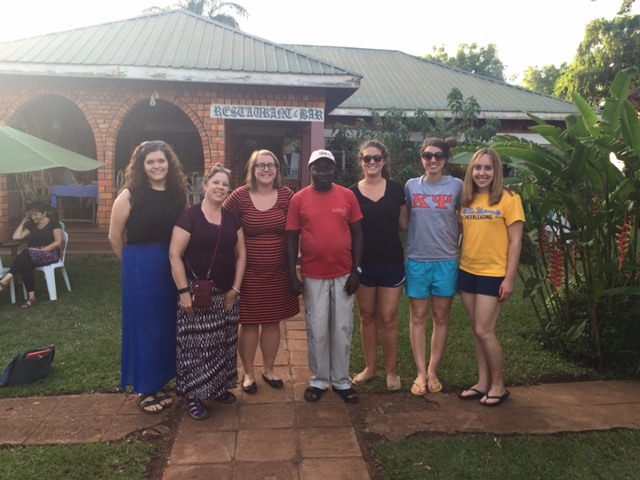
Thank you to all of our collaborators and all of the healthcare sights where we were able to volunteer!  It was another fantastic trip and I hope that there will be many more in the future. And I hope that I will soon be having new American collaborators to expand the work here in Uganda.  More on that as things develop.

We are off to Queen Elizabeth National Park tomorrow for our end of the experience Safari. It is a reward for all of the hard work by the students and they definitely deserve it. It is a well-earned time of relaxation where they will discover the hidden beauty of animals in the wild and a geography that we don’t have in the USA and they will likely experience the “Circle of Life”.

IMG_7202

Kassi, Dr. Bohan, Dr. Nicol, Sam (our wonderful drive wearing a Wilkes Pharmacy Cap), Makenzie, Casey, Lauren

Posted in Diseases/Health, My Safari (My Journey/Adventure) | Tagged , , , , , , , , , , , | Leave a comment

World Malaria Day at Local Schools

April 28, 2016:  A Blog Post by Makenzie

(null)

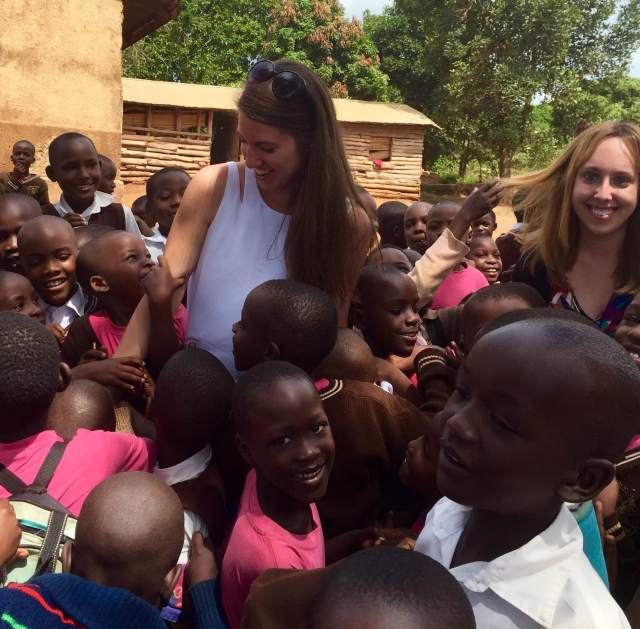
Casey and Lauren are swarmed by children excited to see them.

The true World Malaria Day was Monday April 25, a day aimed at education surrounding malaria prevention, and awareness of the disease. Over 3.2 billion people in the world are at risk for contracting malaria with 214 million cases reported last year. We had the opportunity to tag along with Lynda, a Peace Corps volunteer for Masindi-Kitara Medical Center, and the youth group she trains to educate younger students on malaria. We visited 5 different schools with children ranging from preschool to middle school age. We always enjoy spending time with kids here; they are so kind and welcoming wherever we go.

(null)_3

This little girl clung to Lauren’s hand and followed her wherever she went.

Lauren made a special friend with one of the little girls. The girl held her hand during the whole presentation and followed her everywhere.

(null)_4

The Ugandan youth that were trained by Lynda, the Peace Corp Volunteer, present the information to the school children

Back to the youth’s group presentation…they broke it up into 3 different parts. It started with general information about how malaria is spread, how to prevent it, and what to do if you suspect you have it. The children participated and many of them knew the answers to these questions when asked. It was explained to us that this kind of teaching is started at a very young age and is reinforced throughout the rest of their lives.

(null)_5

The children gather around to watch the drama

A small “drama” was then performed. They group acted out a man going to the doctor, being tested for malaria and then going to the pharmacy to receive the medication. This was especially important as it emphasized the importance of malaria testing and also about finishing the malaria medication and not just stopping after you start to feel better (which can be within the first day of treatment). Finally a story entitled “Mrs. Mosquito” was read. It was a cute story that demonstrated the proper way to use a mosquito net and included lots of pictures to help the younger children understand as many of them do not speak/understand much English.

(null)_6

All schools here in Uganda require school uniforms. They are unique to each school and you can tell which school a child attends by the outfit. The blue color of these outfits is striking.

We enjoyed our time out and about in Masindi and walking to the various schools gave us a better view of the more rural areas of the town. For more information on World Malaria Day visit: http://www.worldmalariaday.org/ .

(null)_2

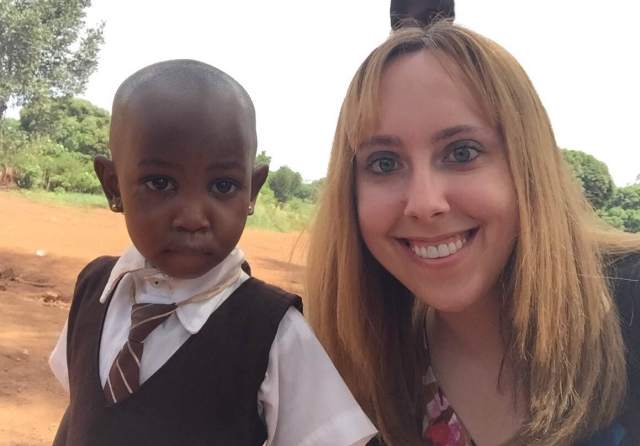
Casey and Lauren in the midst of many children. Notice how one child just had to touch Lauren’s “golden” hair. Often children will want to come up and touch our skin to see if “white” skin feels different than theirs- or maybe it is to see if the “white” color will rub off.

Ps. Tomorrow is our last day of pharmacy school!!!!!! It is also our last day at MKMC, which has been a great experience. We learned a lot from the staff and patients at the clinic and we hope we left them with something as well. Stayed tuned tomorrow for baby day!


Posted in Diseases/Health, My Safari (My Journey/Adventure) | Tagged , , , , , , , , , , , | Leave a comment

Visits to a Pharmacy in Kampala, Uganda

April 27, 2016: A Blog Post by Casey


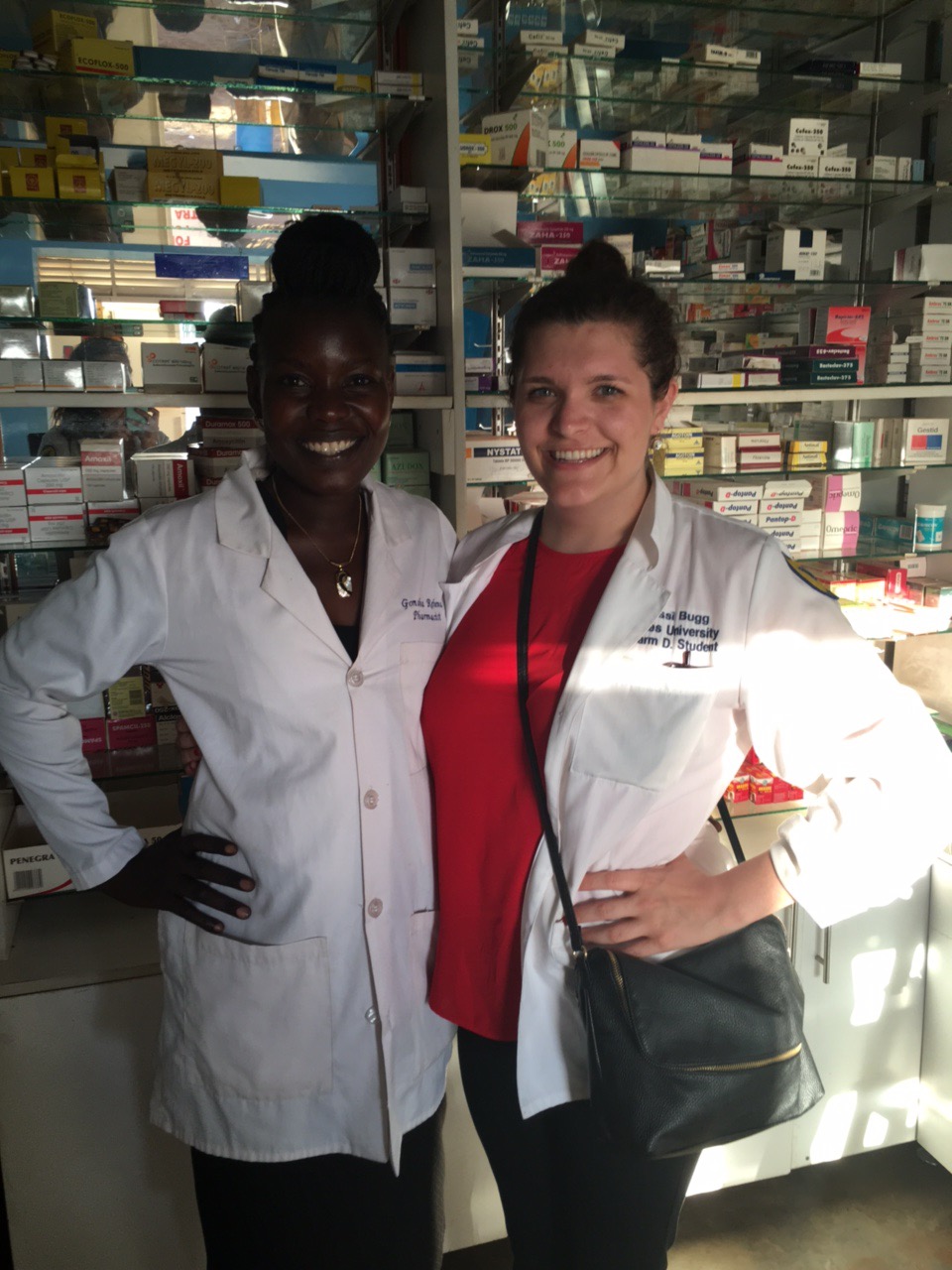
 One of the Ugandan Pharmacists that Dr. Bohan brought to the USA to teach last summer, Gonsha, owns 2 pharmacies in Kampala. A few weeks ago we ventured out to visit one of her pharmacies. Makenzie and Kassi went one day and Lauren and I went the next. Upon arrival we were introduced to the staff and received a tour. Medications are arranged by disease state here, which we found very interesting. Back home medications are arranged in alphabetical order. Another thing we found interesting is that a pharmacist does not need to be present at all times in the pharmacy; as long as there is a pharmacy technician in the pharmacy to dispense medications the pharmacy can operate. I’ve been working in a community pharmacy for 3 years now and I’ve only seen my pharmacist leave the pharmacy to go to the bathroom, and they were never gone for very long.


 When patients come into the pharmacy they do not need a prescription to pick up medications. They simply tell the technician or pharmacist what medication they want, the amount they want and pay for it out of pocket. There is no limit on the amount of medication they can receive. However, a big limiting factor here is the price-most patients have to pay for prescriptions out of pocket. Back home then would never fly. Here if a pharmacy turns a patient away because they do not have a prescription the patient will just leave and walk to the next closest pharmacy in order to receive their medications. Gonsha actually told us about only 3% of patients come into the pharmacy with a prescription. (mind blown AND disturbed)


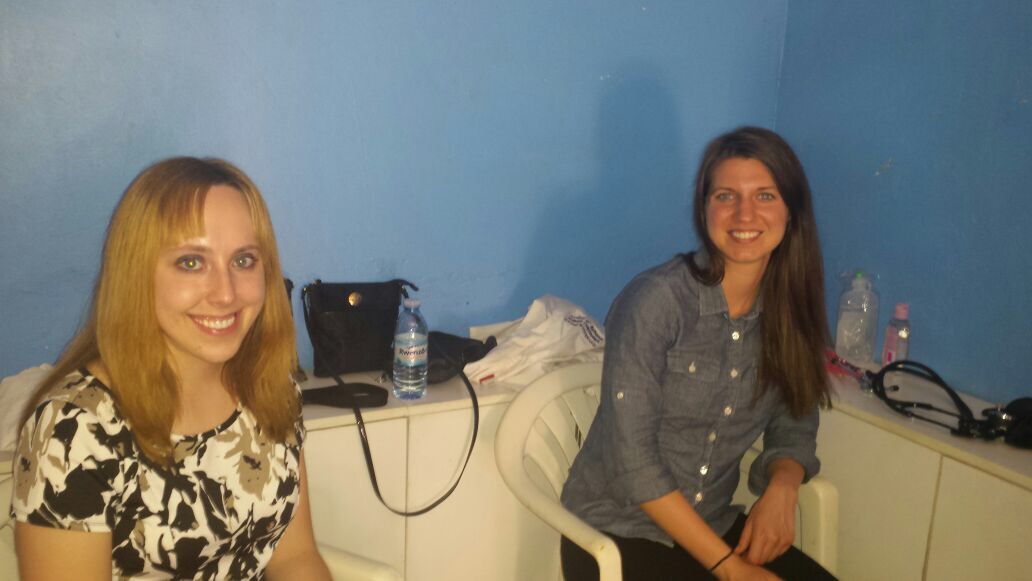
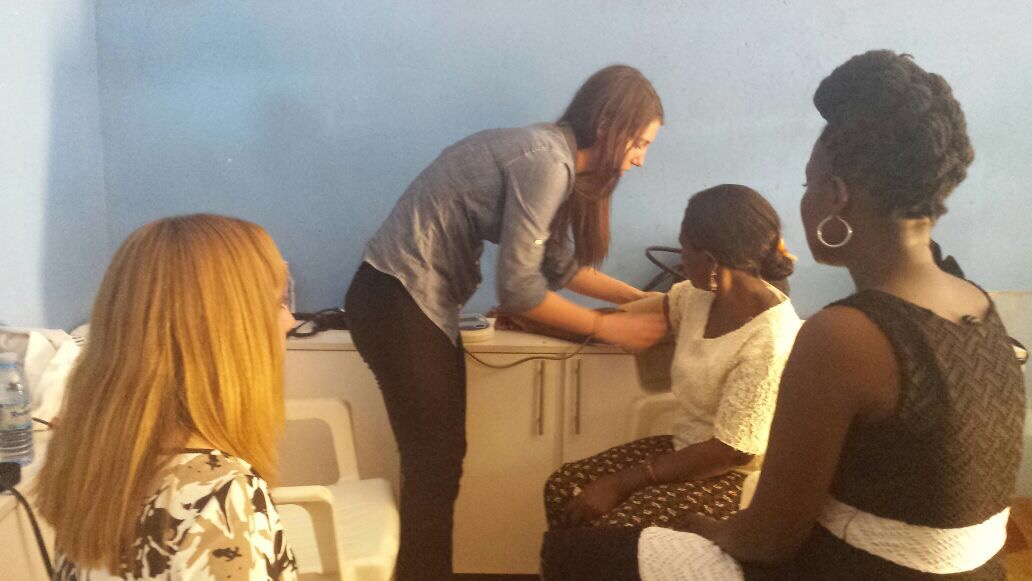
 While we were at the pharmacy Lauren and I did blood pressure screenings. The patients could understand English but couldn’t understand us because of our American accent so Gonsha had to help translate for us. We talked to them about the importance of taking their chronic hypertensive medication. Many patients here stop their anti-hypertensive medication(s) once their blood pressure is controlled. Makenzie and Kassi counseled a patient on how to correctly take their omeprazole. The patient came in complaining of stomach ulcers and stated he was taking his omeprazole three times a day. They explained to him how he only needs to take his medication once a day and if he is having problems he should go see his doctor. 


Posted in Uncategorized | Leave a comment

A Normal Day in Masindi

April 26, 2016


Last night we all slept really well because the rains came and it cooled down nicely. But the difficult part was getting up and getting ready for another day of work at MKMC this morning. It was still raining and the kind of day in which you just wish you could pull the covers over your head and go back to sleep. Also, the power was out so it was pitch black in the room. I bring a little flashlight lantern with me so I groped around but couldn’t find it. I usually leave it on the bed at close reach since the power often goes out at night, but apparently I kicked it off and it was under the bed. Once found, I had some light to start running through my normal routine, but when I set the small lantern on the desk or toilet seat, it really didn’t light up the room- the light went down towards the floor. I finally found a way to hang the light from a cord that was strung across my room- the cord to which the mosquito net was attached and that made a significant difference.  Finally I was ready to go to breakfast. Soon I was drinking delicious hot Ugandan coffee and munching on a fruit plate that begins every breakfast. There seems to always be fresh pineapple, a banana, and a slice of watermelon but today we had a bonus- MANGO! I love MANGO!

IMG_7083

Dr. KarenBeth Bohan next to the entrance to MKMC

After we all ate, Sam, our driver, came to pick us up to go to the Masindi-Kitara Medical Center (MKMC). We are taking 2 trips this week since there are now 6 of us. Sam has a small sedan and all 4 students have been cramming into the back seat while I sit in the front, but with Dr. Melanie Nicol joining us, our number is too big for 1 trip. Since MKMC is only 1-2 miles away, it isn’t a problem for Sam to make 2 trips.

IMG_7091

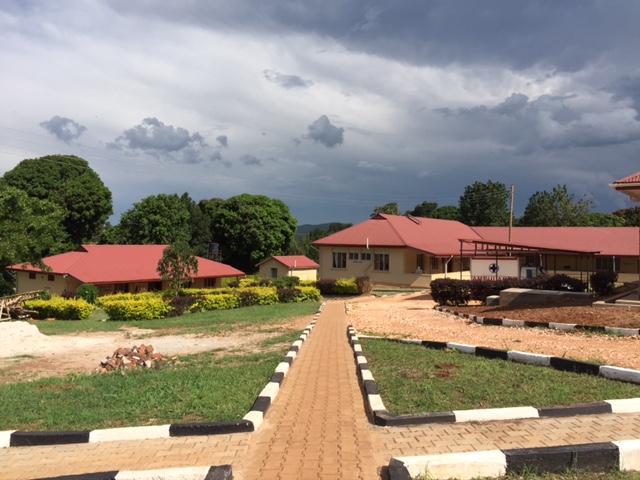
The growing campus of MKMC

Our normal routine at the clinic is for some of us to go on morning ward rounds to see the inpatients and some stay in the outpatient clinic to help out in the pharmacy or see patients with the Clinical Officers.  After rounds we go back to visit the patients and review the charts more in-depth and meet with the patients with a translator, when needed, to ask more questions about their drug therapy prior to admission and to provide education about their disease states and medications.  Today, though, in addition, the students got a chance to watch 2 procedures in the surgical theater. One was a small child of about 3 years old who had a severe laceration of his tongue due to trauma. Normally a tongue wouldn’t need to be sutured but the bleeding was great and so Dr. Godson decided to repair it. The other surgical patient was about 1.5 years old. She came to the clinic about a month ago with severe malnutrition and sores and rashes all over her body. She also had a deep skin infection in her buttocks. She needed IV antibiotics, better nutrition and medications for the rashes for almost a month as in inpatient. Initially she was so sick they weren’t sure she would survive. But, MKMC has a competent and caring staff and sometimes it seems like Dr. Godson works miracles with his surgical procedures. The child eventually improved and today returned to have the large buttock wound finally closed so complete healing can take place. I think the outlook for long-term survival for this child is good, as long as the circumstances that caused the child to initially be malnourished are alleviated. None of the healthcare workers nor my pharmacy team were able to ever figure out exactly why the child was malnourished. The mother seemed caring and was well-fed herself. I just hope she will be able to maintain a healthy diet from now on for this child.

At lunchtime, which is usually around 12:30 or 1pm, we return to the New Court View Hotel for lunch. By that time we are “starving”- OK, not seriously “starving”, but our hunger has gained most of our attention. The food here is delicious and made to order so as we wait, we often debrief the day and figure out what to do for the rest of the day. In the afternoons, if there is nothing pressing at the clinic, we remain at New Court View and work on projects, such as the CME talks we will be giving tomorrow. We also look up the answers to all of the medical questions that have come to us on rounds. We have learned about many disease states that pharmacists don’t often get to see in the States such as the complications of pregnancy. We have seen a few pregnant women who have had pre-term premature rupture of membranes (PPROM). This is a condition where the woman starts leaking amniotic fluid before the onset of normal labor and the “pre-term” part, means this happens prior to the 36th week of pregnancy at a time when you would prefer not to have the baby delivered because it is too small.  This can happen for no particular reason but it can also occur when the Mom gets an infection during pregnancy, such as a Urinary Tract Infection or a vaginal infection.  On our first day at MKMC we were introduced to a Mom who had PPROM and delivered a 32 week old baby who was immediately placed in an incubator- he was only 1.7 kg (3.7lb). In the USA, there would be no question of the viability of a newborn this age and weight, unless there were other medical problems besides prematurity, but here in Uganda, the odds of survival are much lower.  I was so pleased to see that MKMC had an incubator to help maintain appropriate body temperature and a sterile environment. Although the large national referral hospital, Mulago, in Kampala has incubators, the Masindi District hospital only has 1 and if it is in use, then it is not available for other premies.  There was a happy ending for this Mom and her infant as they were discharged home at the end of last week. We’ve seen 2 more similar patients, both with PPROM and babies born at 32 weeks. Unfortunately, one of the babies only survived less than 2 days. This Mom had delivered the baby at another facility and when the baby was so small and not doing well, they came to MKMC. Unfortunately, the birth occurred before any steroids could be given. Steroids given the Mom prior to a pre-term birth are a safe and effective way to help the babies lungs mature in-utero, when he/she doesn’t have enough time for this process to occur naturally. The other 32 week old is currently still in an incubator but doing well.  The Mom of this baby, though, is very anxious to leave the hospital with her child. She has been at MKMC for about a week now because she came in with PPROM and we were able to complete the steroids prior to the baby’s birth, but this has cost the family a lot of money. Now, she thinks her baby is fine and wants to take him home. We all worry, though, that the Mom doesn’t realize how fragile this child still is and can not be treated like a regular baby. If he doesn’t nurse well, he can get dehydrated really fast and this will predispose him to infections or death from dehydration.  Hopefully, the family will find the funds to have her and the baby stay in the hospital awhile longer.

So, as you can read, our time in Masindi has been a great learning experience. Each day brings something new. As we are learning, we are also trying to help the Clinicians by making sure the drug doses are appropriate and looking up the answers to all of their questions.  Tomorrow we will present a CME on Antibiotics, Antenatal Hemorrhage, and Urinary Tract Infections- these were topics they asked us to talk about.

IMG_7149

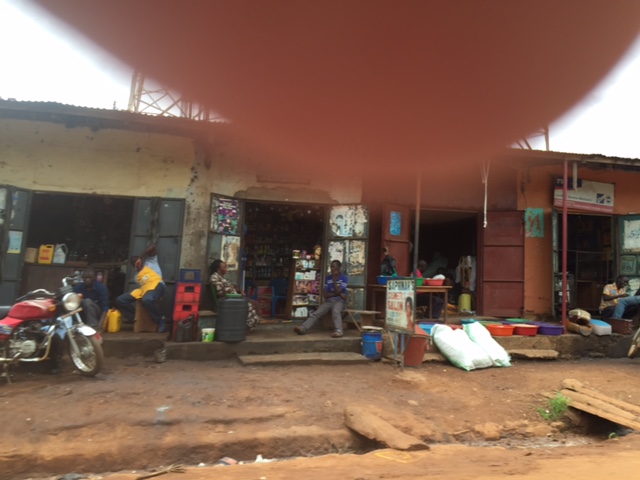
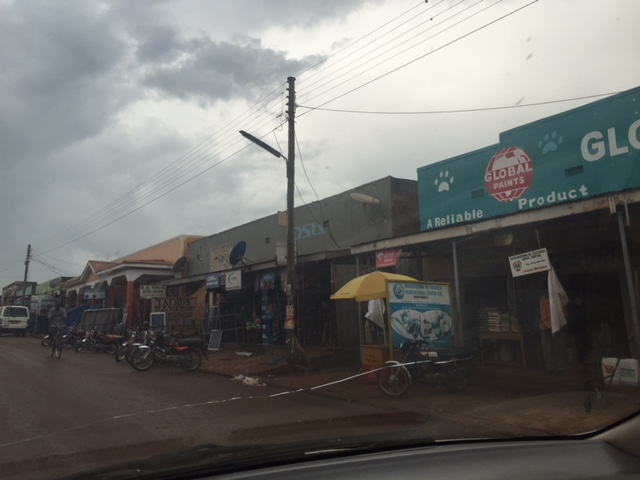
A view of the shops in Masindi; excuse my finger- I was trying to be inconspicuous while I took pictures as we drove along

IMG_7150

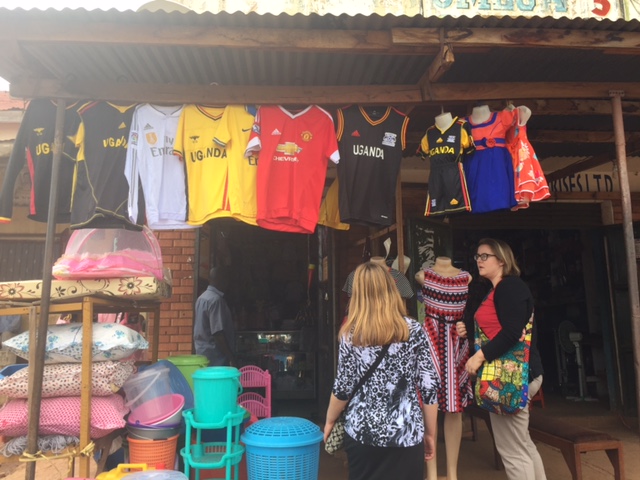
Lauren shops for a Yellow Uganda Cranes jersey while Dr. Nicol looks on (this is the Uganda Football team -“soccer” as the Americans say)

IMG_7143

Another view of the shops in Masindi

Posted in Diseases/Health, My Safari (My Journey/Adventure) | Tagged , , , , , , , , , | Leave a comment

April 25, 2016:  A Blog Post by Lauren

IMG_5187

All prepped and ready to go into Surgery to observe the C-Section delivery of a baby!

Well, fast food had a new meaning this morning…as we were driving to the clinic, there was a boda boda (motorcycle) driving next to us.  We were horrified to see a pig strapped to the back of it. When the pig blinked and went to the bathroom, we were even more horrified to realize it was still alive. I’m not sure where this little piggy was going, but we screamed all the way home.

Luckily our day got better when we arrived at the clinic. Casey and I went on rounds, and we were happy to see that many of the patients that we were following last week had improved over the weekend. The young girl with Neisseria meningitidis meningitis was doing a lot better and was ready to go home, and the pregnant woman with PPROM (preterm premature rupture of membranes) had delivered a healthy baby. Makenzie and Kassi went to the lab, and they were able to see the different lab tests that are performed and view slides of malaria, tuberculosis, and meningitis under the microscope. After rounds, the physician said he was going to the theater (operating room) to perform a C-section, and Makenzie and I were so excited to go and observe. Armed with a face mask, surgical cap, and the infamous crocs (that you heard about in Casey’s post), we were ready for the theater. Everyone inside was wearing rain boots, and I felt like their surgical assistant when the surgeon and nurses told me to tie the backs of their gowns. Then the patient received an epidural, and the C-section began. I couldn’t believe how fast the procedure was.  Before I knew it, the surgeon cut into a green sac and pulled out a baby covered in green slime. (Since Makenzie saw C-sections before, she reassured me that this wasn’t how the amniotic fluid normally looked.) The umbilical cord was cut while the baby was still held upside down, then the nurses rushed to clean the baby up. We were panicking because the baby was very pale and not making any noise. After at least 2 minutes, we finally heard the first cry. It was a boy! Born at 11:15am, weighing 6.6 pounds. We saw the baby and knew the gender even before the mother did. The surgeon asked the mother what gender she thought the baby was, based on the sound of its cry. The mother guessed a boy, and he said she had to wait and see. The baby was dressed in a blue and yellow onesie covered in daisies, and I couldn’t take my eyes off of him.

IMG_7146

During the day it was really hot but in Uganda, the weather can change in a minute. This afternoon the sky got dark, the wind picked up and it got nice and cool. We were actually really happy for a break from the heat. I had to laugh out loud, though, went I walked into the cabana and saw Casey all bundled up in this hoodie. She has turned Ugandan! (we are always saying we can’t believe that the Ugandans wear winter coats in this beautiful weather. When asked, they say that this is “really cold”. Even our driver, Sam, wore a long sleeve shirt today.

Posted in Diseases/Health, My Safari (My Journey/Adventure) | Tagged , , , , , , , , , , , , | Leave a comment

A Visit to the Ziwa Rhino Sanctuary, Uganda

April 24, 2016

IMG_7122

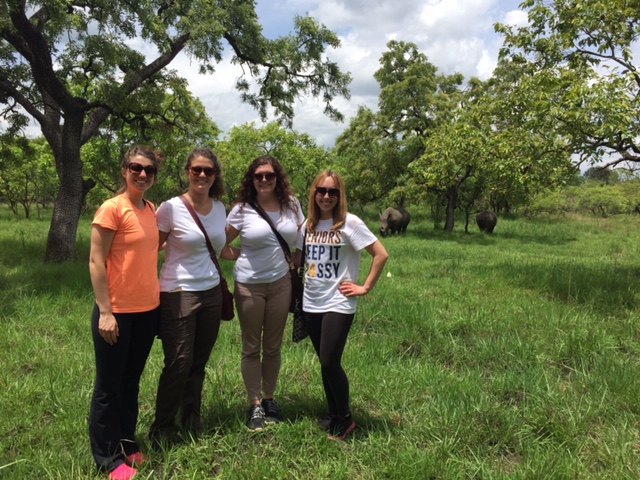
Casey, Makenzie, Kassi, and Lauren with 2 of the Rhinos in the background

Today we took a trip to the Ziwa Rhino Santuary which is only about 40 minutes from Masindi, along the Kampala Road. Rhinos used to be native to Uganda in the Murchison Falls National Park but by 1983 they became extinct due to poaching. The Ziwa Rhino Sanctuary is a 70 square kilometers of bush that is fenced in its entirety and was developed to grow a herd that could eventually be used to repopulate Murchison Falls National Park.

They currently have 16 White Rhino, of which 10 were born in the park. They need to have a herd of 30-45 before they can start efforts to re-populate Murchison Falls.  The White Rhino is so called due to a pronunciation error by British colonizers. The story goes that the Rhinos are called a name that sounds like “white” but really the word is “wide” but the British heard the name as “white” and so this breed has been called that ever since. The “wide” name was because of their wide mouths.  The color of these Rhinos is actually grey although they looked brown to us because they roll around in the mud to stay cool. Today we drove about 10 min down a red-dirt road where we parked and then hiked about 15min into the bush, through grasses, small bushy trees, and over very bumpy ground until we came upon 6 Rhinos resting in the shade. Since the day was a bit overcast, their were 2 Rhinos actually standing and moving around grazing. Usually the Rhinos lounge around all day in mud puddles and under the shade of the bushy trees to keep cool. But when the sun is behind clouds they do stand up and graze. But most of their feeding comes at night as they roam the entire park. Our very knowledgeable guide, Edward, helped us move around the herd at a safe distance but brought us to a number of different angles so we could get great pictures of the Rhinos.  It was so cool to be so near these giant creature. To us they looked pretty gentle, but we were told that when spooked, they can definitely run and gore you with their horns. Our instructions prior to trekking to the spot of the Rhinos was to go and hide behind a tree or better yet, climb it, if the Rhinos start to run our way, although the guide assured us that wouldn’t happen.  But, we closely followed every instruction of the guide.

IMG_7136

We had a delicious lunch at the Sanctuary after trekking to see the Rhinos. Note the “Beware of Rhino” sign on the tree behind them.

As we drove to the Rhino Park, we came upon a shepherd leading his Ankole Cattle along side of the road. These animals are so interesting to look at. They are beef cattle and their horns can be melted down and used to make eating implements and bowls, etc.

IMG_7102

These are Ankole Cattle

We also came upon a bunch of Verret Monkey’s as we entered the Rhino Sanctuary and saw a couple of tortoise’s on the road on our way out of the Sanctuary. (I usually refer to this type of creature as a turtle, but I found out at the animal park in Jinja that this type is actually a tortoise and a turtle is the kind that lives near water and has webbed feet. So the little guy pictured is definitely a tortoise.

IMG_7133

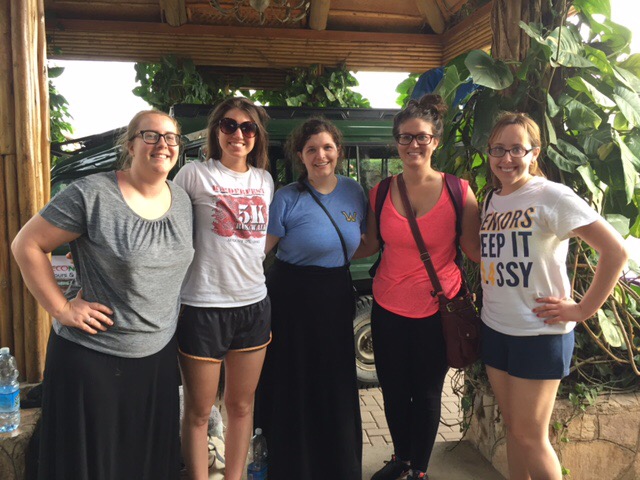
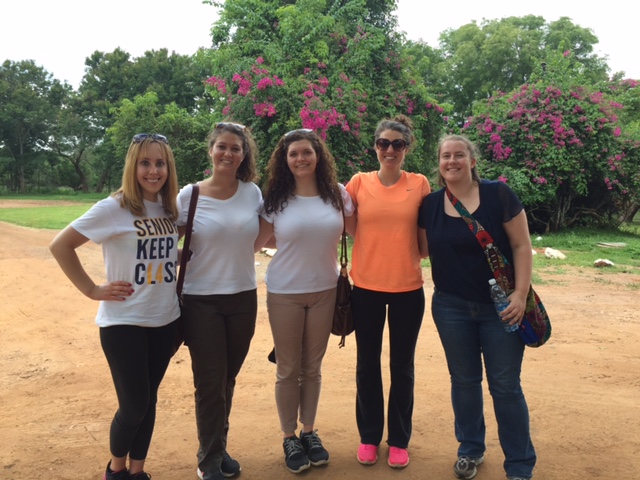
Lauren, Makenzie, Kassi, Casey, and Melanie (Dr. Nicol)

Posted in My Safari (My Journey/Adventure), Ugandan Nature | Tagged , , , , , , , , , , , , , | Leave a comment