A Visit With Pharmacy Interns at Mengo Hospital

28 September 2015:

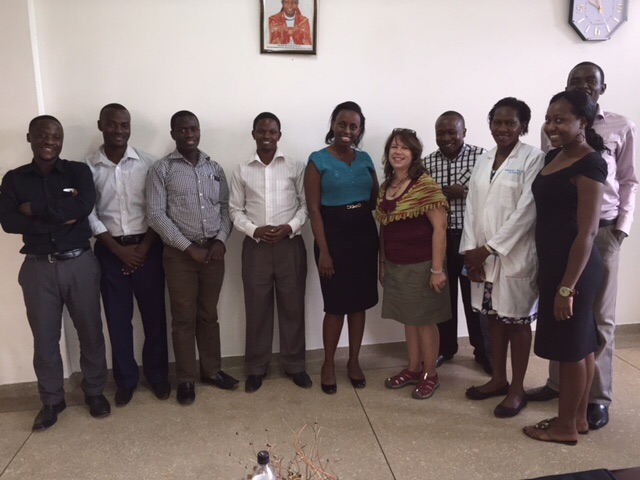
The Pharmacy Interns of Mengo Hospital and myself (left to right: Wendy, Hassan, Sam, KarenBeth, Robin, Isaac)

The Pharmacy Interns of Mengo Hospital and myself (left to right: Wendy, Hassan, Sam, KarenBeth, Robin, Isaac)

If you remember, last Monday I took a visit to two private hospitals, Nsambya and Mengo. I was able to participate in Ward Rounds with the Pharmacy Interns at Nsambya Hospital but at Mengo, I gave a presentation on the Implementation of Pharmaceutical Care. I urged them to begin to try interacting with some patients to obtain a medication history and also to review some charts for possible drug therapy problems.  Today I was back to Mengo both participate in Ward Rounds with the Interns and to check up on what they accomplished last week in terms of pharmaceutical care interventions. I was pleased to find that a couple of the Interns had identified and helped to solve some specific drug therapy problems, such as a patient taking 2 ulcer medications at the same time from the same class of drugs and the physician had positively responded to her suggestion to stop one. This same Intern had also identified a significant drug interaction with a blood thinner, Warfarin, and another drug, Fluconazole, which if this went undiscovered, the patient may have had a serious bleed. In this case both drugs were necessary so the Warfarin dose can be decreased until the Fluconazole is stopped.  I reminded the Interns, though, that it is very important to keep following up on their patients after making recommendations. She will need to make sure the patient continues to do OK on both Warfarin and Fluconazole and make sure the drug doses are adjusted when the Fluconazole is stopped. If this doesn’t occur, the opposite problem could happen and the patient could have too low of a dose of Warfarin and have another blood clot.
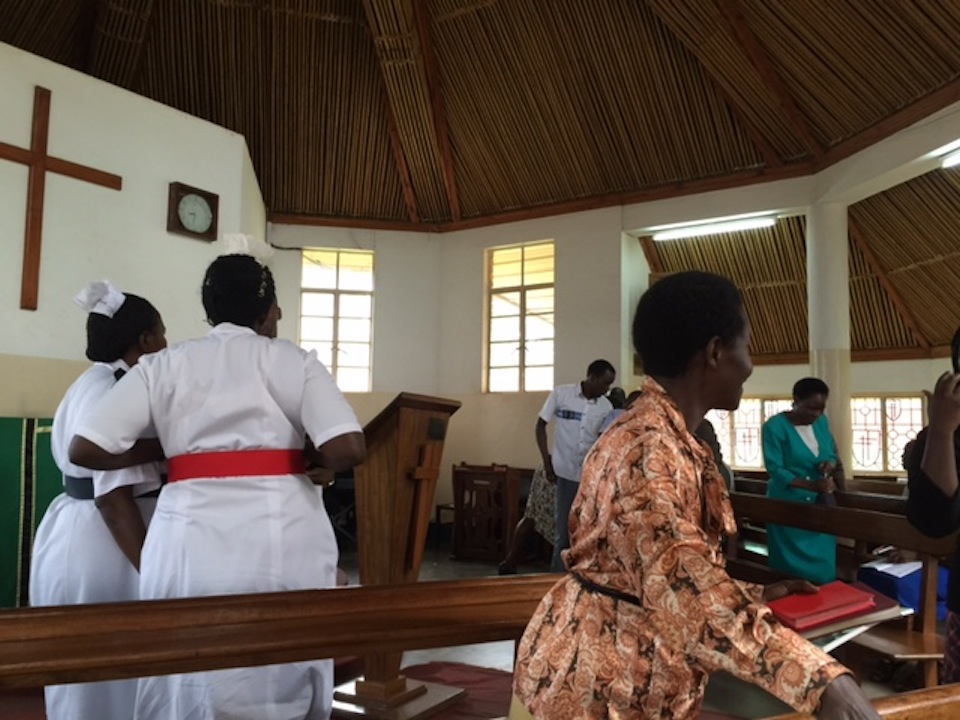
The Worship Service was just finishing. What a nice way to start a new week!

The Worship Service was just finishing. What a nice way to start a new week!

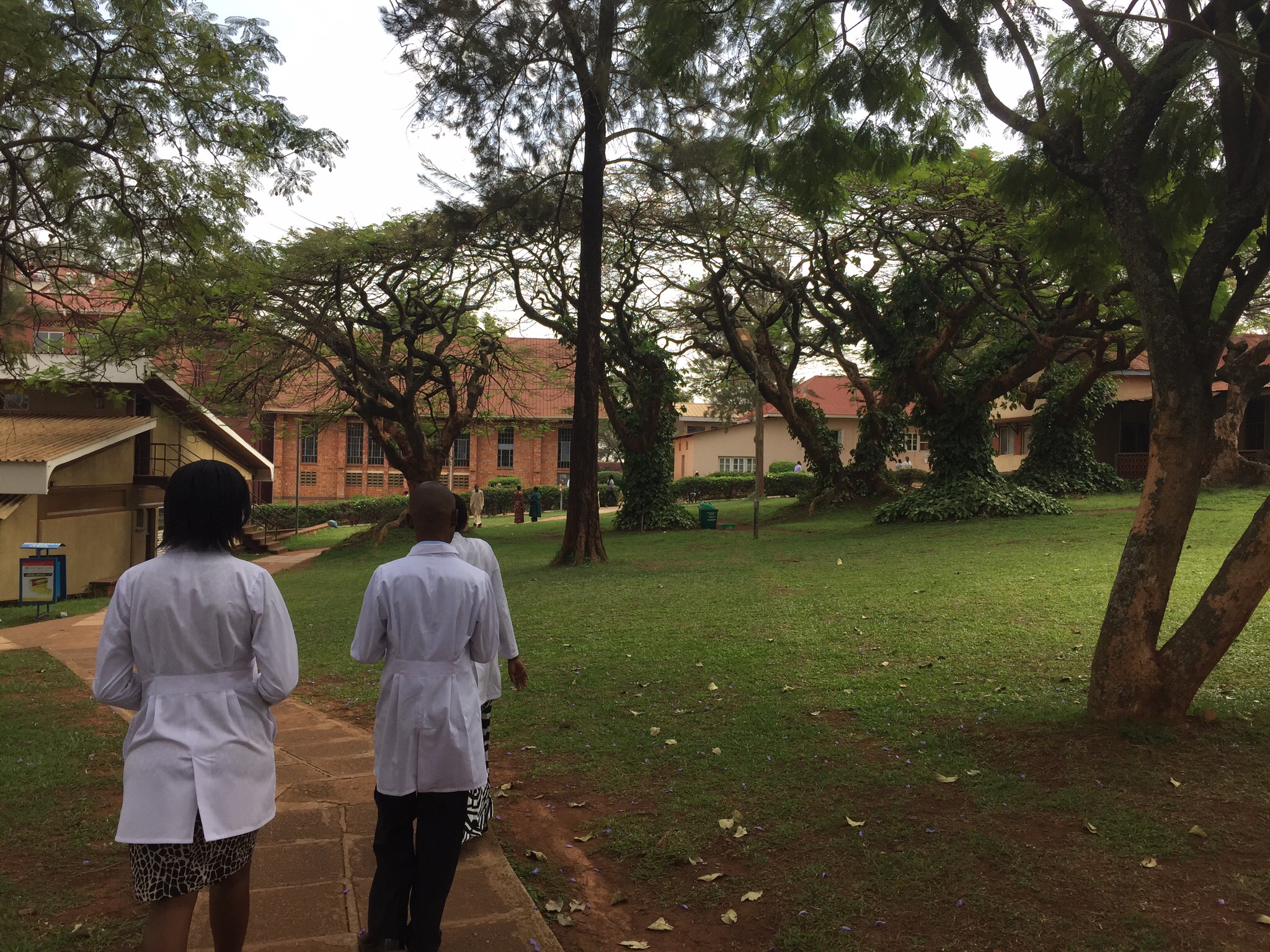
The morning started with a worship service at the chapel on the hospital campus. Mengo Hospital is a faith-based Anglican Hospital that was started as part of the Missionary work of Dr. Sir Albert Cook in 1897 and it was the first hospital in Uganda. Carol, the Pharmacist, was supposed to lead the praise and worship music at the beginning of the service but she had to pick me up and thus got caught in a big “jam” (this is how they refer to traffic jams) so we didn’t arrive until the sermon time. At the end of the service, though, another song was sung which I was happy find familiar and was able to sing along by heart with “Jesus, My Redeemer”.

A view of the Mengo Hospital Chapel from the outside

A view of the Mengo Hospital Chapel from the outside

After worshiping, we went to the Pediatrics Ward and started to go around and talk with the patient’s caregivers to see if there was anything we could suggest to help improve care. I had some good discussions with the Pharmacy Interns about antibiotic spectrum of activity (what organisms the antibiotics treated) and how to treat Pneumonia and Otitis Media. There are a couple of very important issues that make it hard to know what antibiotics to use to treat infections in Uganda.

First of all, there is little published data on what microorganisms are responsible for causing bacterial illnesses in Uganda. We generally assume the causative agents are similar to those in the USA and use similar antibiotics but this really should be investigated so we know for sure. For instance, besides the normal bacteria that cause Pneumonia, in the USA we also have some “atypical” bacterial organisms that need to be treated as well in the initial regimens but this child only was treated for the normal bacterial organisms.  The child with pneumonia was improving on the antibiotic regimen so that was good, but I still think more studies need to be done to figure out what organisms are most common in Uganda for each type of infection.
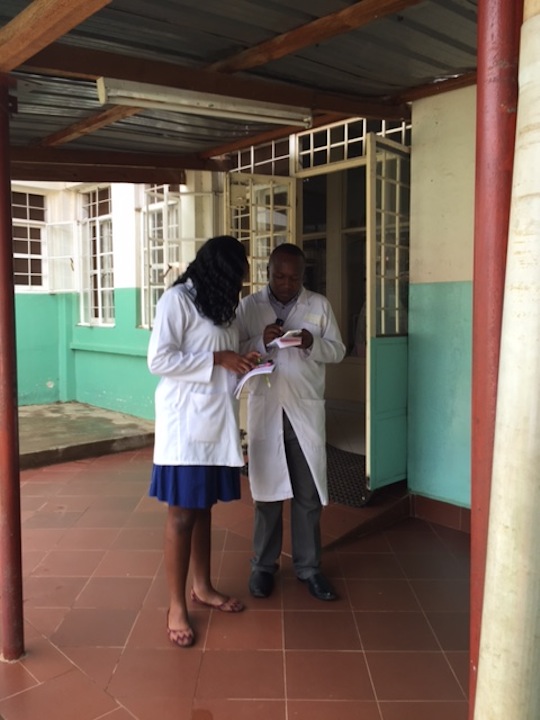
Wendy and Robin look up drug information in his smart phone. One of the things I've been working with the Pharmacy students and Interns on is the use of point-of-care medical apps on their phones (most do have smart phones now days)

Wendy and Robin look up drug information in his smart phone. One of the things I’ve been working with the Pharmacy students and Interns on is the use of point-of-care medical apps on their phones (most do have smart phones now days)

The other issue, and probably the more critical one, is that there is also little data on the antimicrobial susceptibility and resistance patterns in Uganda.  And the small data I’ve seen is dismal with extremely high resistance rates for the most commonly used Antibiotics.  In the USA we have this information and put it together into what’s called an Antibiogram, a list of all the organisms cultured in a hospital and information about what antibiotics will kill those organisms. This is important both so we can follow the resistance patterns and make sure we are not starting to get highly resistant super bugs, but also to help us decide what initial treatments will work best for our patients.

Another HUGE issue in Uganda is that patients can get antibiotics at the Pharmacies and Drug Shops without prescriptions from a Physician. Although they are supposed to be on a prescription, reality is that no one is able to enforce this so it is very common for patients to go to Drug Shops or Pharmacies and ask for Antibiotics or Antimalarials and be given them.

The Interns have just arrived at another patient's room and are getting ready to go in and interview the parent of a 4 year old boy.

The Interns have just arrived at another patient’s room and are getting ready to go in and interview the parent of a 4 year old boy.

[A Pharmacy is a shop with a wide supply of both prescription and non-prescription medications and it must be supervised by a Pharmacist, although a Pharmacist doesn’t have to be present for drugs to be dispensed, as in the USA; a Drug Shop is a business, kind of like a convenience store, that has some non-prescription medications but is also allowed to stock certain kinds of prescription medications but there is NO Pharmacist supervising the dispensing in the shop.]

The reason Drug Shops are allowed to dispense Anti-Malarials and Antibiotics without prescriptions and without supervision by Pharmacists is to meet the needs of the patients living far away from medical centers. The idea was to prevent deaths due to infectious diseases which could occur when patients couldn’t get to regular medical centers. But, I wonder now if these Drug Shops, and actually the Pharmacies as well, are starting to contribute to the high resistance of Antibiotics in Uganda and maybe causing more harm than good at this point. Ideally, the people working in the Pharmacies and Drug Shops would have excellent skills at triaging a patients symptoms and have a good understanding of when the symptoms are serious enough that the patient should be referred to a health clinic and not given an antibiotic and to also know when an antibiotic is not needed, such as when the signs and symptoms are more consistent with a viral infection. But, I’m certain that this isn’t often the case. I’ve talked to many pharmacists and students working in these Pharmacies and most often what occurs is that a patient comes in and either asks specifically for what he or she wants and it is given without question or the patient states the symptoms and the worker chooses the antibiotic he thinks is appropriate.  I’ve been told that Pharmacy Workers are discouraged from telling patients that they don’t need an antibiotic because they may have a viral infection where an antibiotic doesn’t work just because the Pharmacy Owner, usually a business man, wants to make money. I’ve even heard stories from Pharmacists who were told NOT to come to the store because they may not sell as many unnecessary drugs as the other untrained workers in the store.

What I think many people don’t understand is that this practice of just dispensing Antibiotics without much thought or testing is soon going to render many of the cheap Antibiotics useless because of increasing resistance.  There needs to be a campaign within Uganda and other developing countries with similar practice to help both healthcare providers and patients become aware of this problem and urge them to stop requesting antibiotics for viral infections. The Centers for Disease Control (CDC) has done this in the USA.  I’m not sure how this has affected the rate at which patients demand Antibiotics from the physicians when they are sick, but those that I work with back home have become much more resistant to prescribing antibiotics when the infection may be viral and go away on its own.

The group of Interns I worked with today: Sam, Isaac, Robin, Wendy, Hassan (left to right)

The group of Interns I worked with today: Sam, Isaac, Robin, Wendy, Hassan (left to right)

Back to one of the patients we saw today at Mengo. It was an adorable 11 month old girl who had developed a cough and fever a week ago. Initially the parents just went to a Drug Shop and got an antibiotic for the child but after 5 days, the child was no better and they brought her to Mengo Hospital. This is a classic situation where the child should have been referred to a medical center from the beginning. Young children can go from a minor infection to a severe one very fast, especially if they get dehydrated. There were 2 things going on with this patient that made me worry about this possibility. First of all the patient had a high fever which can cause sweating and fluid loss. In addition, she had vomiting and poor feeding. We didn’t get a chance to question the mother about the conversation she had at the drug shop but I doubt that the worker gathered this type of information. The antibiotic was probably just dispensed. If this information had been obtained, the child should have been referred. Also, the antibiotic was actually dispensed on the second trip to the Drug Shop. The first time the mom just got paracetamol for the child’s fever (acetaminophen) but it wasn’t working to take down the temperature and the child was coughing more severely. At this point the child should have definitely been referred, but instead an antibiotic was given. Fortunately the child was finally brought to the hospital but had this occurred days earlier, the child probably would have responded to therapy more quickly. When you have Pneumonia, antibiotics alone may not cure it. The patient needs to have appropriate supportive care like fluids to replace those lost during fever and vomiting and the patient may also have other components to the illness like wheezing and may need something to open up the lungs (brochodilators).

As you can see, I had a really interesting day.  I’m so glad the Pharmacist and Interns at Mengo Hospital want to become more engaged in direct patient care. I’m sure their work together with the Medical Team of Physicians and Nurses will be very helpful to improve patient care.
Posted in Diseases/Health | Tagged , , , , , , , , , , , | Leave a comment

A Day with 300+ Pharmacists at the Annual General Meeting of the Pharmaceutical Society of Uganda

27 September 2015:

Sam Opio, the Secretary of PSU, opens the Conference

Sam Opio, the Secretary of PSU, opens the Conference

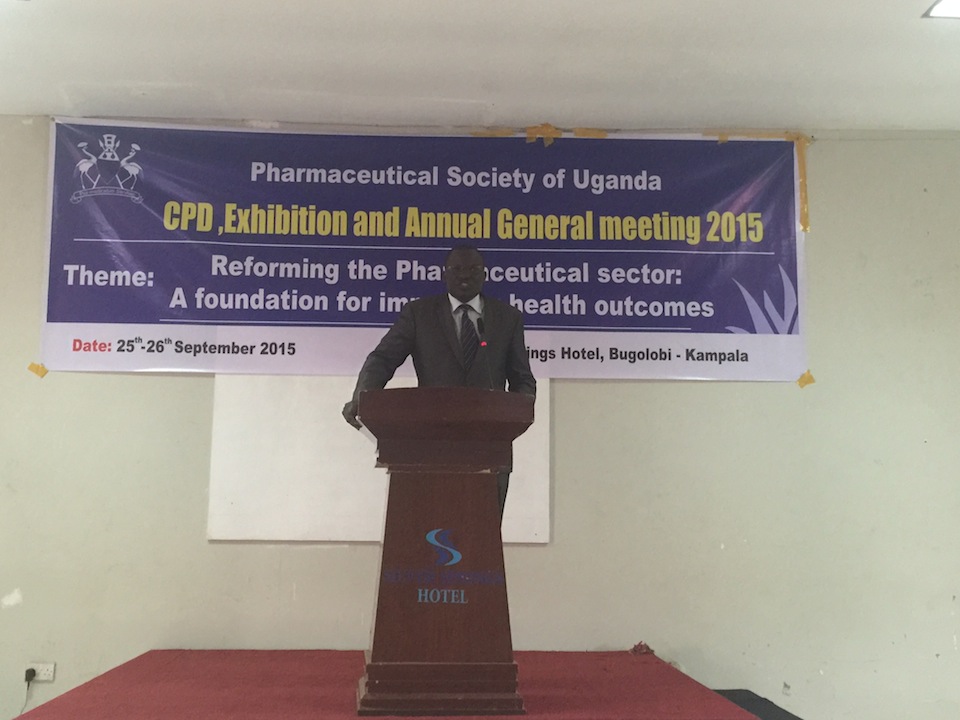
On Friday I had the pleasure of participating in the Annual General Meeting (AGM) of the Pharmaceutical Society of Uganda (PSU). This event draws 300-400 of all of the Pharmacists in Uganda (out of a total of 746 pharmacists) to a gathering where they spend 2 days together learning about everything from the State of Pharmacy Practice in the country to new regulations and laws being considered that affect them, to a synopsis of new taxation laws that affect pharmacists and pharmacy owners to issues of Pharmacovigilance (drug safety) and much more.  I had attended a small part of this meeting back in 2013 to administer a survey on the state of Pharmaceutical Care (PC) I had developed with the Secretary of the PSU, Sam Opio, and a faculty member at  Makerere University, Robert Otto. But this year, I was thrilled to be an invited speaker!

KarenBeth's presentation on Strengthening Pharmaceutical Care in Uganda

KarenBeth’s presentation on Strengthening Pharmaceutical Care in Uganda

Up until today, the work I’ve been doing along side faculty at Makerere University, with Pharmacists at Mulago National Referral Hospital, and with the Ugandan Pharmacist participants of the 8 week Pharmaceutical Care training Program in the USA was known to only a few handfuls of Pharmacists in Uganda. The wave of interest for advancing Pharmaceutical Care to Improve Safe Medication Use has significantly grown among pharmacists, healthcare administrators, and other healthcare professionals over the past few years in Uganda. PSU asked me to talk about how the PC efforts of the USA and other countries are improving both patient care and the economic use of drug products, the state of implementation of PC in Uganda today, and to offer suggestions on how to strengthen PC in Uganda. From the questioning and comments, it was clear to me the presentation was well received. One of the participants thanked me for motivating them to engage more in PC activities and for giving them a lot of specific examples for how to do this.

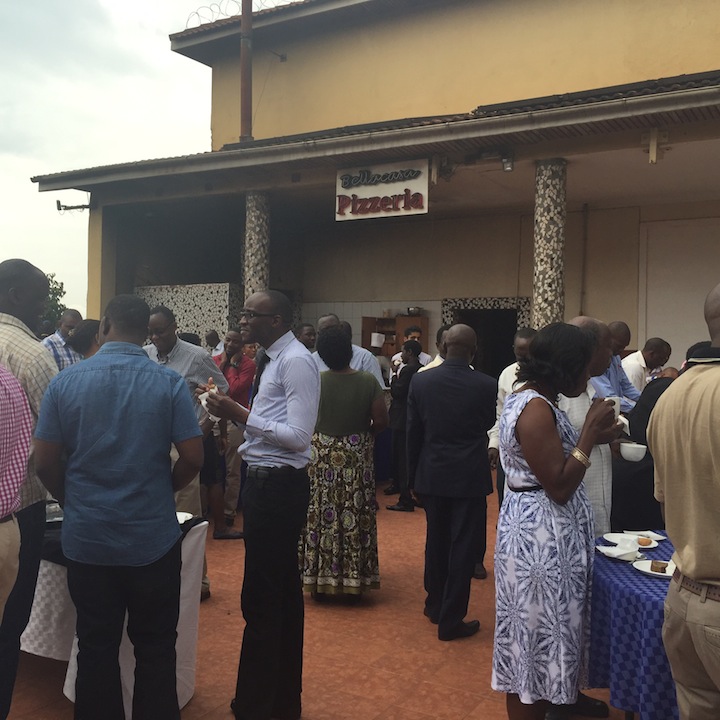
Tea Break at the Silver Springs Hotel where the AGM was held.

Tea Break at the Silver Springs Hotel where the AGM was held.

I am also happy that I was able to stay within my allotted time frame for this presentation, which was 20 min. Unfortunately because the program started 30-45 minutes late and the morning tea time and the time for questioning of the first few speakers went really long, lunch was delayed and this made the audience a little antsy. This is a pretty common occurrence for the programs I’ve attended here. What ends up happening is that the longer the time past lunch, the less time they give you for your talk, so for example, even if they told you to prepare for 20 minutes, they might, on the spur of the moment, tell you to take only 10min or even less.  The final speaker before lunch was talking about a very important topic- Pharmacovigilance. She was Huldah Nassali, the Drug Information Officer for the National Drug Authority, which is like our FDA.

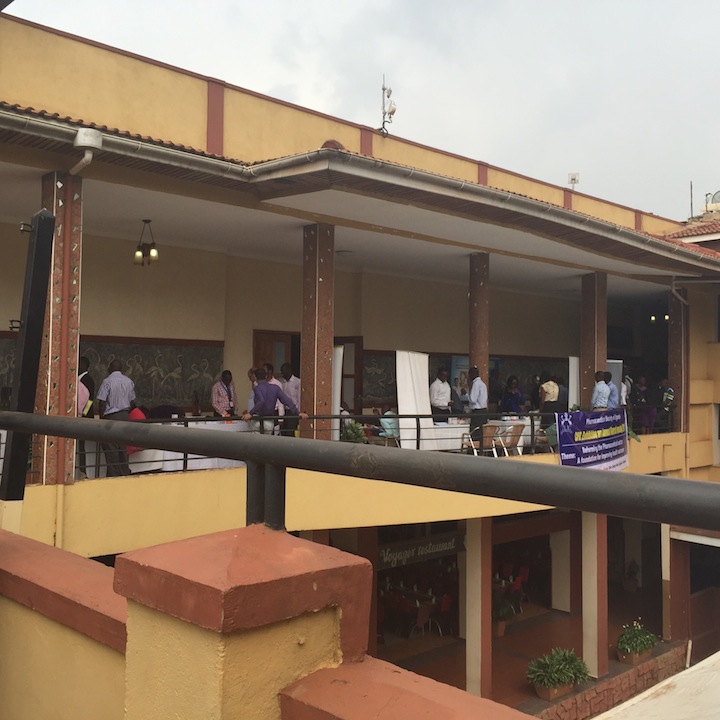
Tea Break on the deck over looking the pool at Silver Springs Hotel

Tea Break on the deck over looking the pool at Silver Springs Hotel

Unfortunately her talk was greatly cut down in time but her worthy goal was to motivate Pharmacists to increase their reporting of Adverse Drug Reactions (ADRs) they see in patients they’ve treated. She had developed a tool to do this to assist them. This is a very important role of a Pharmacist because we are often the last person in the chain to talk with a patient who has had a drug prescribed and the first person they come back to when a bad reaction occurs. Through the tracking of ADRs, we, as pharmacists, can detect serious drug safety issues and improve overall medication safety.

The pool at Silver Springs Hotel

The pool at Silver Springs Hotel

After a delicious lunch buffet of the traditional Ugandan foods we heard presentations on antimicrobial resistance in isolates of Neisseria gonorrhea from infection in male patients at the Mulago Hospital STI clinic, and the Use and Practice of Radiopharmaceuticals in Uganda.  Currently there is only 1 Radiopharmaceutical pharmacist at Mulago who is ready to retire so there is a desperate need to encourage some young pharmacists to pursue this training and take his place. Sulah Balikuna, a pharmacy faculty from Makerere University whom I’ve worked with in the past then gave a very interesting talk on Pharmacoeconomic Analyses.  This is definitely something that the Pharmacy Administrators need to work on at the government facilities.  Currently many of the antibiotics being used at Mulago are likely having high resistance rates yet alternatives would be very much more expensive. A Cost-Effectiveness analysis could help to show that continuing to spend less money on drugs, but on drugs that don’t work and the patients stay sick longer and in the hospital longer, is actually not as economically beneficial as spending a little more on drugs that can cure patients faster and reduce complications and length of hospital stay.

This is the Pharmaceutical Industry Displays at the Conference

This is the Pharmaceutical Industry Displays at the Conference

Since the afternoon sessions started late due to the morning late start and a late lunch, all of the speakers times were cut down significantly and what happened to the Pharmacovigilance speaker in the morning also happened to Sulah and then to Cathy Namulindwa, one of the pharmacists who studied with me in the States this summer. She talked about the implementation of Pharmaceutical Care in Uganda from a slightly different perspective but end up being cut off early. I was proud of her as she was sharing some of the information she had learned – this definitely is the start of the positive outcomes from the Pharmaceutical Care Training Program at Wilkes University for Ugandan Pharmacists. Although she didn’t get to finish her talk, I know that both she and Gonsha, the other PC participate this year, will be doing many more training sessions for the Pharmacists to help them increase PC services at their facilities.

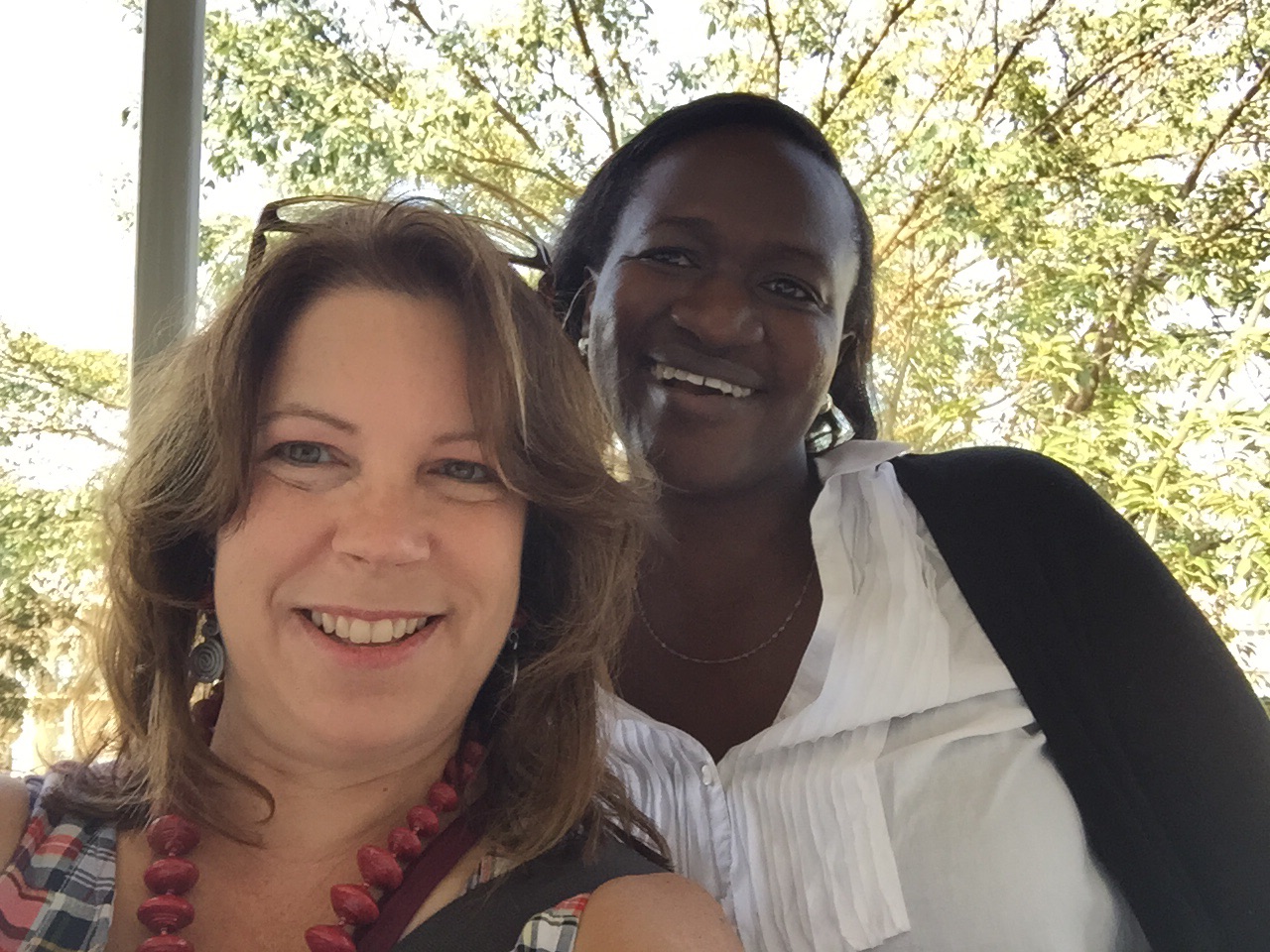
Gonsha and KarenBeth at the AGM Conference.

Gonsha and KarenBeth at the AGM Conference.

Posted in Diseases/Health | Tagged , , , , , , , , | Leave a comment

An Obession With A Huge Bird

24 September 2015:

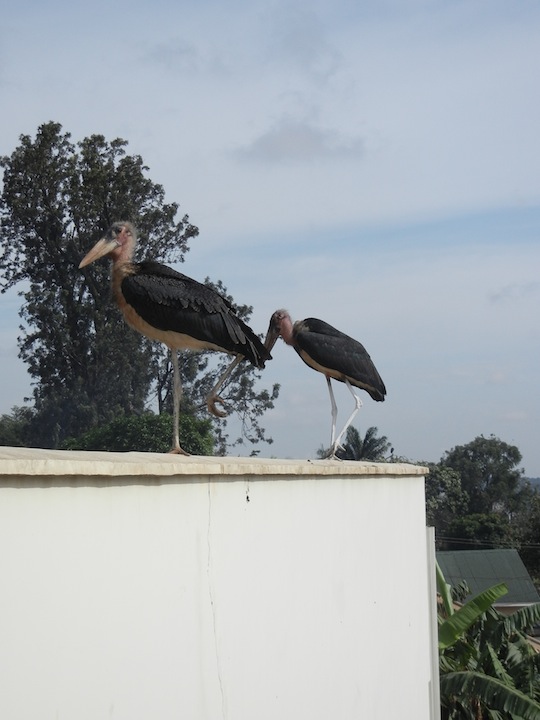
Marabou Storks on the roof of the Pharmacy School

Marabou Storks on the roof of the Pharmacy School

I’m obsessed with a really interesting HUGE local bird. It’s called the Marabou Stork and they are actually quite ugly but somehow I can’t seem to stop watching them. They nest on the top of tall trees and I can watch 2 nests right from my EdgeHouse window. As I sit here and try to get work done, the noise they are making as they build new nests as well as the sounds their flapping wings make as they take off to find more materials keeps drawing my gaze. Living around these enormous creatures must be what it would have been like to live among the Pterodactyls that lived 228-66 million years ago.  They eat just about everything, so I’ve heard, including any kind of  trash.  Many people think they are a nuisance but some think they help with trash control.  They are all over the Makerere University Campus. They roost high up in the trees. They are so large it’s a wonder they don’t collapse the top branches.  I’ve been trying really hard since I’ve been here to get a good picture of the ones at EdgeHouse but they are eluding me. I’ll see them out my window on the lawn and then I scare them off when I open my loud metal door.

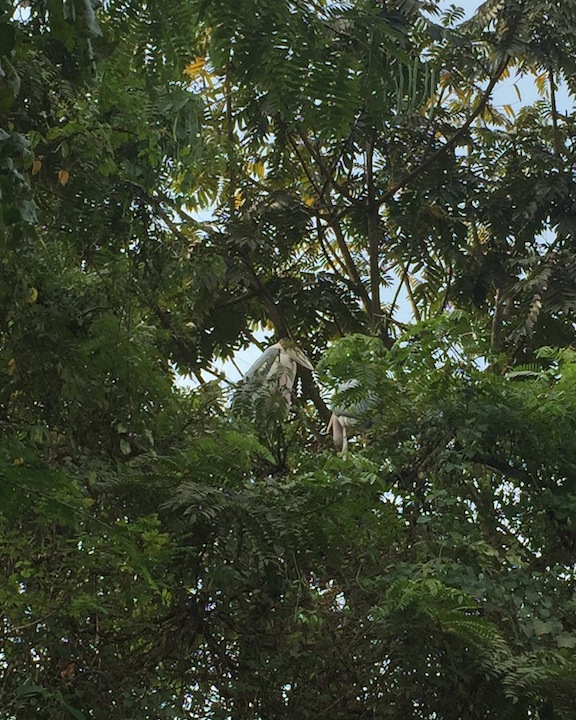
This is the tree where one of the nests is. I

This is the tree where one of the nests is. You can just barely see the birds- in the top 1/3 of the photo, just left of center.

The one time I could have gotten a great picture, I was so focused on getting a movie of it flying that I forgot to take a still photo.  I’m including the movie hear but I could only get the SD version to load so it is a little blurry.

The beginning is slow but what I really want you to see AND hear is at the end when the bird takes off for its nest.  When I get home I will try to remember to replace it with the HD. I’m not sure if this is a Momma or Papa Bird but I’m pretty sure they are building a new nest on top of the tree in the photo. This pair is obviously different from the pair roosting on the roof of the pharmacy school as you can see by their colors. Although they are pretty ugly they really intrigue me.

You can see the nest a little better in this photo.

You can see the nest a little better in this photo.

I can’t help thinking about how they are God’s creatures as we are and are preparing for the birth of young ones. I don’t know anything about their mating patterns but they seem to be often in pairs so I wonder if they mate for life like some birds or even if not, maybe the male and female work together to prepare for their young. Regardless, they’ve given me lots of viewing pleasure. When they fly overhead the flapping of their wings and the sounds they make are quite loud. You can definitely hear them coming. So far they seem to be gentle and avoid me, which is just fine. But, if these creature are sometimes aggressive, they certainly would be something to be afraid of.

This is the best close up I could get with the zoom on my phone camera.

This is the best close up I could get with the zoom on my phone camera.

Posted in Ugandan Nature | Tagged , , , , , , , , , | Leave a comment

A Word About Time

22 September 2015:

The 4th Year students work together on a patient case in class- The Pharmaceutical Care Skills Lab

The 4th Year students work together on a patient case in class- The Pharmaceutical Care Skills Lab

Time and the value of timeliness is one of the biggest cultural differences I’ve encountered since working in Africa. Most everyone has heard the term “Africa Time” or something similar. I’ll speak only to my observations in Uganda since all of Africa is not the same. Many Americans, though, lump the countries together and some aren’t even aware of the major differences among the African countries both in culture and location. Some don’t even realize that Egypt and Libya are in Africa- no they aren’t in the group of Sub-Saharan countries that we tend to refer to as “Africa” but they are on the continent- Africa. Ok, forgive my digression. Let me get back to TIME. I had come to Uganda a couple of times before I was referred to a book called “Foreign to Familiar” by Sarah A. Lanier. It is a small, inexpensive paperback book that I’ve found invaluable to both myself and understanding the cultural differences between Uganda and the Eastern Part of the USA where I’m from as well as for preparing my Wilkes Pharmacy students for their experiences here. The author explains how “warm” cultures, like Uganda’s, value people and relationships much more that timeliness and getting tasks accomplished where as “cold” cultures like the Northern Europeans and the areas of the USA which are similar, like Pennsylvania where I come from, value getting tasks done. An interesting example she gives in the book that I can easily relate to is the way one enters a store and asks for the location of an item. Someone from a “cold” culture will walk into the store, find the shopkeeper and simply ask “where can I find the XYZ”. In a “warm” culture, this would be considered downright rude. Instead, you are expected to enter the store and GREET the storekeeper before just jumping right in and asking for something. Although I am aware of this and have tried hard to act appropriately while in Uganda, a few trips ago I was entering the Orange (mobile and internet store) and I must have been frazzled from running around doing errands because I entered the store, went up to the shopkeeper and said straight out “I need to purchase some airtime.” Immediately I realized my mistake- the woman almost visibly stepped back, composed her shock at my forwardness, probably realized I must be one of those impertinent foreigners (she wouldn’t have probably known whether I was European or American because although I think I sound quite different in my accent than a Brit or Dutch person, Ugandans aren’t always able to discern the differences in our accents). Anyway, the shopkeeper said to me, “Good afternoon to you and how are you doing today?” It was immediately clear to me that I made a hugh faux pax. And this was in front of my students- not a good example. I immediately made right, apologized, greeted her, and eventually we got on with the sale. My point is that relationships are really important and always come first in Uganda. This is often why someone might be late to work or to a meeting. Someone in their family may have needed something that caused the delay. Still, I wonder if the lack of appreciation for showing up on time has gotten out of hand. Could it be that this is one of the reasons they find it hard to advance in certain ways? I certainly don’t think the American focus on tasks or timeliness to the detriment of family, and our workaholism is something I want Uganda to embrace, but sometimes it is a little frustrating- OK, a lot frustrating- when people/students don’t show up on time. I had once asked a Ugandan Pharmacist, after I realized that no one ever shows up on time for meetings, if school classes start on time. I mean, how can the teaching be adequate if the full class time isn’t able to be utilized. I was sincerely told, that “yes”, classes do start on time and when something like this is important, the students will show up. But, I have not found that to be the case. Last year and this year I am helping out to teach the Pharmaceutical Care course that I’ve written about previously but the students are not showing up on time, as they didn’t last year. It is supposed to start at 9 and run to 12 but yesterday, once again it was 9:59 and only about 11 of the 4th Year students showed up on time out of a class of 33. What am I supposed to think and do? If I go ahead and start and let the students trickle in, I end of re-explaining things or the students are just out of luck. I’m not sure they realize that I feel like their lack of showing up means they don’t value what I’m here to teach. It turns out that when I confronted the members of the class that had arrived on time, they told me that the rest of the class is not likely to show up because they have an exam scheduled for the next day. OK, well this sounds like a typical student thing to do, but I sure wish I would have known the reason earlier because I would have been able to start on time with those who did show. Once the class got underway, it went really well and the students present were fully engaged and I think they got a lot out of the class. My time at Nsambya and Mengo Hospitals was so fulfilling on Monday as I worked with Pharmacists and Pharmacy Interns who really wanted me to be there. And, yes, they were all there on time. The Intern who picked me up to go to Nsambya Hospital was in fact a few minutes early and I wasn’t quite ready. I have become so used to tardiness that I, myself delayed. Luckily, I was just about ready and we only left my place a few minutes late. And then the group I met at Mengo Hospital in the afternoon was also there on time and waiting for me to arrive. So, it is clear to me that sometimes the “Africa Time” excuse is just that, an excuse. When it is important, people can be on time. Today this very issue of Pharmacy Students and Pharmacy Interns came up again in two different conversations. Both the Pharmacy Administrator at Mulago Hospital as well as the Faculty of the Makerere Pharmacy School admit that the students and interns lack of punctuality needs to be addressed. Part of the problem seems to be the lack of holding the students or interns accountable for tardiness and absences. In the past, everyone has just looked the other way, possibly because they, themselves, can be late from time to time (or more than that). But, I think all are beginning to realize that for progress towards the implementation of Pharmaceutical Care to take place and for the rest of the healthcare workers to understand the role of the pharmacist and value what we do, punctuality, responsibility, and reliability are going to have to become priorities.

Posted in Diseases/Health, Teaching | Tagged , , , , , , , , , | 2 Comments

A Visit to Nsambya and Mengo Hospitals in Kampala, Uganda

21 September 2015:

Carol, the Mengo Hospital Pharmacist, and her Interns after our discussion on Pharmaceutical Care

Carol, the Mengo Hospital Pharmacist, and her Interns after our discussion on Pharmaceutical Care

Until today, all of my clinical pharmacy work in Kampala has been based at Mulago National Referral Hospital and Makerere University School of Pharmacy. But after the presentation I made last week at the Pharmaceutical Society of Uganda’s Internship Supervisors meeting, I was asked to come visit Mengo Hospital, a faith-based Anglican hospital in Kampala to both give a presentation on Pharmaceutical Care to Pharmacy Interns and Physicians, as well as to advise them on the way forward to implementation of Pharmaceutical Care services. It was a lovely meeting and I seemed to hold their rapt attention. I kept thinking I was going on too long but every time I looked around the room, I saw people engaged and taking notes. This was followed by a short presentation on an antibiotic use study that one of the Pharmacists, Carol, had done to investigate potential issues where pharmacists could make a positive impact in both improving patient care and reducing the unnecessary use of antibiotics. We all had a great discussion about the challenges to implementation of PC and before I left, the interns agreed to work on 3 things over the course of this week: interacting with patients to do medication reconciliation (learning what Meds a patient was on prior to the hospital and making sure the appropriate drugs are continued), evaluating patients’ kidney function and making sure their drugs are dosed appropriately, and documenting at least 3 interventions which helped the patients. I agreed to come back on Monday to go on rounds with them and to hear how it went. I asked them to note the barriers or difficulties they have so we can address them together. The whole group seemed very enthusiastic and I’m eager to come back in a week to see their progress. Five of the interns were from Makerere and since I had the pleasure of working with them in the PCSL last year, I know how competent they are. And I’m sure the others will catch on quickly, especially as they learn from their colleagues.

Edel, KarenBeth, and Linda- some of my past Ugandan Students. We are standing outside of the women's ward.

Edel, KarenBeth, and Linda- some of my past Ugandan Students. We are standing outside of the women’s ward.

Earlier in the day I visited another private hospital having been invited there for a tour and to participate on rounds with 3 other interns whom I had worked with at Makerere and a 4th very competent intern whom I just met. Nsambya Hospital is also a faith-based Catholic institution and the grounds were beautiful and peaceful- so unlike the Mulago campus.

Edel, Linda and Joseph walk across the lush Nsambya Hospital Campus

Edel, Linda and Joseph walk across the lush Nsambya Hospital Campus

It’s so exciting to see the students I’ve trained using their skills. When I asked if they liked their internship site they all agreed they did but their answers seemed a little hesitant. On further questioning, it turned out that everything was great except they wished they could participate in PC even more.

Joseph stands in one of the wards. I was pleased to see the curtins hanging around the patient beds. This isn't done in Mulago Hospital and there is no privacy for patients. Also, I bet it helps a little with Infection Control. In the USA, private rooms are what most hospitals are moving towards to decrease the risk of transmission of infections between patients, but this just won't be possible in Uganda.

Joseph stands in one of the wards. I was pleased to see the curtins hanging around the patient beds. This isn’t done in Mulago Hospital and there is no privacy for patients. Also, I bet it helps a little with Infection Control. In the USA, private rooms are what most hospitals are moving towards to decrease the risk of transmission of infections between patients, but this just won’t be possible in Uganda.

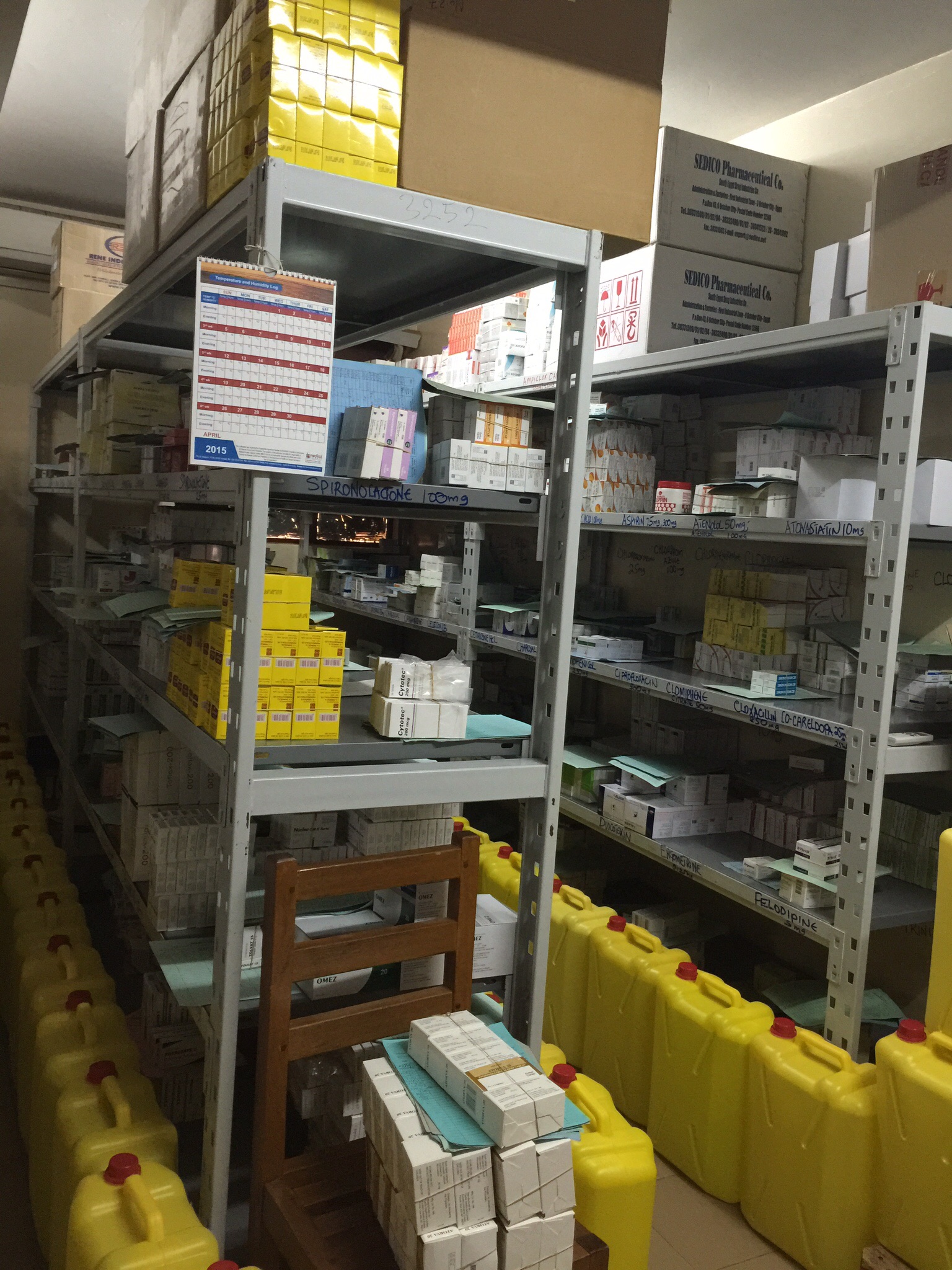
Notice how neat and orderly the "store" is. "Store" is what Ugandans call the storeroom- where they keep their stockpile of medications and supplies. The Sister who is in charge must be quite organized.

Notice how neat and orderly the “store” is. “Store” is what Ugandans call the storeroom- where they keep their stockpile of medications and supplies. The Sister who is in charge must be quite organized.

It was a delight to see them embracing clinical pharmacy work. Although they may think there isn’t much PC going on, I know this has changed so much for the better since I started coming to Kampala. With these new Interns and the students I’m currently training, it won’t take too long to grow the pharmacy work force into one that can provide the PC and really make a positive difference in the health outcomes of patients.

Aaron, Edel, Linda, and Joseph stand outside the beautiful Catholic Chapel on the Campus of Nsambya

Aaron, Edel, Linda, and Joseph stand outside the beautiful Catholic Chapel on the Campus of Nsambya

Posted in Diseases/Health, Teaching | Tagged , , , , , , , , , , | 4 Comments

A Pharmaceutical Care Presentation

18 September 2015:

Presentation on Pharmaceutical Care to Pharmacy Intern Supervisors at the PSU Offices (The Pharmacy House). Gonsha is seated to the left.

Presentation on Pharmaceutical Care to Pharmacy Intern Supervisors at the PSU Offices (The Pharmacy House). Gonsha is seated to the left.

When I come to Uganda I never can anticipate exactly what I activities I will participate in here. Of course, I have planned ahead for my main tasks, and this time, that was the teaching of the Pharmaceutical Care Skills Lab (PCSL) and working with pharmacy students and Interns at Mulago Hospital. But, every trip, other things come up as well. Late last week I was asked to prepare a presentation on Pharmaceutical Care and How to Implement It for a meeting of the Intern Supervisors in Uganda. The PSU (Pharmaceutical Society of Uganda) had planned a meeting of all the Hospital Pharmacists that are supervising Interns to work on developing new policies and procedures. When I met with the Secretary of the PSU, Sam Opio, last Thursday he realized it would be a good audience to hear about the work I’ve been doing with Makerere School of Pharmacy and Mulago Hospital in hopes that more hospitals will be interested in starting to provide Pharmaceutical Care services.

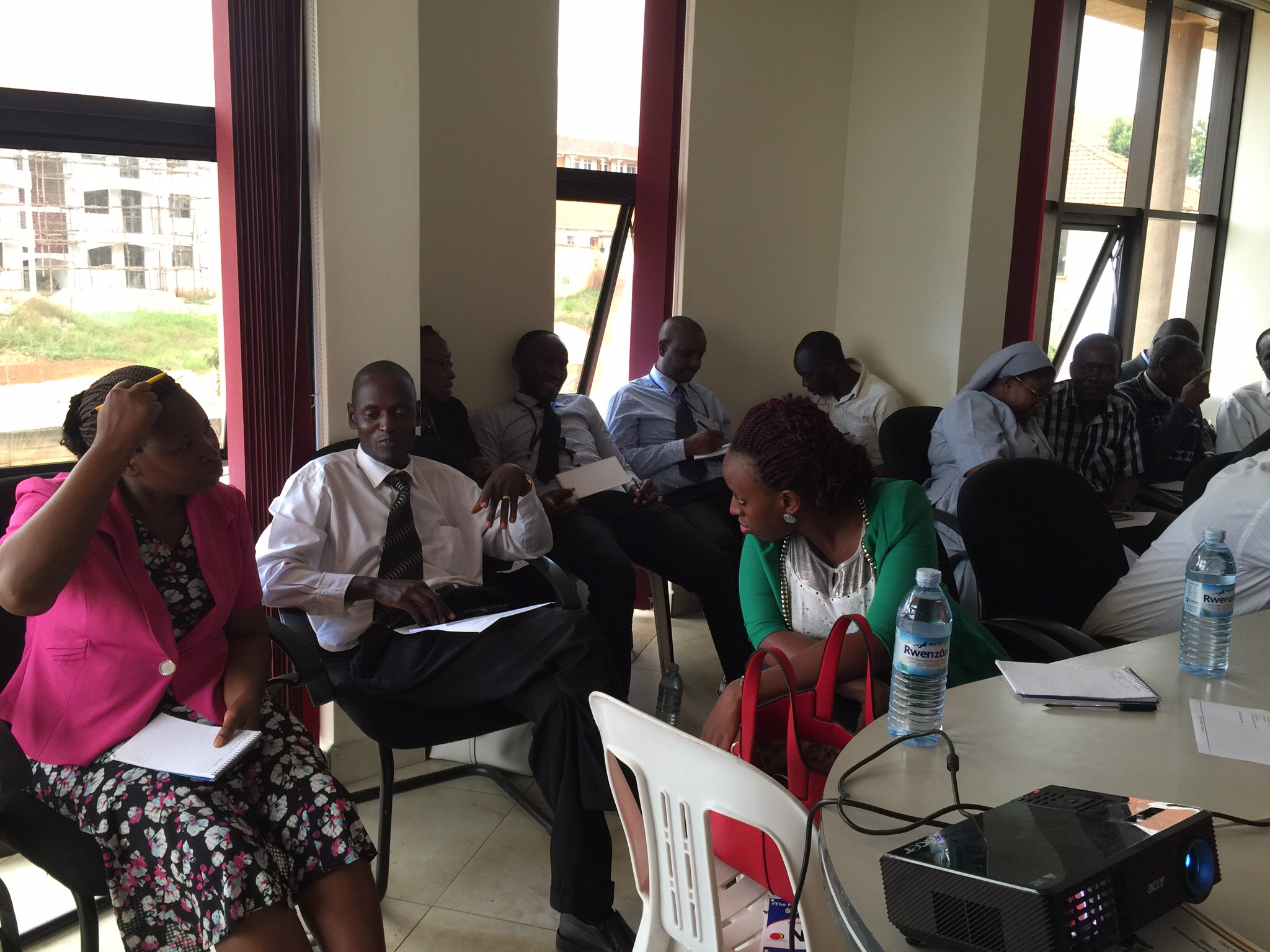
The participants eagerly talked among themselves when I asked them to discuss the Pharmaceutical Care activities they already were engaged in at their facilities

The participants eagerly talked among themselves when I asked them to discuss the Pharmaceutical Care activities they already were engaged in at their facilities

I wasn’t sure what kind of interest I would receive from the other hospitals in terms of having the Interns and themselves get more active in direct patient care. It is not that I thought they might not be interested in implementing Pharmaceutical Care because most of the pharmacists I have spoken to are really interested and know it is beneficial to patient care, but there always seem to be so many barriers to overcome that I wasn’t sure how feasible it is. But my worries were completely unfounded. My reception was terrific, in fact during the questioning after my presentation, it became clear that many of the Hospitals represented want to know how they can get me to come and work with them. Wow, I sure wish I could go to all of the hospitals to work with the Pharmacists and Pharmacy Interns to identify barriers and to help them figure out what is feasible, but I am only one person and have a limited time in Uganda. This is exactly why I really want to interest more American Pharmacy Faculty in joining with me on this project. Most of us are committed to our work at our own Universities for much of the year and would only have limited time to come to Uganda.
In the afternoon, Sam Opio, the Secretary of PSU, gave a presentation on the Intern Program and the issues they were going to address with new policies

In the afternoon, Sam Opio, the Secretary of PSU, gave a presentation on the Intern Program and the issues they were going to address with new policies

But if we can all work together and each of us come at different times of the year, we could really provide the mentorship and guidance that Ugandan Pharmacists and the PSU needs to make a real difference in patient care. Of course, the other challenge from my end is funding. So far I haven’t been able to find a grant to apply for that would provide funding for this type of project. I will keep on looking though, hoping that something will eventually pop up. In the meantime, if any of you readers are interested in supporting my work in Uganda, there is a DONATE button on the top right hand portion of this Blog. The money will go directly to Wilkes University into a fund specifically for this Uganda Project. Thanks for considering this opportunity. While I’m here this visit, I have been invited to work with a couple of other hospitals, Nysambia and Mengo Hospital. I will be telling you more about my experiences with the Pharmacists and Pharmacy Interns there next week.
Posted in Diseases/Health, Teaching | Tagged , , , , , , , , , , , | 2 Comments

A Meeting with the Infectious Diseases Institute and A New Principle Pharmacist at Mulago Hospital

16 September 2015: My week has been productive with lot of very interesting meetings. Today I’ll talk about my Monday meetings. imageIn the morning I had a chance to sit down and talk with one of the Pharmacists at the Infectious Diseases Institute, Eva Laker, to learn more about their mission and her day-to-day work. We had met briefly during my visit a year ago, but this time I wanted to really figure out if IDI would be a place that my Wilkes Pharmacy Students could rotate through when we come in April 2016.

KarenBeth and Eva Laker, one of the Pharmacists at IDI

KarenBeth and Eva Laker, one of the Pharmacists at IDI

IDI serves as a referral center for difficult to treat patients with HIV/AIDS. Most regular HIV care can be managed by basic government health care centers of level 3 and above or any private hospital. The HIV drugs are free to patients at all centers. Some centers provide more services than others such as The Aids Support Organization (TASO), which my students and I have worked with ever since I started the Global Health Advanced Pharmacy Practice Experience Rotation. Basically it seems like patients can choose to get their care wherever they prefer, but many will choose the facility where they first get their screening and diagnosis. IDI is a high-level research center and this is one of their primary focuses but they also provide clinical care for complicated patients. These would be those who are failing first-line therapy or those with co-existing kidney or liver problems or other diseases that affect the management of HIV.

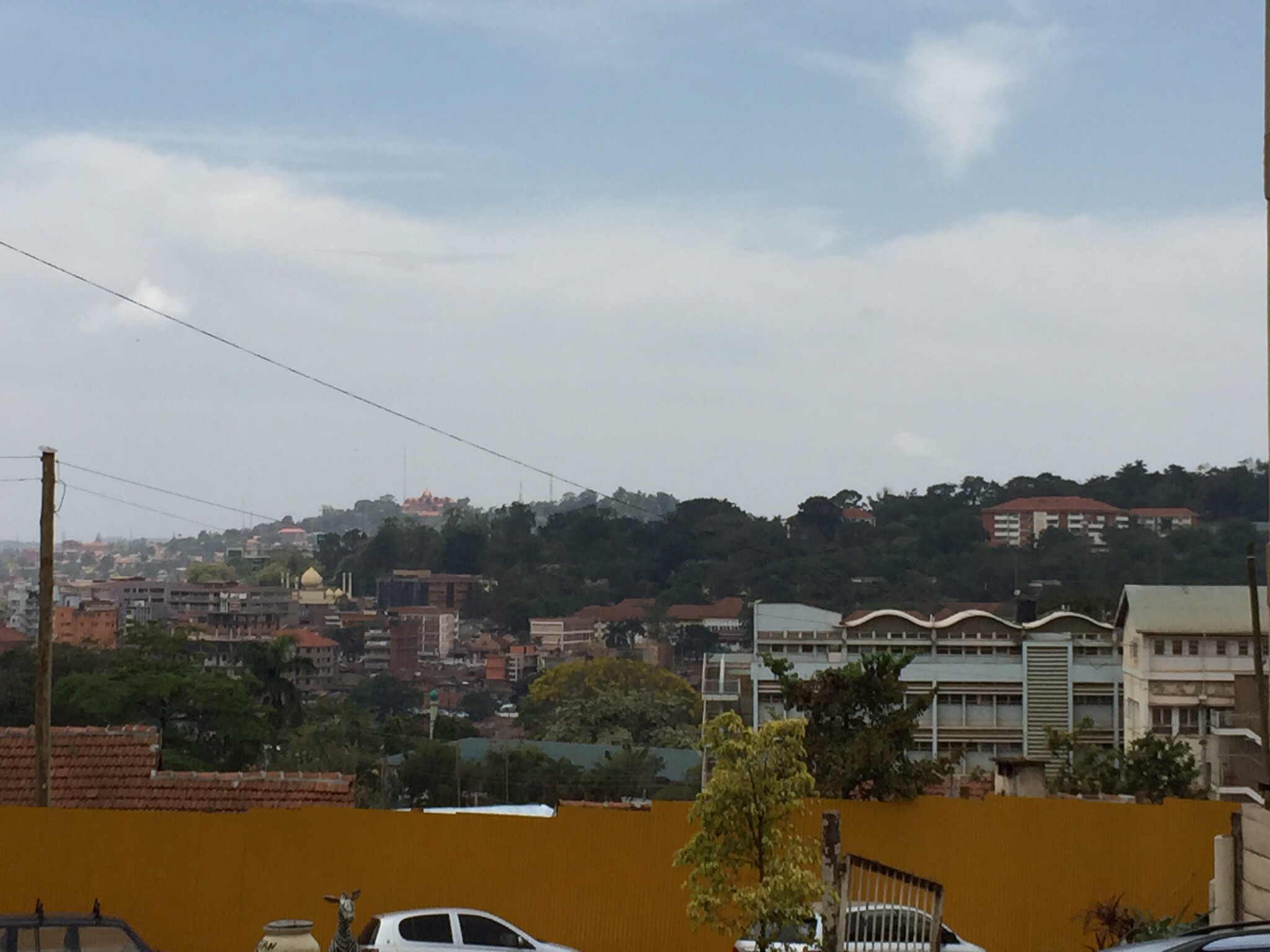
One of the beautiful views of Kampala from the IDI

This is the view from the Mulago Guest House lawn, where I met with Martha, the Principle Pharmacist of Mulago National Referral Hospital

One of the things that is important to me when I’m figuring out new partners to work with is that we create a mutually beneficial relationship. If Eva and her partners at IDI are willing to work with my pharmacy students and teach them about HIV and the challenges of healthcare, then I want my students to provide something of benefit to them. Many times this is done in the form of presentations to help with their professional development or some small project. Together, Eva and I came up with the perfect idea. As I mentioned, they see patients with kidney and liver problems so my students and I will present a talk on how to manage the common HIV treatment regimens for patients with these conditions and then we will also do a small medical chart review to identify whether there has been a problem with the dosing of medications in any of their patients. If so, we will try to work with Eva to figure out a process to get the Pharmacist involved to help with drug dosing on these patients when they come to the clinic for follow-up visits. After my talk with Eva, another pharmacist, Mohammed Lamorde, who specifically researches the Pharmacokinetics of HIV drugs, joined us. This is the field of pharmacy that investigates drug concentrations in the body and whether or not other drugs the patient is taking can affect these levels. Anyway, we had a great conversation and he listened to some of the research ideas I have had to study processes that could help improve the treatment of Malaria and bacterial infectious diseases in Uganda. He gave me lots of good ideas and I hope that perhaps one day we can collaborate on one of these proposals.

Another view of Kampala from the IDI

One of the beautiful views of Kampala from the IDI

Later Monday afternoon, I got a chance to meet and talk with the new Principle Pharmacist at Mulago National Referral Hospital, Martha. Ever since I’ve been coming to Uganda, there has been an Interim Principle Pharmacist, so I am thrilled that the position has been filled with an extremely competent woman. I was impressed with her desire and plans to improve the pharmacy processes and to work towards implementation of more Pharmaceutical Care activities on the wards so that patients can truly benefit from the Pharmacist being involved in their care.

Posted in Diseases/Health | Tagged , , , , , , , , , , | Leave a comment

I Never Could Have Guessed I’d Go Horseback Riding in Uganda!

14 September 2015:

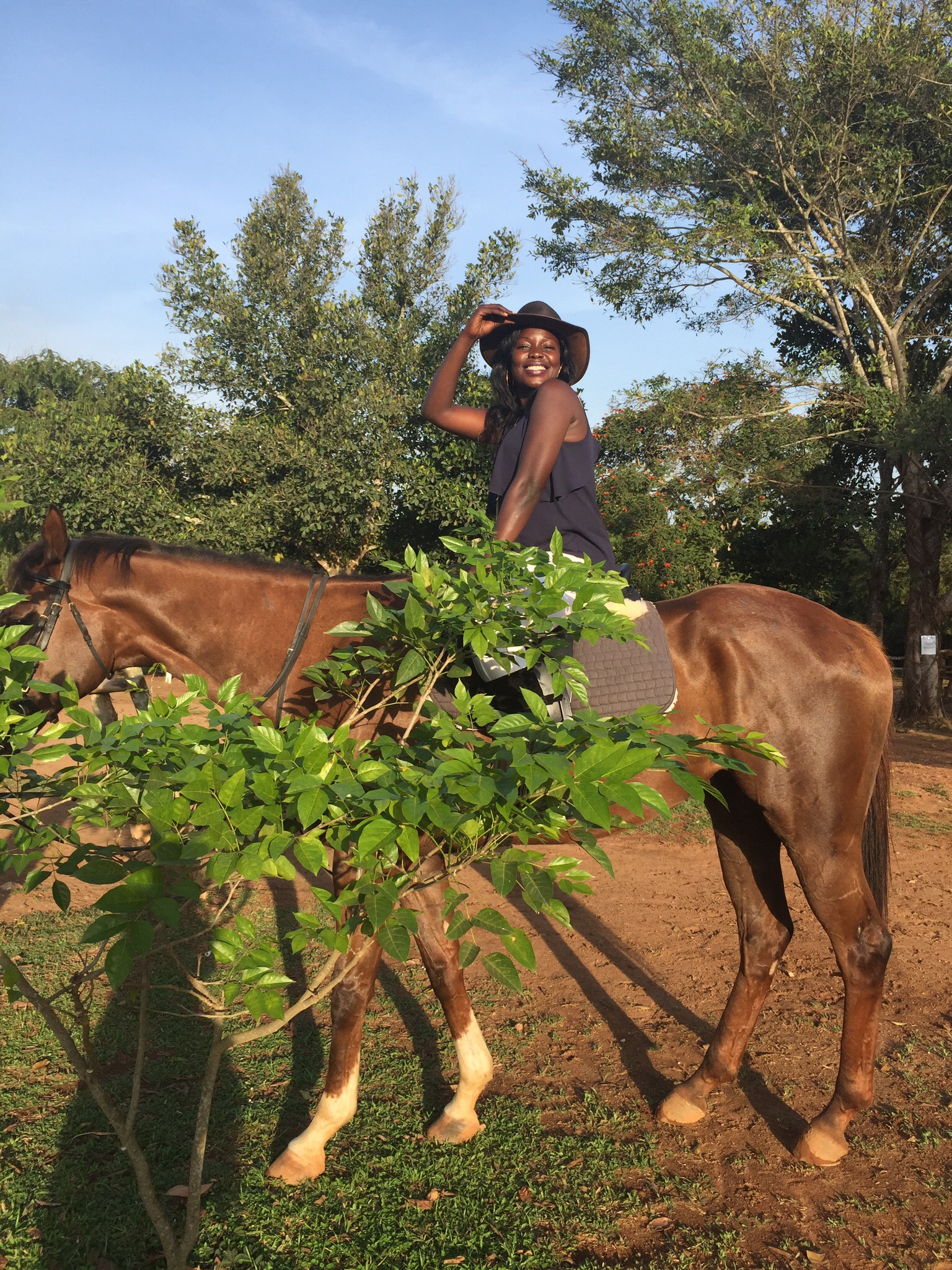
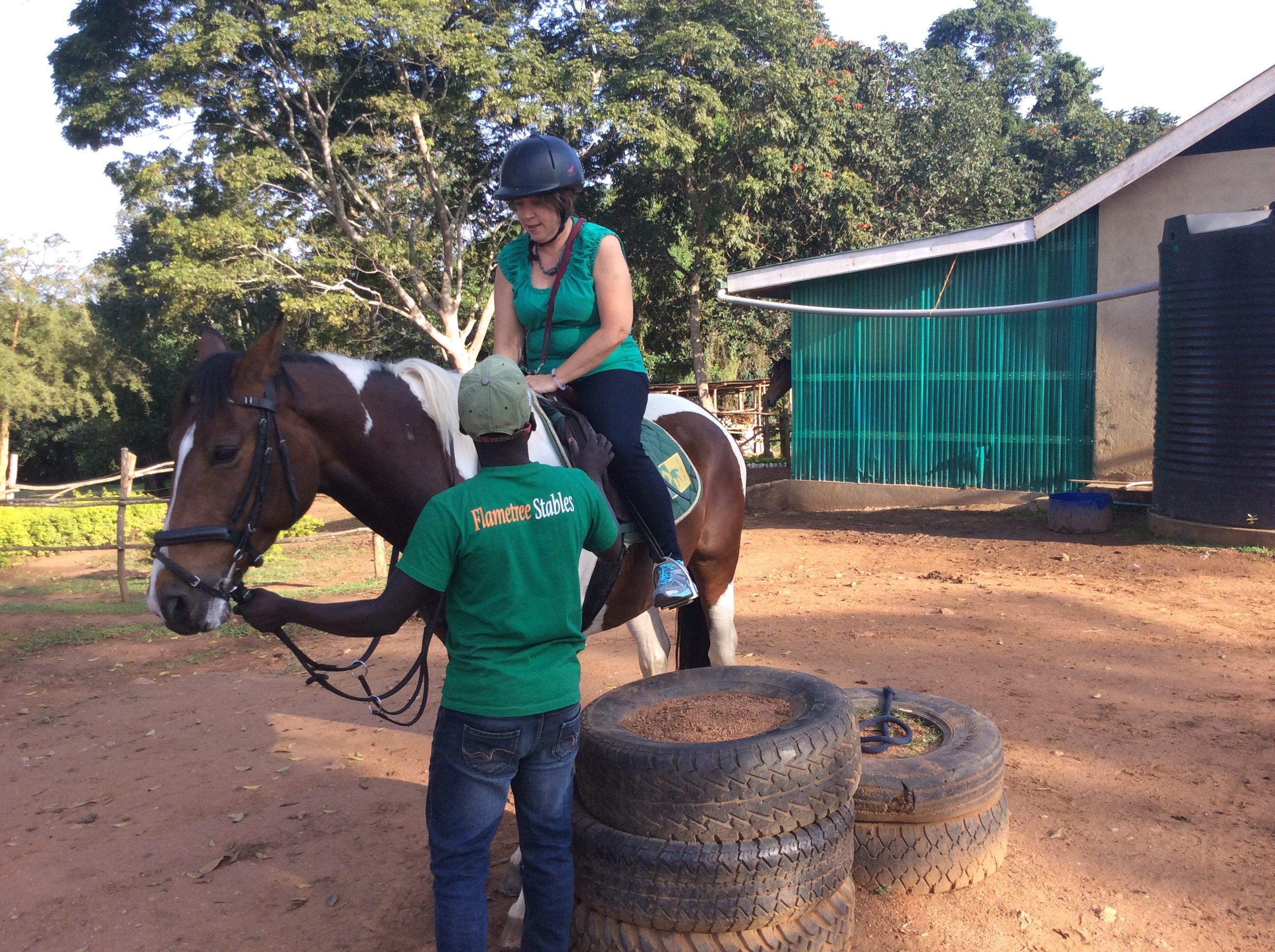
Jackson, my guide and trainer, coaches me to get on my mount, Chiccadee, a beautiful mare.

Jackson, my guide and trainer, coaches me to get on my mount, Chiccadee, a beautiful mare.

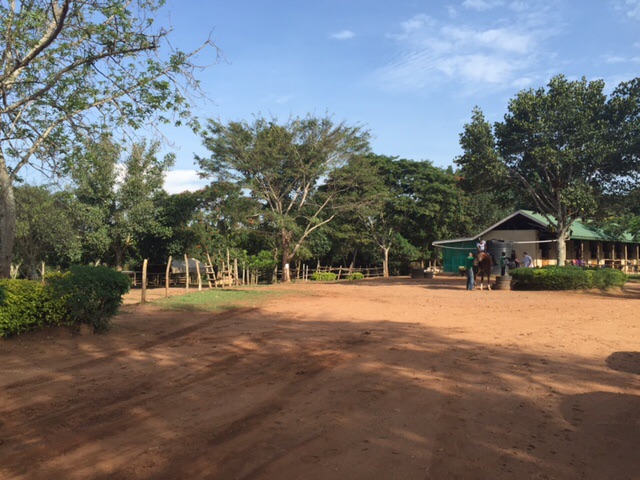
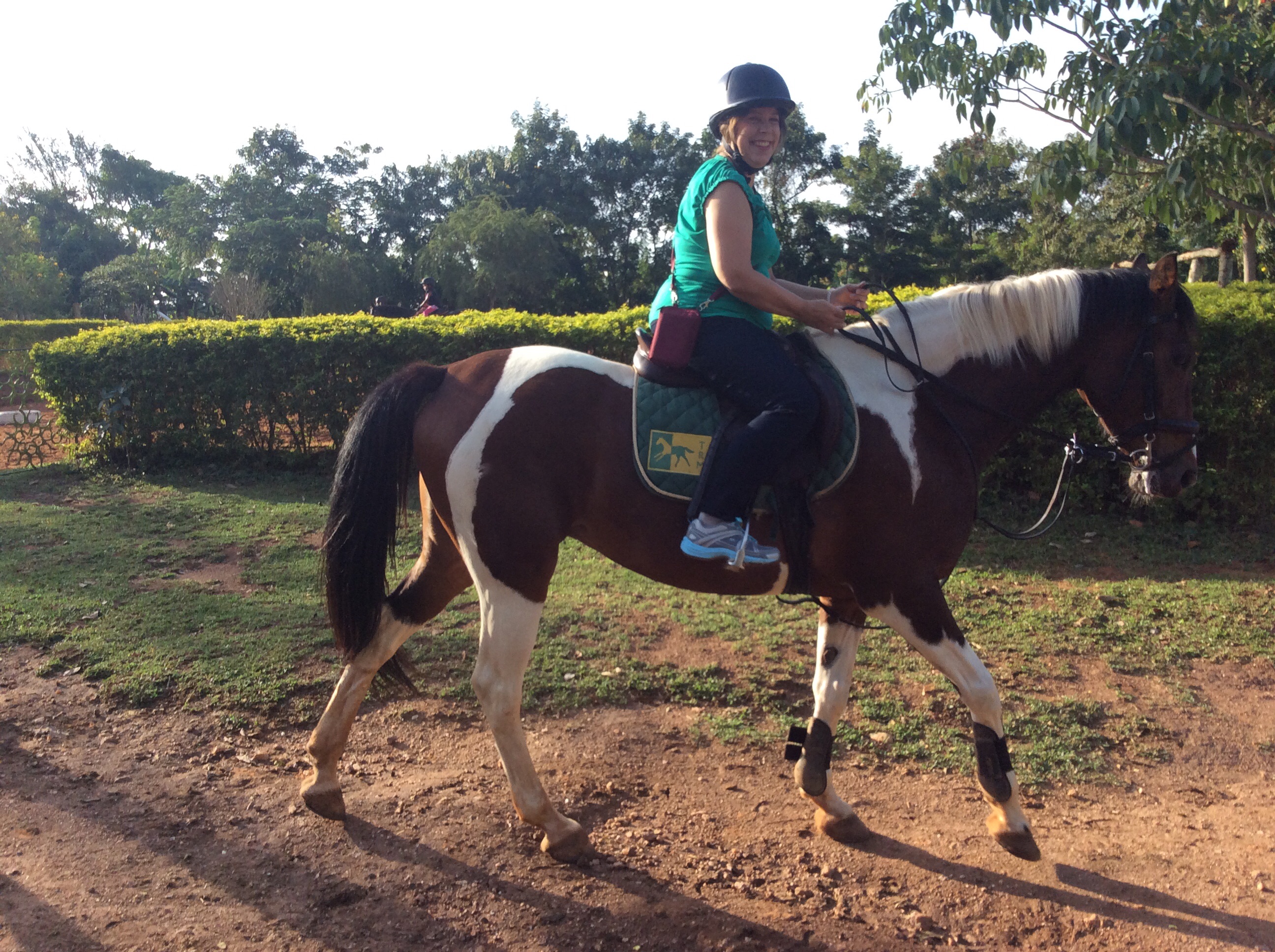
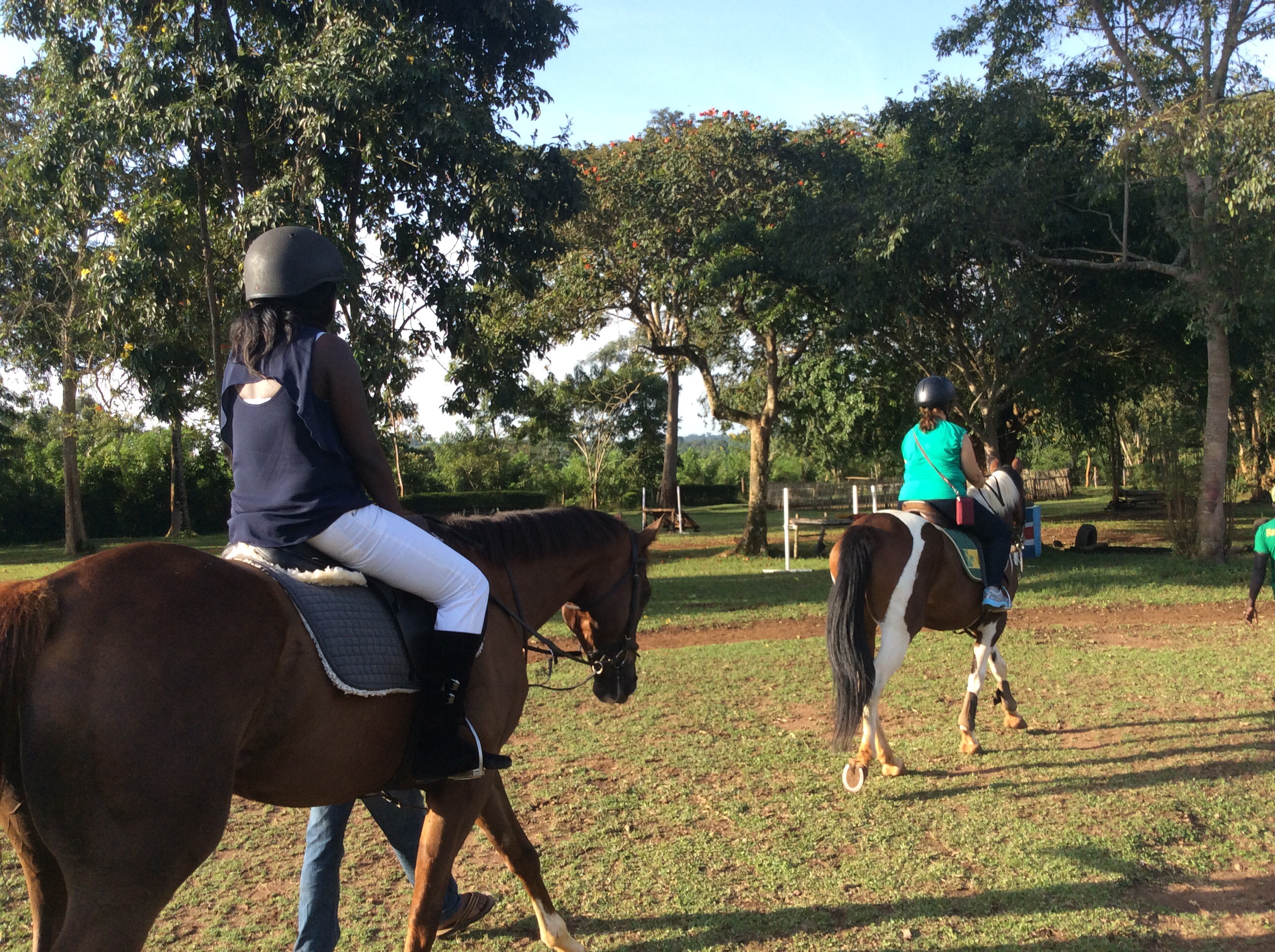
So, did anyone guess where Gonsha took me on Saturday from the 2 pictures at the end of the previous blog?  As the title says, we went horseback riding. When I was a teenager I had the common “horse-crush” that many young girls have. I used to go riding every once and a while and even took a couple months of lessons a long time ago. Since my teen years, though, I think I’ve only been riding twice on gentle trail rides. But never did I think I would take part in that activity in Uganda. It turns out there are just a few riding stables in Uganda but the one that Gonsha took me to was called Flametree Stables just outside of Kampala. I was truly impressed with their operation. They have 28 or so of their own horses and they board about a dozen more. All of the animals I saw seemed to be in really good shape and well taken care of. The stalls were also quite clean and the barn smelled good- if you like “clean barn animal smell”, which I actually do.

image imageWe basically went on a slow trail ride led by guides but at the end, they brought us into a fenced training area and asked if we wanted to go faster. Although I was a bit nervous, I couldn’t say “no”, so the trainer led my horse into a trot and taught me to post. It turns out that those lessons from eons ago seemed to still be with me.  All in all it was a great day! Thank you so much Gonsha for just a unique experience!!

The lovely Gonsha!

The lovely Gonsha!

Posted in My Safari (My Journey/Adventure), Ugandan Nature | Tagged , , , , , | 1 Comment

Weekend Activities: Doing Laundry the Ugandan Way & A Lively Worship Experience

13 September 2015:  With this blog I’ll tell you about some of my usual activities on the Weekends while in Kampala, Uganda beginning with Sunday and working backwards.

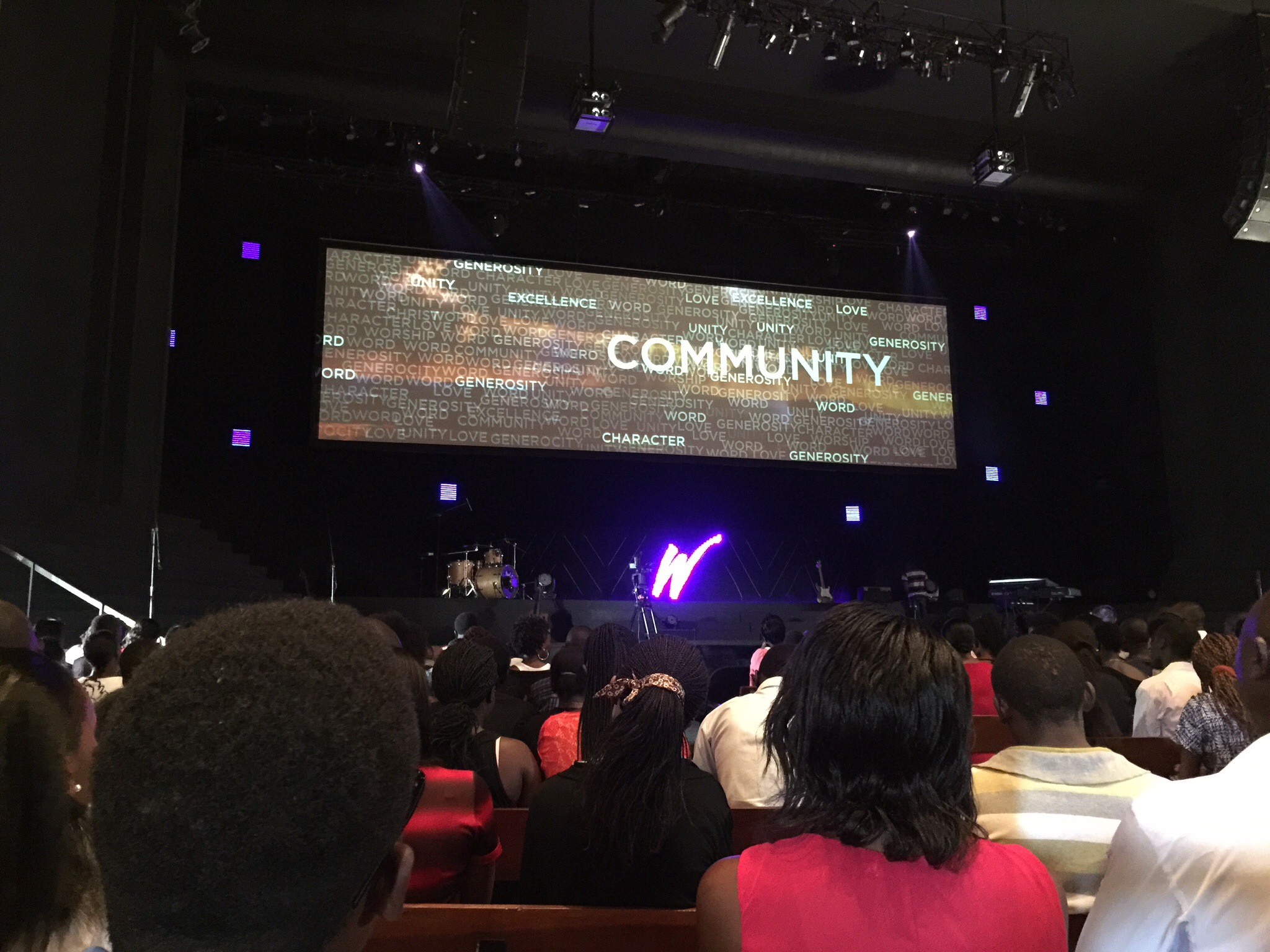
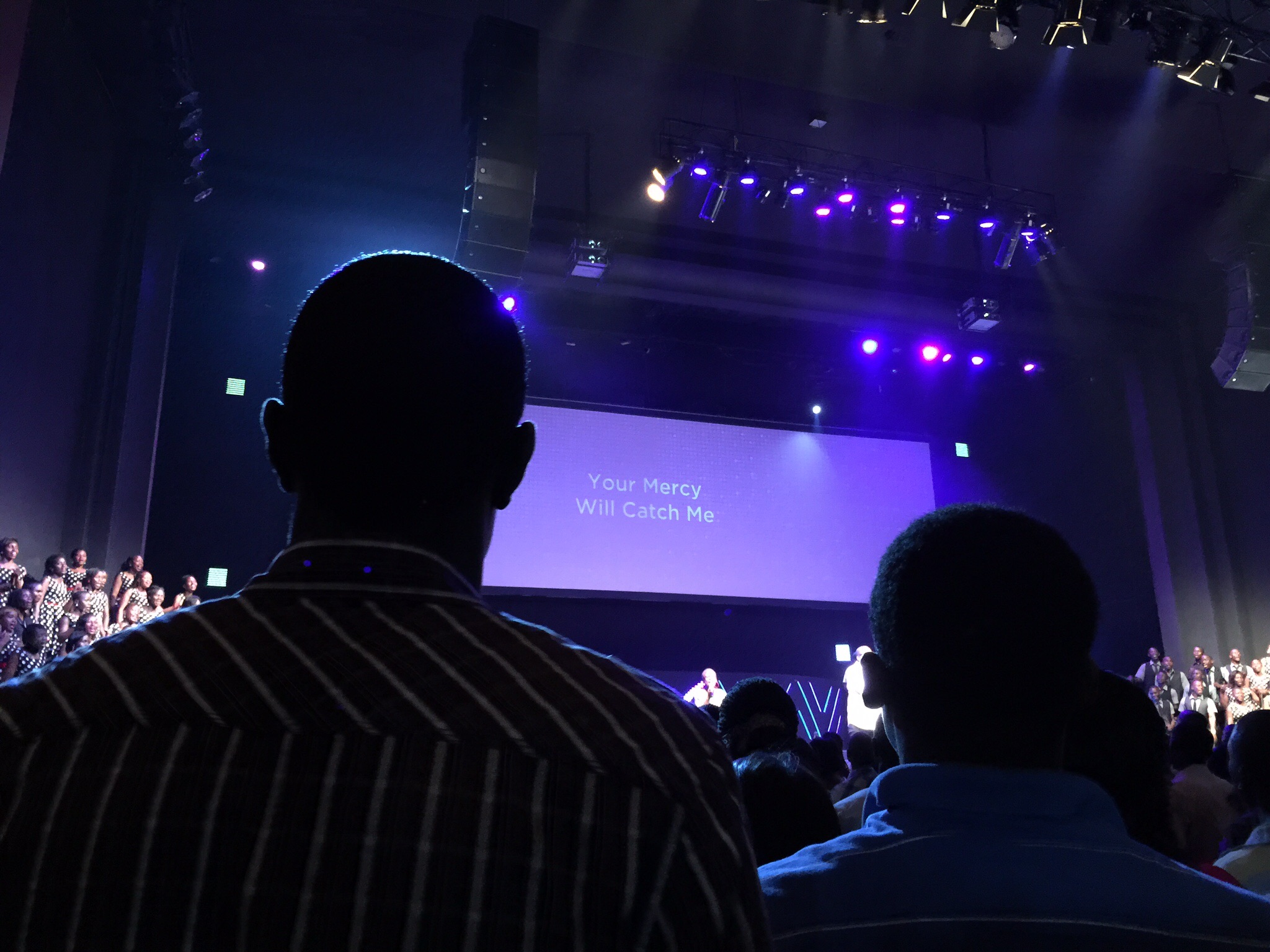
Watoto Church, Downtown Kampala, before the service the large screen runs many interesting colorful slides about their ministries which keeps you occupied while you wait, since people got there so early to get seats

Watoto Church, Downtown Kampala, before the service the large screen runs many interesting colorful slides about their ministries which keeps you occupied while you wait, since people got there so early to get seats

I usually try to attend worship services on Sunday mornings, if at all possible. Both to fellowship with other Christians, but also to learn more about the Ugandan religious practices.  Some of you might be surprised to learn that 85% of Ugandans are Christian with the majority of the others Muslim.  One’s religion is very important to Ugandans in a more public way than for  most Americans. In America, unless it specificially comes up in conversation or we are at church, we rarely talk openly about our faith and religious practices.  Although the majority will state in survey’s that they are Christian, regular attendance at worship services has decreased significantly over the past 50 years and in many communities, Sunday is not considered a “day of rest” or a day which is held sacred to families. Events are often planned that interfere with worship service times such as children’s community sports games or school-sanctioned activities which families are expected to attend.  In Uganda, though, Sunday is definitely considered a “day of rest” and/or “family day” and the worship services and activities often last hours and sometimes most of the day.  In the Ugandan culture, just knowing one’s religion helps them to know much about a person. I usually give my Wilkes student’s a “heads up” about this before they travel to Uganda with me because it will be very likely that they may be asked about their religion during their first conversation with a new person.  In fact when you are at the hospital collecting the demographic information about the patient, their religion is always asked and recorded, along with another interesting fact that we don’t collect, their tribe.  In the USA, this would be equivalent to always asking patients about their ancestry. e.g. Where does your family originate? Are you Irish, Italian, Hungarian, etc? While we do gather ethnicity information about some patients (those who don’t speak English well or who are not US citizens), I think it might actually be really helpful to know every patient’s history.  I suppose we don’t because most American families have been here for generations and perhaps we think the cultures have melded together into the “American Culture”. But despite this, many of the people I know claim their ethnicity especially on holidays, so I think many of their unique cultural habits and beliefs still exist.  Health beliefs such as the use of traditional healers, use of herbal and alternative medicines, thoughts about what to do with body parts that have been removed due to surgery, to the grief and death processes may differ dramatically among tribes and cultures in Africa as well as the rest of the world.  Knowing this information can give insight on how to help an individual patient and his/her family better. In Uganda, not only is this information collected during the admission of the patient to the hospital, but it is also relayed when pharmacists and physicians present patient cases to each other. For example: in the USA, a patient case presentation might start off by saying something like this:  “JC is a 24 year old male who was brought to the Emergency Room by Ambulance after being attacked during a bar room brawl…”  In Uganda, that same case would go something like this: “JC is a 24 year old Anglican Bugandan man who lives in Wakiso District who was brought to the hospital by his brother after being attacked at a bar…”

The singing begins...notice the choir standing on both sides of the stage up front. It was quite large- I think maybe 75 people. The women are in black and white polka dotted dresses.

The singing begins…notice the choir standing on both sides of the stage up front. It was quite large- I think maybe 50 people. The women are in black and white polka dotted dresses.

This Sunday I enjoyed attending one of the worship services at Watoto Church in downtown Kampala.  This is a Pentacostal Christian church that was started back in 1984. It has grown dramatically over the years and is know for its Watoto Children’s Choir that sings all over the world and for its ministry to children orphaned by AIDS and other calamties in Uganda.  As you can see from my pictures, if you woke up in the middle of Watoto Church, I don’t think you’d suspect you were in Uganda. The lighting and huge screen look like something you would find in American and you might suspect you were in a large urban church in the USA.  The music, led by a choir that wears fashionable black and white polka dotted dresses, was more than lively!  I thoroughly enjoyed the dancing, clapping, and modern praise and worship music. Thanks so much to Cathy for bringing me. (she is also in the choir- you can just barely make her out in the picture above- she is woman on the top row closest to the left edge of the photo) The packed congregations of Uganda always amaze me.  Every church I’ve attended here has been the same. People come early just to wait in lines outside so they can get a seat in main sanctuary and this one had both a main floor and a large balcony filled to the gills. If you can’t get a seat, there are tents set up outside where the music and video of the service is played.  As I write this, I realized that it IS possible for Ugandans to be on time or even early for events.  [Living on “Africa Time” is part of the normalcy when I’m here. There are few people I work with here who start events on time. Most activities start substantially late, even some University classes. I fit in pretty well here, since promptness isn’t one of my strengths. But as they’ve shown by their church attendance, I guess working on “Africa Time” is not something that is unavoidable.]

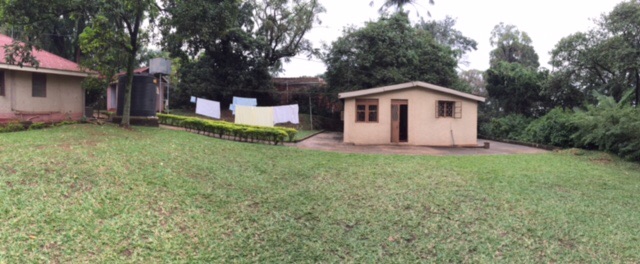
The small house to the right of the photo is my home away from home in Kampala.

The small house to the right of the photo is my home away from home in Kampala.

Saturday morning was Laundry Day for me. While it is possible for me to have the housemaid do my laundry, I actually enjoy doing it by hand when I’m here.  It is pretty easy because when you travel and only bring a small amount of clothes, the pile to wash is substantially smaller than it would be at home.  I do my wash the normal “Ugandan Way”, at least that is what Gonsha told me when she picked me up to go on an outing with her.  I have a large blue basin that I fill with warm water and soap powder in the bathtub. Then I soak the clothes and wash each piece separately by rubbing together. I dump the dirty water and add clean water to rinse the clothes and then wring them out as well as I possibly can. This is what I think is the major benefit of the washing machine.

Hanging laundry to dry. My house is in the background. The blue wash bucket is on the cement.

Hanging laundry to dry. My house is in the background. The blue wash bucket is on the cement.

It is easy to do all the other parts, but a washing machine can spin with such speed that it wrings out the clothes to almost dry. Then when they are hung on clotheslines outside, it only takes a short time to finish the job. I also realized that it is actually pretty good both upper body (the wringing) and lower body (the squatting) exercise to wash clothes manually.  One of the pieces was a sweater which needed to be laid out to dry. Before I came to Uganda I never would have thought of this, but a nice sturdy bush is a perfect place to dry a sweater. It doesn’t get stretched out and the sweater can breathe and dry more quickly since the air can move below the top of the bush, unlike when you lay a sweater on top of a towel.

I laid the sweater to dry on a bush, which worked quite well.

I laid the sweater to dry on a bush, which worked quite well.

The final pictures of this blog are to give you a little hint about what I did with Gonsha the rest of the day. Since most pictures were taken with her camera, I will need to wait until later this week to tell you about the massive amount of fun I had in the afternoon. Can you gues what we did?

Gonsha picked me up in her new car!

Gonsha picked me up in her new car!

image image

Posted in Diseases/Health, My Safari (My Journey/Adventure) | Tagged , , , , , , , , , | Leave a comment

A New Experience for 3rd Year Makerere Pharmacy Students + A Presentation to the Pharmacy Interns

10 September 2015:

The 3rd Year Pharmacy Students along with Patrick, one of the Mulago Pharmacists (brown checked shirt), Bush, one of the Makerere Faculty (blue checked shirt), and KarenBeth are all ready to go start working on the Hospital Wards.

The 3rd Year Pharmacy Students along with Patrick, one of the Mulago Pharmacists (brown checked shirt), Bush, one of the Makerere Faculty (blue checked shirt), and KarenBeth are all ready to go start working on the Hospital Wards.

The 3rd Year Makerere University Pharmacy Students started a new chapter of their training today at Mulago National Referral Hospital. It was their first day on the patient wards as active participants and not just observers. Their task today was light as they haven’t yet started to learn about diseases and their pharmacotherapy yet, but I wanted to get them out on the wards anyway, to put what they are learning into a more patient-centered perspective.  So in class they studied adverse drug effects (ADE) (side effects) and drug-drug interactions (DDI) and the mechanisms of each. Instead of just having them do an assignment where they can research and study the ADE’s and DDI’s of common drugs, I felt that seeing patients who are taking these drugs and then learning about these issues would help them to experience the role of the pharmacist. If pharmacists are well-informed about the common ADE’s of drugs, they can help their patients avoid them or identify if an ADE is the reason the patient needed to come to the hospital and then recommend the offending drug be stopped. Likewise, if a pharmacist can review a patient’s medication regimine and identify whether or not DDI’s are possible, the pharmacist can recommend changes to prevent the occurence of a significant DDI. Sometimes this means changing drugs, but sometimes this means just administering the drugs in a different order.  Tomorrow I’ll get to see what they learned during their first presentation of the semester.

Pharmacy Interns give their rapt attention to Gonsha as she introduces the program for the session.

Pharmacy Interns give their rapt attention to Gonsha as she introduces the program for the session.

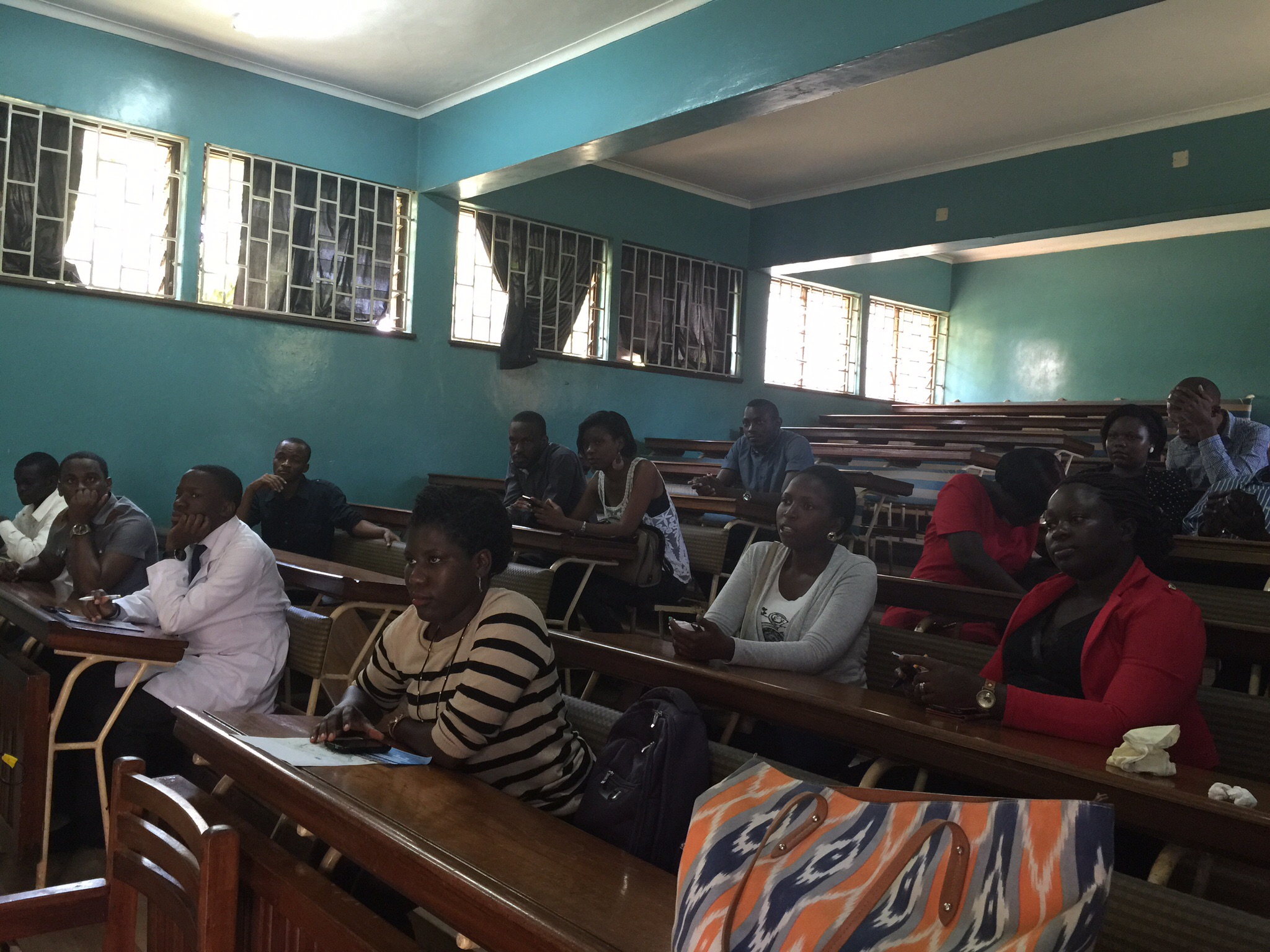
In the afternoon, I helped Gonsha Rehema, the PSU (Pharmaceutical Society of Uganda) Intern Trainer who recently worked with me in the USA, teach the Pharmacy Interns about the importance of documenting the ways we are helping patients.  For a long while, even in the USA, Pharmacists have been the “quiet” helper in terms of positively impacting patient care. Everyday Pharmacists worldwide are preventing ADE’s and DDI’s and helping to make sure the right dose of a medication is given but for some reason, we seem to keep this information to ourselves.  This may be in part because we think it is just a natural part of our job, but in a world where no one’s job is secure anymore, especially with the advent of so many advanced technologies that can assist in healthcare, it is important that we start to speak up and make what we do known to the people- both patients and other healthcare practitioners.  If we don’t and allow our jobs to be phased out or downsized, we may just find that the era of safer medication use will come to an end. All healthcare practitioners are valuable and critical parts of the healthcare team and together we can improve patient health outcomes, but we can’t just say this to others. It really is up to us pharmacists to prove it.  Don’t get me wrong- I’m all in favor of technological advancements but as I was explaining to the 3rd year students today, what may be a significant DDI necessitating a medication change in one person, may not be a problem for another.  This is where “ART” meets “SCIENCE”.  In medicine, there is rarely black and white.  As I tell my students back home, when teaching in the classroom I need to teach it to you in black and white because as learners it would get so confusing to try and learn a million nuances. But once you get out into practice or into experiential learning you will find out it is “all gray”. Each person is unique and although we do follow evidenced-based treatment guidelines, we still need to consider each patient individually.
Gonsha and KarenBeth talk to the Pharmacy Interns about Clinical Intervention Documentation

Gonsha and KarenBeth talk to the Pharmacy Interns about Clinical Intervention Documentation

When I was here in Uganda last year, at one point there were about 75-80 Pharmacy Interns at Mulago Hospital. It was a wonderful thing because finally there could be extra staffing on the busy wards and one pharmacist could stay in the dispensing area while the other went on ward rounds to assist the physicians.  I was so pleased with this improvement! But when I came back several months later, the number of Interns had decreased to only about 30. You see there was an overlap of when they started so when the group that finished in July left, the Hospital Administration refused to take anymore. I heard that they said they didn’t think they needed them.  This was such a let-down. If only the Pharmacy department could have captured the good work the Interns and Pharmacists were doing when they were actually at full staff and written a report, the Hospital Administration could have seen that it will probably cost them more in inappropriate and unsafe medication use leading to longer durations of stay in the hospital and serious ADE’s than it would have cost to keep the number of Interns high.
So my goal today when talking to the the Pharmacy Interns was to convey the importance of documenting every time they help identify and solve drug therapy problems.  Hopefully this data will then be collected and be the start of a way to justify the staff needed to improve safe medication use.  Another side benefit of documentation that I always relay to my Wilkes students is that if for no other reason at all, document so that you remember the good you are doing and let in motivate you in your work.  Everyday so many things happen and if you don’t write them down you won’t recall all of the times you potentially saved a patient’s life or recommended a more effective pain killer, or helped to heal an infection faster because you made a recommendation to change the antibiotic.
Posted in Diseases/Health, Teaching | Tagged , , , , , , , , , , | Leave a comment