My Journey Continues: Returning to Uganda Amidst Worldwide Ebola Concerns

This in not an official U.S. Department of State (DOS) blog and the views and information presented are my own and do not represent the Fulbright Program or the DOS.

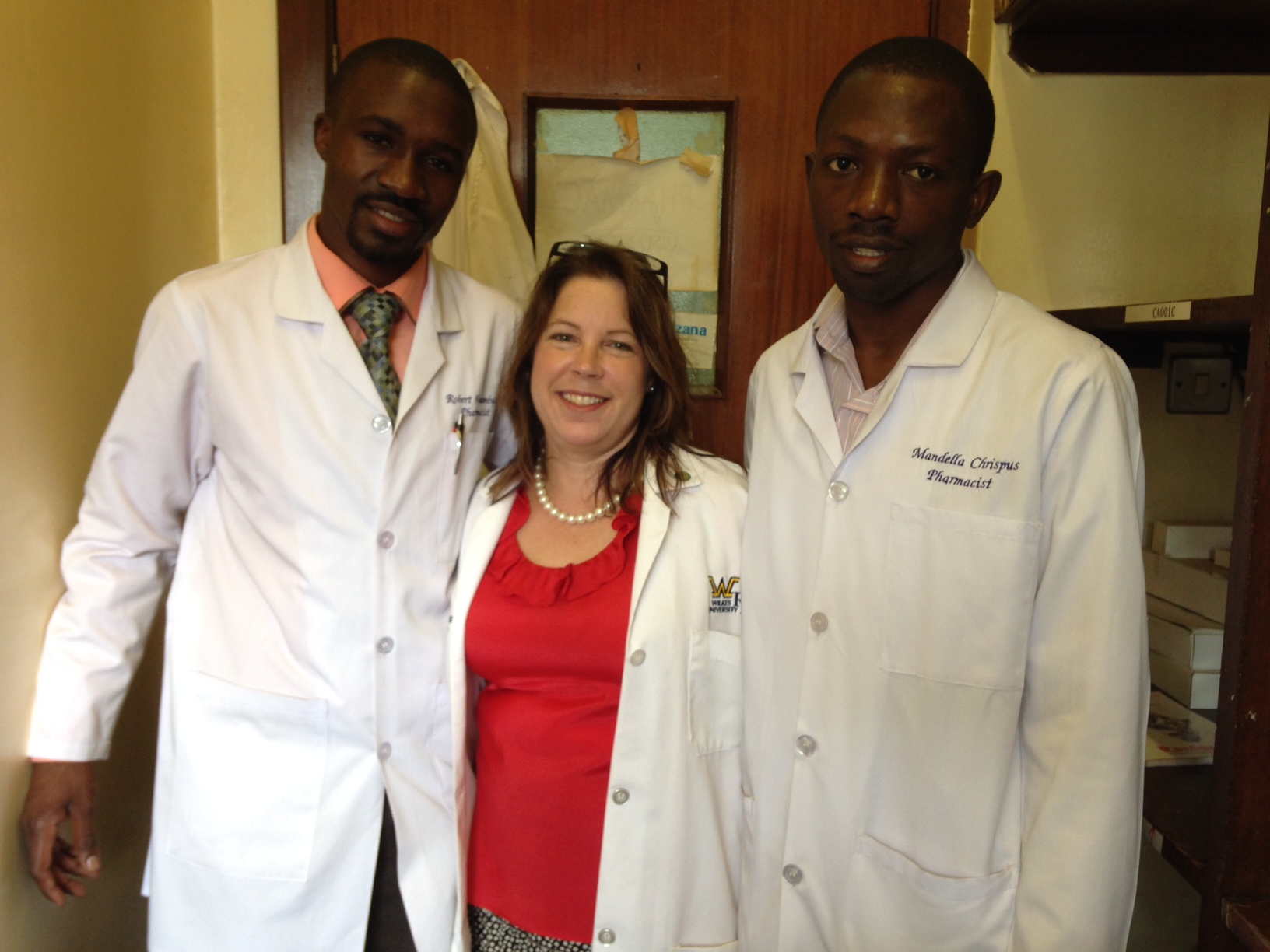
As I write I am embarking on my journey to Uganda to complete my Fulbright Specialist Program (FSP) project with visit 3 of this grant. This is definitely NOT my last trip to Uganda, but the nature of the FSP is to conduct and complete a short-term project with the host institution, Makerere University School of Pharmacy in my case. So this is my last official trip for the development of the Pharmaceutical Care curriculum with support from the U.S. Government. My goals for the next month are to teach some more classes and observe the teaching of the course by Makerere faculty, to assess student learning, and assess the curriculum and process of teaching and make any necessary changes to ensure continuity in the future by the University faculty. Wow, as I wrote that I realized I definitely have a challenge ahead but working together with the Pharmacy School faculty will make this doable.

Over the past few weeks as I’ve had interactions with family, friends, co-workers, and fellow church members and explained that I’m headed back to Uganda again, there has been one common question: “But aren’t you scared of getting Ebola?” I have decided to dedicated this post to my recurring answer and maybe it can help to calm not only those who care about me but people all over the world as this tragic epidemic continues and threatens to break loose and wreak worldwide havoc.

As I wrote out my usual answer, I realized it was quite long so I’m going to get to the bottom line right away. For those that want a more detailed explanation, continue reading on past the bullet points below.

Bottom Line:
• Uganda is in East Africa, 6900 miles away from the epicenter in the West African countries of Guinea, Sierra Leone, and Liberia. This is 2.5 times further apart than New York City and Los Angeles, California are.
• Ebola is contagious only by direct contact with the virus loaded bodily secretions of someone infected: blood, vomit, diarrhea, etc. – As a pharmacist, I do not usually directly care for patients in terms of physical examination or caring for these types of symptoms.
• The fever comes first, then as the patient gets sicker the other symptoms occur leading to release of secretions. You can’t get it by touching a person with only a fever and no secretion production.
• Ebola is not transmitted by the airborne route. You can’t get it by breathing the air around the infected person. We should all be worried more about catching Influenza is much more contagious and you can get it if you are not vaccinated and are standing within 3 feet of a coughing person with the flu.
• Uganda has not had a single case of Ebola from this current epidemic, although the healthcare system is quite familiar with caring for patients and containing this disease from outbreaks in the past. Currently they do health screening at the airports and all borders as well as have a system in place to isolate any patients that could possibly have Ebola, until it is ruled out.
• Ebola is certainly a scary disease and we should have a very healthy respect for it and know how to protect ourselves. Mass hysteria and propagation of falsehoods regarding risks, though, is not helpful, nor is ceasing work in countries and areas not affected by Ebola where people and systems rely on the help of others like me.
• I read an article today from a newspaper in Council Bluffs, Iowa about a high school girl who is going to Uganda on a mission trip (or already went) who has agreed to voluntarily quarantine herself for 21 days after arriving back in the USA due to concerns of the townspeople and parents of the other kids at her school. Unless this girl has directly cared for patients with Ebola, she is not at risk for getting the disease. And she can’t transmit the disease to anyone else unless she actually comes down with Ebola and is emitting bodily secretions, which she can’t get if she didn’t actually take care of Ebola patients. And there are no Ebola patients in Uganda at this time. This is just an example of how very poor decisions are made when people don’t take the time to learn the true risks. The article also stated that Uganda was in Central Africa, which is not true. There is no reason for this young woman to be kept away from her school friends and classes for 21 days just to quell the unfounded fears of the townspeople. I certainly understand the fear of getting Ebola and if it were transmitted by respiratory route this whole thing would be a different story. Before things get out of hand, proper education should done.

Now for my longer answer and commentary for those who are interested:

To be at risk for contracting Ebola several things need to happen. First of all, you need close proximity. You have to be near someone who has the disease. I am going to Uganda, which is in SubSaharan East Africa while the Ebola outbreaks are in West Africa. To give you an idea of how far I am away from anyone who has Ebola, consider the distance from Monrovia, Liberia where Ebola maintains a stronghold to Kampala, Uganda where I will be spending the next month, is 6900 miles apart. That is 2.5 times greater than the distance between New York City and Los Angeles, California. Of course, air travel condenses this space but there are many less people flying between West and East Africa than between NYC and LA daily and my flight to Uganda come from Detroit to Amsterdam to Entebbe, Uganda.

Next the disease in question needs to be contagious person to person. Ok, so Ebola is spread person to person. An example of a disease that is not contagious but is widespread in Africa is Malaria. A person who has Malaria can’t give it to someone else. [Bonus information: You can only get it from being bit by the female anopheles mosquito who harbors the parasite in her saliva. This is injected into the human when she takes a blood meal (bites you) for the sole purpose of feeding her embryos (baby mosquitoes in utero, in other words). Male anopheles don’t bite humans- they don’t need blood to survive. So the natural instinct of a mother to care for her unborn children is why humans get infected with Malaria. Interesting, huh?]

Then you need to consider how the disease is spread. We can all “thank our lucky stars”, as my mother used to say, that Ebola is not transmitted by the airborne route. You have to be in direct, unprotected contact with the bodily secretions (blood, vomit, diarrhea, urine, etc.) of a patient who has Ebola to get the disease and patients who are infected don’t start to develop these secretions and bleed until they have a fever. You can’t get Ebola from a patient who breathed on you or coughed in your presence. Influenza, on the other hand, is an example of a disease that is highly contagious by the airborne route. The possibility of contracting the flu should be of much greater concern to Americans and worldwide.. Although to most it means just a rough week at home in bed with a fever and feeling terrible, more than 58,000 people in the USA died in 2011 from influenza and pneumonia combined. (These are kept together because influenza often leads to pneumonia.) Maybe you are willing to risk getting the flu rather than getting the vaccine to prevent it, but you may not realize that before you even know you are really sick with the flu, you may already be spreading it by coughing and sneezing to anyone who comes within 3 feet of your airspace. And you never know when someone who gets it from you might have a severe illness and require hospitalization or even dies from influenza.

So let’s say a person does come into direct contact with the secretions of a patient who has Ebola, in order to get the disease you still have to get those secretions past the barrier of your skin. So if a healthcare worker, for example, is wearing protective gear but gets some on his skin while removing the gear AND the skin isn’t broken, like with a rash or cut, then it can be immediately washed off and the worker should be fine. The trouble comes when the worker unknowingly gets secretions on skin and it isn’t washed off or if the hand is contaminated and the person touches his mouth or eyes. Even then, contracting Ebola isn’t an automatic death sentence. In past outbreaks across the world, the fatality rate has sometimes been as high as 80-90% but fortunately the rate with this epidemic seems to be about 40-50%. The people who are most likely to survive Ebola are those with excellent supportive care given really early after diagnosis. Supportive care includes everything we do to help sick patients except for drugs or serums that are directly able to treat the virus. So this mostly includes stuff like hydration- giving plenty of fluids, possibly blood transfusions for patients who are bleeding, etc. Unfortunately, that seems not be be possible with many of the Africans who are infected. Since I’ve been doing work in Uganda since 2011 (this is my 6th visit there), I’ve realized that the Ugandans, and probably most Africans, are very self-reliant and do not seek medical care quickly when supportive care is most effective and helpful. They often try traditional medicines, herbs, and these actually do work sometimes for certain diseases- not Ebola-, or they just tough-out minor illnesses like colds and respiratory tract infections. They don’t even always seek care to suture wounds if not profusely bleeding and they think they can get it under control. This is one reason Tetanus is still a big problem and causes many deaths here. Even deep wounds can often heal on their own without stitches but the supportive care of a Tetanus Vaccine can truly be life saving and this isn’t obtained when a patient doesn’t seek healthcare. Ok, I digressed again. The bottom line is that I think that in the beginning of the outbreak, those affected probably didn’t realize the severity of their illness and seek care until it was too late. The longer the person suffers from the Ebola virus, the more virus particles grow in their blood and the more contagious they are to those who care for them. So not only is the prognosis much more grim, but more people become infected from the contagiousness of the body fluids. I would think currently the people in these countries are well aware of the symptoms and threat of Ebola and are trying to get to healthcare early, but their healthcare systems are breaking down due to the masses of those now infected and the numbers continue to grow. The countries where Ebola still has a strong grip, really need the help of the developed world. The USA should get involved, as we are doing, not only for the obvious humane reasons, but to also contain this disease before the numbers of those infected surpass the ability to get it under control. I just read an article in the NY Times today while on the flight that said an effective Ebola vaccine has been ready for human trials for 10 years but no drug company would sponsor it and provide the financing for this research because there wasn’t a market for it. From a business perspective, this makes sense, but this is a disease that should be in the interest of all the world to eradicate. It would be nice if drug companies could work together to solve this and share the cost burden or maybe World Leaders need to team up to figure this out. Unfortunately it has taken this growing Ebola epidemic to catch the world’s attention, but now there are plans for vaccine trials. I hope we can use this experience to look back for possible other untapped opportunities to arrest population-threatening diseases and think forward about how to get on top of this via research and infection control education before we are caught by surprise again.

Posted in Uncategorized | Tagged , , , , , | 2 Comments

Ugandan Pharmacy Students Provide My Motivation

This in not an official U.S. Department of State (DOS) blog and the views and information presented are my own and do not represent the Fulbright Program or the DOS.

A beautiful fall day: blue sky and leaves changing colors at French Creek State Park in Pennsylvania

A beautiful fall day: blue sky and leaves changing colors at French Creek State Park in Pennsylvania

Greetings from Pennsylvania, USA. I am currently stateside and in between my 2nd and 3rd visits to Uganda as part of the Fulbright Specialist Project. The Autumn season is in full bloom here with the leaves on the trees turning from greens to yellows, oranges, reds, or browns and then dropping off the trees. I have included some pictures so that my Ugandan readers and others from parts of the world without this change in season can see what I mean. The weather has also turned cooler with highs around 65F (18C) and lows around 34F (1C). Although that seems cold to some, this is my favorite time of year.

A walk in the woods along a pathway covered with fallen leaves in French Creek State Park, PA Oct-2014

A walk in the woods along a pathway covered with fallen leaves in French Creek State Park, PA Oct-2014

If you are a regular reader you know I have been helping to develop curriculum to teach 3rd and 4th year pharmacy students Pharmaceutical Care Skills for the Pharmacy School at Makerere University. When I was there for the first 4 weeks of the semester, I taught the new course and introduced skills like how to talk to patients to gather information about their symptoms and the past medications taken. The students then learned to take this along with any pertinent data from the medical chart and determine if there are any drug therapy problems that a pharmacist could help to alleviate. Finally the students learned how to present this information to the physician in the form of a recommendation that could help improve the patient’s health outcomes.

Leaves in various stages of green turning to yellow, orange and reds.

Leaves in various stages of green turning to yellow, orange and reds.

The other part of the course is to take the information learned in class to the hospital where students interact with patients and their caregivers and work with the Pharmacists and Pharmacy Interns to apply their skills to help real patients get better. This is called Experiential Learning.

Since I’ve been away from Uganda, the Makerere faculty, along with assistance from USA volunteer Pharmacists working with HVO (Healthcare Volunteers Overseas), have been continuing to teach the course and work with students at Mulago National Referral Hospital. Although I’m not there on site, I have been able to keep up with the goings on via the Pharmacy Students’ Reflective writing assignment that is uploaded to the Makerere eLearning Management System. Not only has this allowed me to see the evidence of the students’ learning from their descriptions of how they have used their knowledge and skills at the hospital to help improve drug therapy for the patients, but often they have included their own comments about how the experiential learning component is helping them to see their role as pharmacists-to-be from another perspective. I get an overall sense from their insightful remarks that they are really motivated and excited about this new role. And, this motivates and excites me!! Here, see for yourself in the words of some of the Makerere Pharmacy students, which I have extracted from their Reflective Writing Assignments.

“Overall it is a great learning experience and gives us as students an insight of what to expect in the future as pharmacists. We get to see areas of improvement as a department and as a hospital in all. Students also get to practice and improve their clinical communication skills with both the doctors and fellow medical practitioners and also teaches students to work as a team, both as students and as team players in the health care system.’

I felt like I was an important member of the health care team since my advice could be important in patient care.”

“Felt encouraged to read more so that I can be in a better position to give medications and management of medical conditions.”

“The whole thought process to identify what exactly was ailing this patient was very stimulating and made me feel as though I was part of a real medical team. It made me realise that not everything in medicine is always black and white, and sometimes we are faced with enigmas, or what we may call idiosyncrasies.”

“First and foremost I am grateful for having the wonderful sessions on clinical pharmacy skills practice. I know this can revolutionize our practice in the field of pharmacy and delighted to be part of the squad to bring this revolution in the practice of pharmacy in Uganda and elsewhere. Thanks to all the lecturers and special thanks to KarenBeth Bohan.” (emphasis was the student’s)

“Today’s experience has been of great value in shaping my ways to approach and get whatever information to make my practice a success. For its said, one learns how to swim only from the water and also it is a common saying that you learn from your previous mistakes.”

“I must say it was an eye-opener towards my practice. I look up to building my clinical skills so I can become a competent pharmacist.”

“The experience I’ve had today and the information and skills I’ve acquired so far in clinical pharmacy have helped me get an interest in this branch of pharmacy and will improve on how I care for patients as a pharmacist in future. It has also changed what I think of pharmacy as a profession because I originally thought it was just about dispensing drugs and collecting a pay cheque! Am now realizing its wider and more interesting.”

“These hospital exposures are going to enable me improve my skills in relating with patients and making the right decisions that will improve drug therapy outcomes in the patients that I will deal with in the future.”


Posted in Fulbright Specialist Project, Post-Safari Musings | Tagged , , , , , , , , , | 1 Comment

Wild Things at Murchison Falls National Park, Uganda, continued…

This in not an official U.S. Department of State (DOS) blog and the views and information presented are my own and do not represent the Fulbright Program or the DOS.


Murchison Falls as seen from the Victoria Nile River boat ride

Murchison Falls as seen from the Victoria Nile River boat ride

During our three game drives, I think Jeff and I saw more of God’s wild creatures than ever I saw before on one trip. Here are some more pictures of the magnificent animal sightings.

Jeff standing on a rock at the top of these Magnificent Falls

Jeff standing on a rock at the top of these Magnificent Falls

As I write this, I am getting ready to leave Uganda but this time I am looking forward to returning in just 4 weeks to continue my work with the faculty at Makerere University School of Pharmacy and with the Pharmacists and Interns at Mulago National Referral Hospital. It is so nice to be able to assure my in-country partners that I’m not leaving them for long and that when I come back, I’ll bring even more curricular content that I have developed to help the students learn the Pharmaceutical Care Skills to help them make a positive impact on patient care. So, stayed tuned and in 1 month, look for more Ugandan adventures from my experiences going Out of the Pharmacy Classroom and Into Africa!

Elephant grazing by the side of and drinking from the Victoria Nile River

Elephant grazing by the side of and drinking from the Victoria Nile River

A pair of Crocodiles warming themselves in the sun

A pair of Crocodiles warming themselves in the sun

Hippo

Hippo

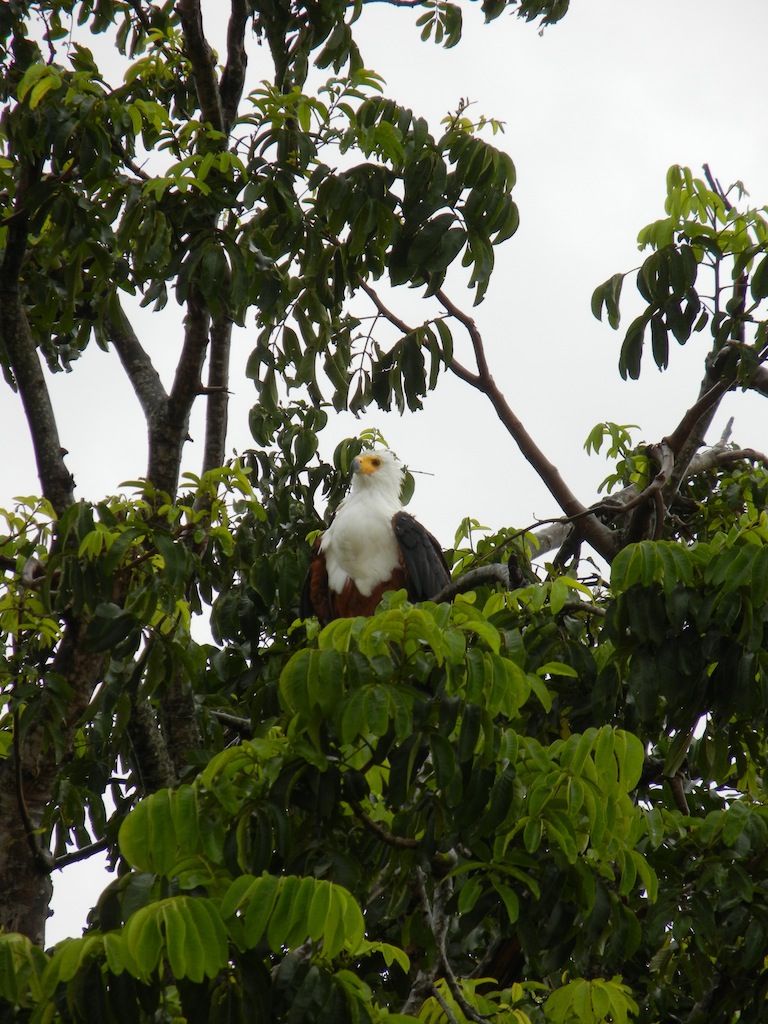
DSCN7790-African Fish Eagle Bird

The Puff Adder Snake that had been attacked by a Cobra

The Puff Adder Snake that had been attacked by a Cobra

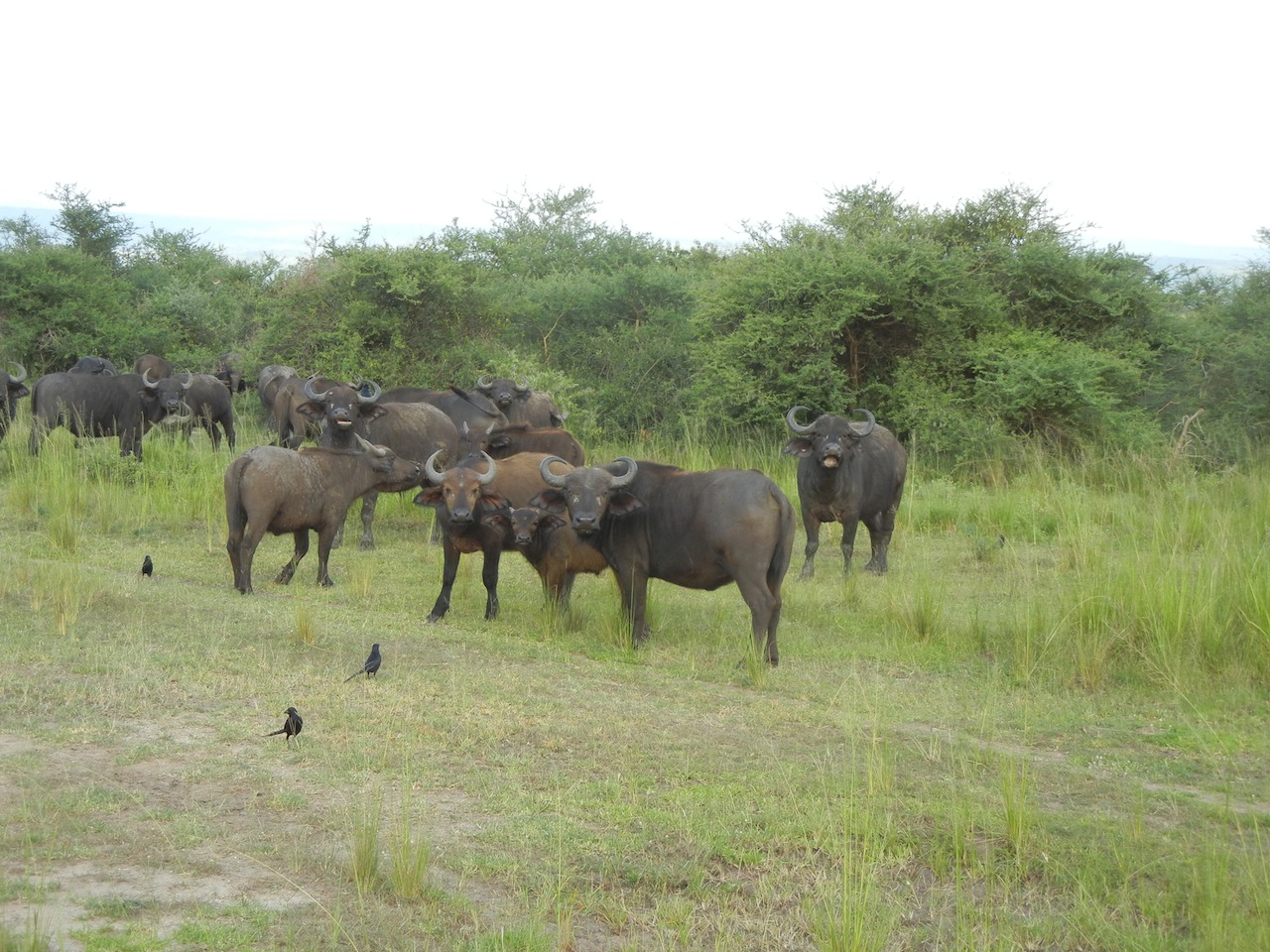
A small herd of Cape Buffalo- They always seem to be looking right at us but the Ranger Guide said their sense of smell is what makes them look in our direction but their eyesight is very poor

A small herd of Cape Buffalo- They always seem to be looking right at us but the Ranger Guide said their sense of smell is what makes them look in our direction but their eyesight is very poor

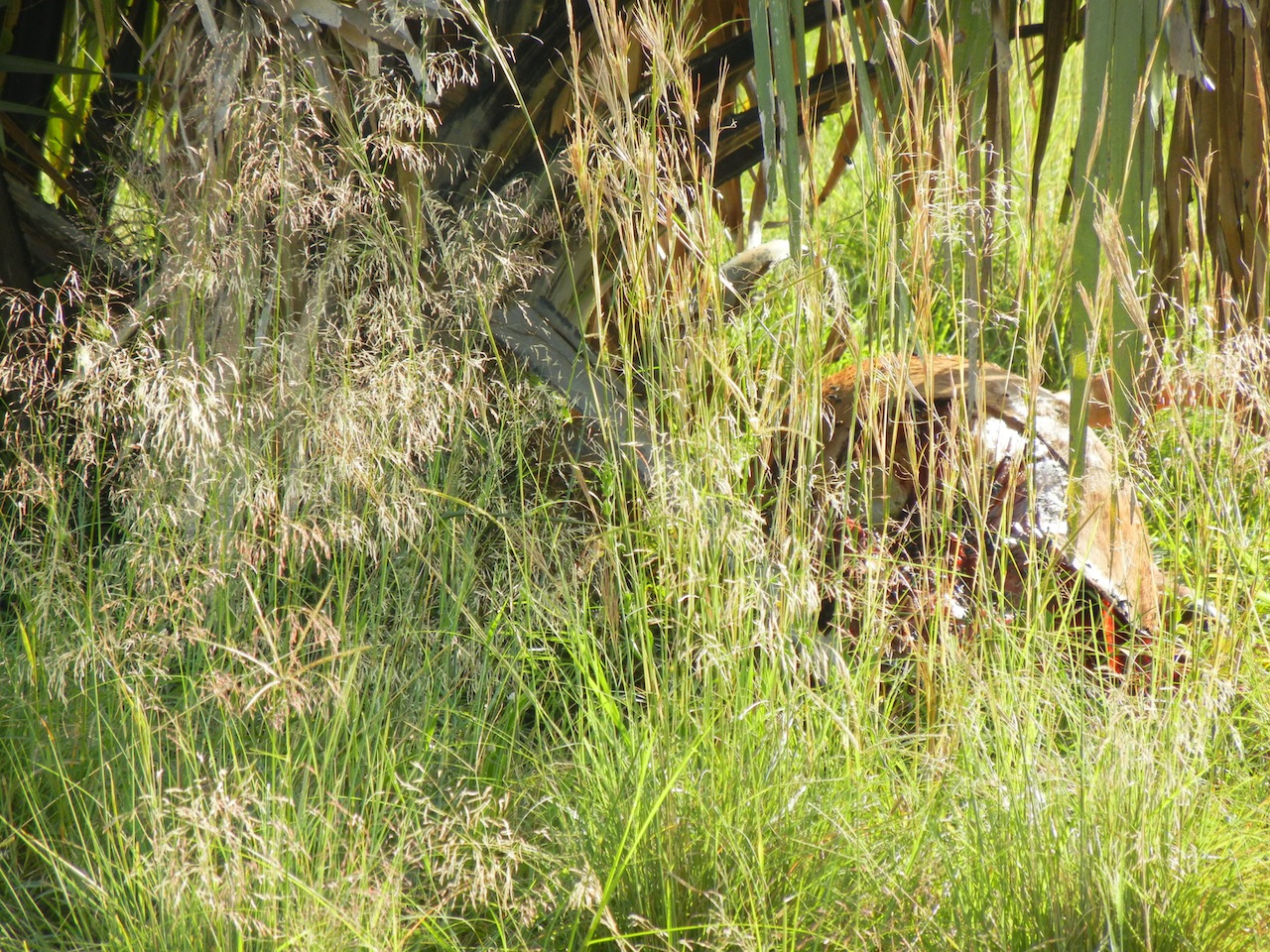
A young Male Lion with the start of a mane looks on while the hyenas and jackals destroy what is left of his kill (or his lioness's kill)

A young Male Lion with the start of a mane looks on while the hyenas and jackals destroy what is left of his kill (or his lioness’s kill)

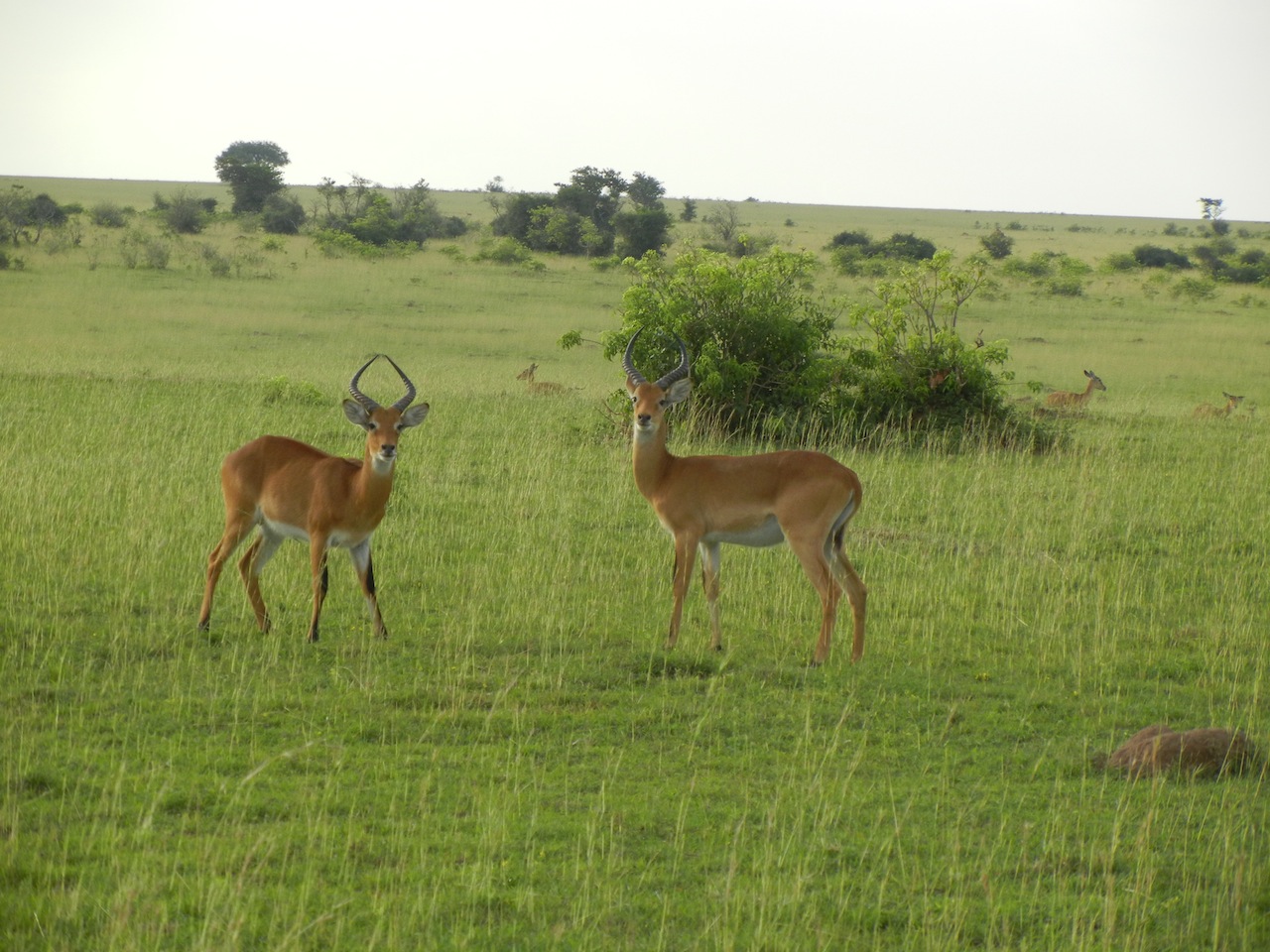
The Uganda Kob- this is the type of Antelope that the Hyena was chowing down on in the picture from Blog Post for 19Sept14

The Uganda Kob- this is the type of Antelope that the Hyena was chowing down on in the picture from Blog Post for 19Sept14

Posted in My Safari (My Journey/Adventure), Ugandan Nature, Uncategorized | Tagged , , , , , , , , , , , , , | Leave a comment

We Went “Where the Wild Things Are”: A Safari To Murchison Falls National Park, Uganda

This in not an official U.S. Department of State (DOS) blog and the views and information presented are my own and do not represent the Fulbright Program or the DOS.

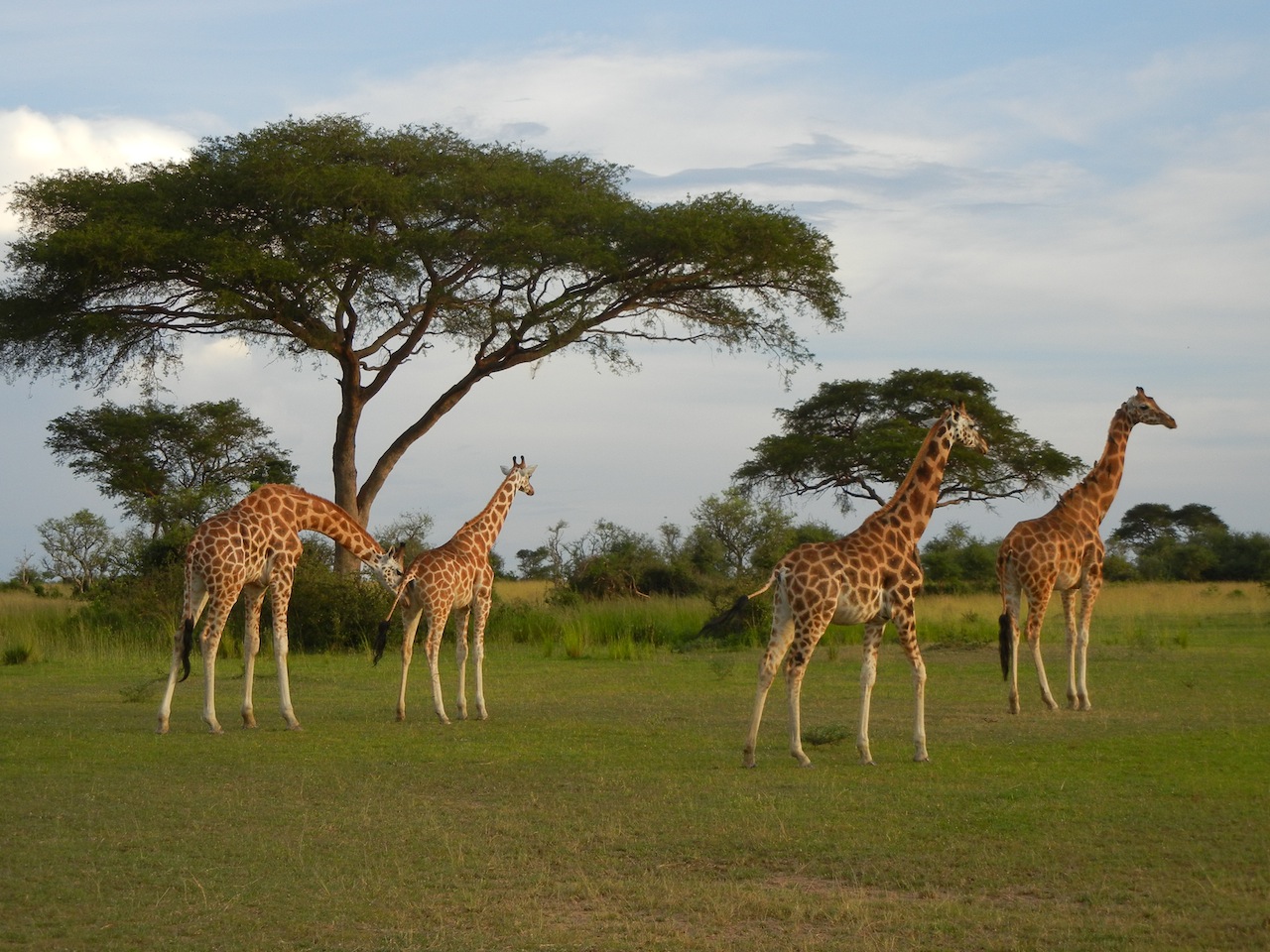
Giraffes with an Acacia Tree in the background

Giraffes with an Acacia Tree in the background

This is my 4th trip to Murchison Falls but I have been so excited to share it with my husband for the first time. We were going to see the “gentle giant” elephants, several different species of graceful antelopes, the awkward lumbering long-legged giraffes, hopefully a lion at rest basking in the sun, and many more of God’s wonderful creatures whom much of the world will never see in the wild. This trip, though, has been a bit different, although also very amazing.   We have learned that these animals truly are wild and the “circle of life” lives on.

We came upon this Lioness sitting right by the side of the road in the shade of a bush. Her recent kill was behind the bush. I took this picture from the car window, which was completely open. See how close I am by the bottom left hand corner where you see the window frame edge.

We came upon this Lioness sitting right by the side of the road in the shade of a bush. Her recent kill was behind the bush. I took this picture from the car window, which was completely open. See how close I am by the bottom left hand corner where you see the window frame edge.

On our first game drive, we came across a lioness panting by the side of the road, freshly worn out from her kill, which rested behind her- one of those graceful Jackson Hardebeest, with interesting ringed antlers.

The Kill

The Kill

Jackson Hartebeest, like the one killed by the lion

Jackson Hartebeest, like the one killed by the lion

The next morning we came across another lion’s kill, the remains being devoured by hyenas and jackals, while the male lion looked on from afar. Coming home from the drive to the top of the cascading mountains of water down Murchison Falls we saw a cobra snake attack a puff adder snake by the side of the road. We have no idea what prompted the fight between the serpents cursed to slink on their bellies for the remainder of time, but as the cobra slinked away, we watched the puff adder go through the convulsions of its death from the formers bite or spit. Today we learned that although the animals are beautiful creatures to look at, they are still very dangerous and their space needs to be respected.

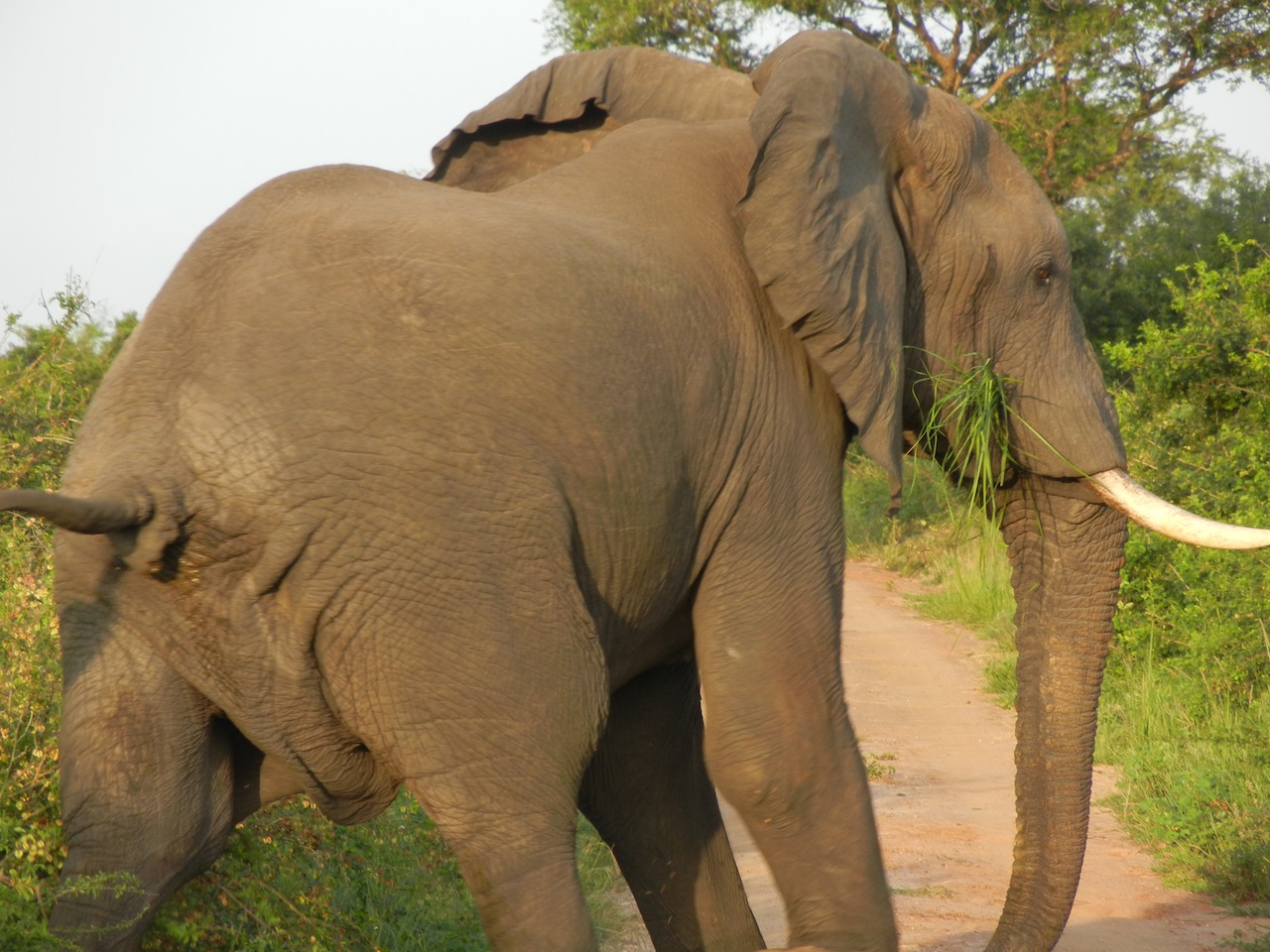
This elephant crossed directly in front of our vehicle but not before looking at us as if he wanted to charge our vehicle. Luckily, he turned and sauntered off.

This elephant crossed directly in front of our vehicle but not before looking at us as if he wanted to charge our vehicle. Luckily, he turned and sauntered off.

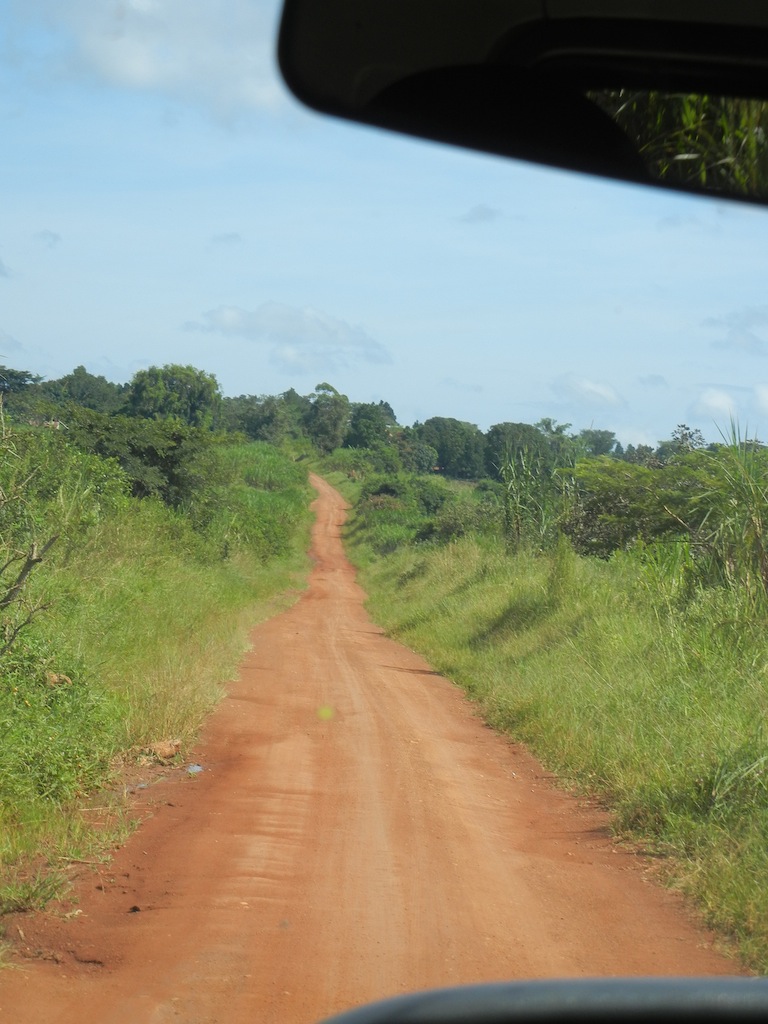
Bumpy road to Murchison Falls.

Bumpy road to Murchison Falls.

Now a little background information: Murchison Falls National Park, Uganda, is in the Northwestern part of the country. From the far side of the park you can see the distant mountains of the Democratic Republic of the Congo across from Lake Albert. We entered via the Main Gate, just 30 minutes over a bumpy red dirt road from Masindi. Sam, our driver, rented a 4-wheel drive SUV Toyota Van with a roof that pops up for better game drive viewing per my request which ended up being a great decision. Throughout the game drives, we can stand and see 360 degrees of the Savannah and get really good shots with our cameras. Plus it is just plain fun to hang on to the top edge of the van for stability as we ride standing up throughout the park. At times, though, the bumps and ruts are so much we just have to sit down.

Borassus Palms dot the landscape.

Borassus Palms dot the landscape.

The park has four types of landscapes. You enter and drive quite a ways through a Tropical Rain Forest. We saw baboons scampering all over the road along with many birds and some black and white Colobus Monkeys. The park gradually flows into Woodland Savannah with much less dense trees and shrubs than the forest. After crossing the Victoria Nile River to Paraa Lodge, via the ferryboat, the land becomes successive segments of Woodland Savannah, Savannah Grasslands, and Borassus Palm Savannah over and over again throughout the large park. When the Borassus Palms spot the Savannah, it reminds me of the Truffula Trees from Dr. Seuss’s “The Lorax”. Some animals seem to roam the entire landscape regardless of the type of terrain, while others tend to seem to enjoy a specific area. I’m going to let our pictures do the rest of the talking but one last comment of explanation. When we Westerners want to take a trip such as this to see the African wildlife, we usually say we are planning going on a “safari” but that word actually means “journey”. Africans would say that we took a safari to Murchison Falls National Park, but each day we take “game drives” to see the wild animals. And, as you’ll see from our pictures this trip so far, we were able to see the “wild” part of nature in action. So enjoy the pictures and don’t get too frustrated with yourself when the Lion King’s “Circle of Life” song enters your mind and you can’t get rid of it the rest of the day. This so far has been a truly amazing experience!

Sunrise over the Savannah

Sunrise over the Savannah

A Hyena scavanges the kill of a lion while Jackal looks on

A Hyena scavanges the kill of a lion while Jackal looks on

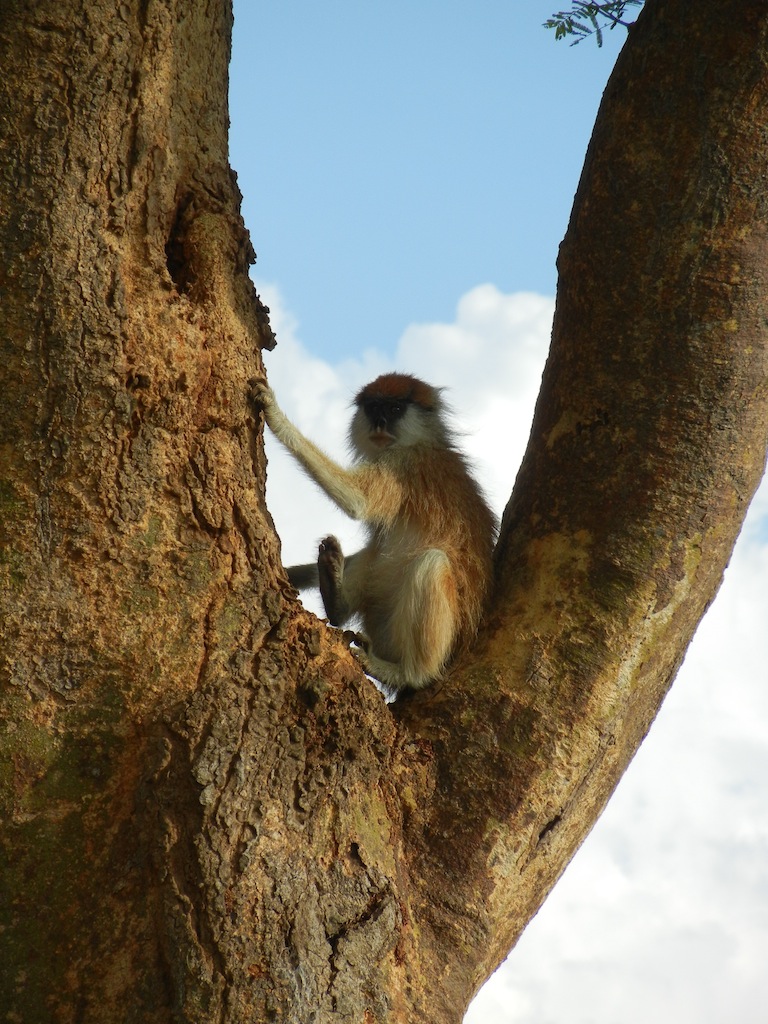
A Vervet Monkey

A Vervet Monkey

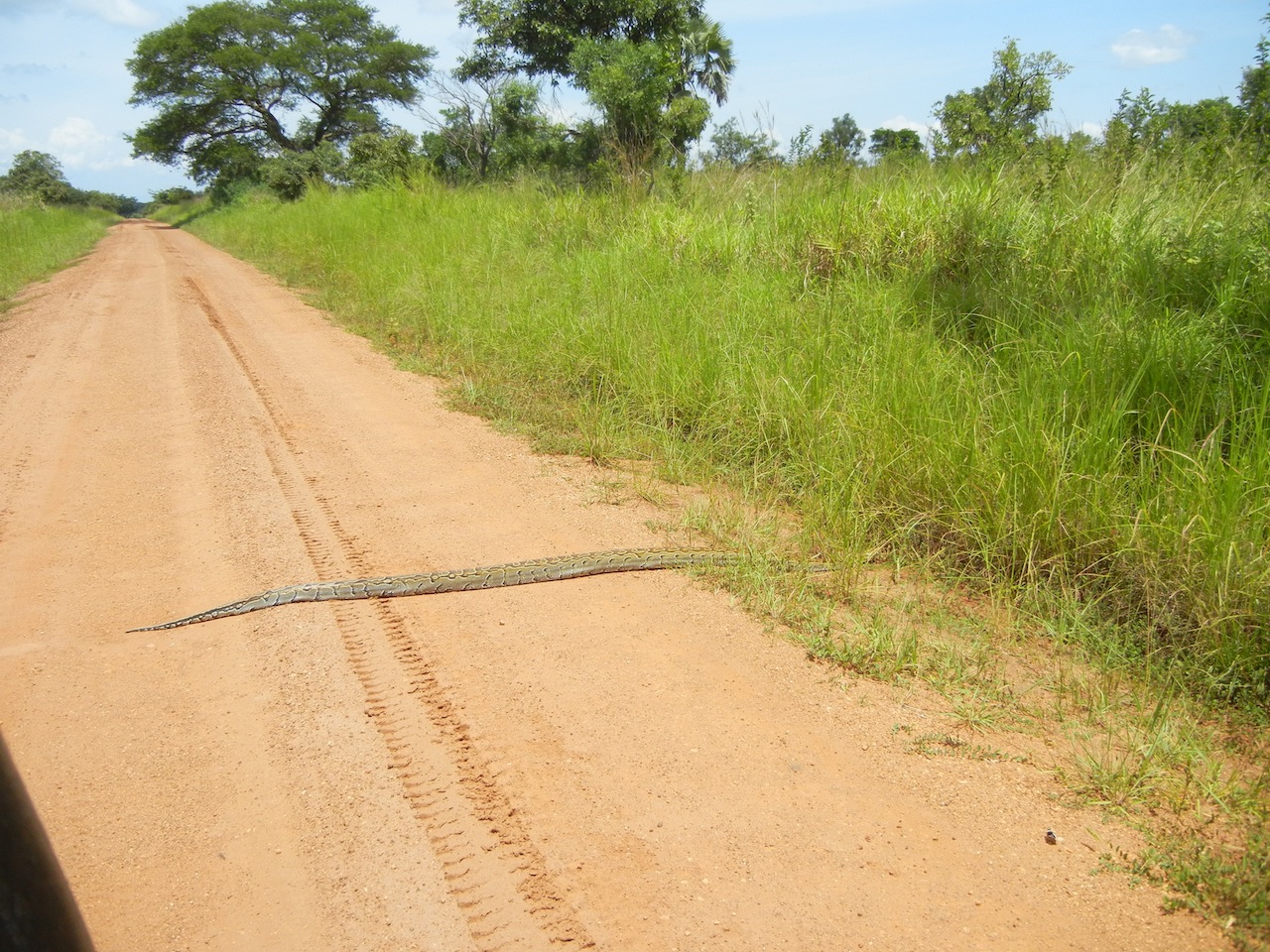
As we drove through the beginning of the park we saw a python crawling across the road- my first snake siting ever in all of my trips to Uganda

As we drove through the beginning of the park we saw a python crawling across the road- my first snake siting ever in all of my trips to Uganda

Warthogs are a very common site all over the park.

Warthogs are a very common site all over the park.

Baboons welcome us as we drive into Murchison Falls Park

Baboons welcome us as we drive into Murchison Falls Park

Posted in Fulbright Specialist Project, My Safari (My Journey/Adventure), Ugandan Nature | Tagged , , , , , | 1 Comment

A Trip to Jinja and Masindi, Uganda

This in not an official U.S. Department of State (DOS) blog and the views and information presented are my own and do not represent the Fulbright Program or the DOS.

Ssezibwa Falls- Jeff, KarenBeth, Monty, Kiran, Russ (left to right)

Ssezibwa Falls- Jeff, KarenBeth, Monty, Kiran, Russ (left to right)

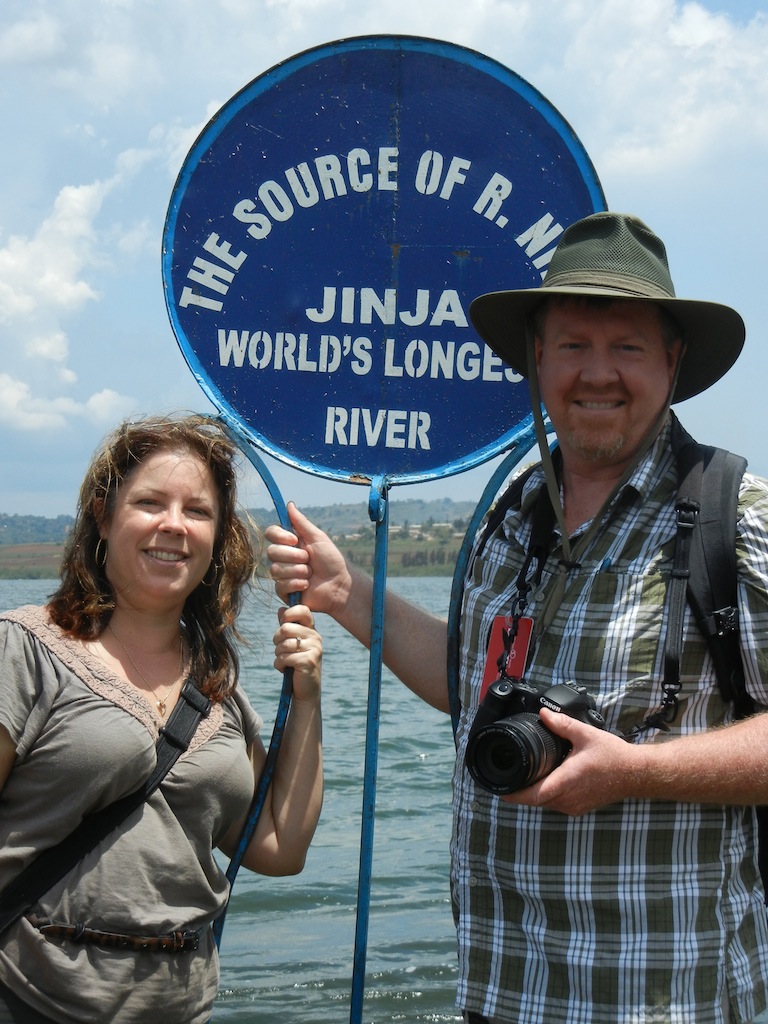
Over the past 2 days, I’ve been showing my husband, Jeff, my favorite places in Uganda and have been introducing him to all of the friends I work with while I’m here. He’s seen many pictures of these places but meeting the people and seeing the sights first-hand is so much better. On Tuesday we took a day trip to Jinja, Uganda, which is Northeast of Kampala to the Source of the great Nile River. Since my driver’s vehicle could hold more than just the two of us, I invited my housemate, Monty, and two other Fulbrighters to join us, Russ and Kiran, and true to the saying, more was merrier! We had a fantastic trip.

Jeff and KarenBeth on the boat ride to the Source of the Nile

Jeff and KarenBeth on the boat ride to the Source of the Nile

We couldn’t have asked for better weather and the guides for both Ssezibwa Falls and the boat ride to the Source of the Nile were great. We did split up for the late afternoon, though, and Jeff and I headed to the Jinja Sailing Club where we ate a delicious, slow-paced meal right on the shores of Lake Victoria, while the others explored the shops of downtown Jinja.

Banana Tree by the side of the road

Banana Tree by the side of the road

We didn’t leave the area until about 6:30pm which landed us in pretty bad traffic. By the time we reached home close to 10pm, we were ready for bed. But, since Jeff and I were leaving Kampala in the morning for the rest of our vacation, we had to stay up quite a bit later to pack.

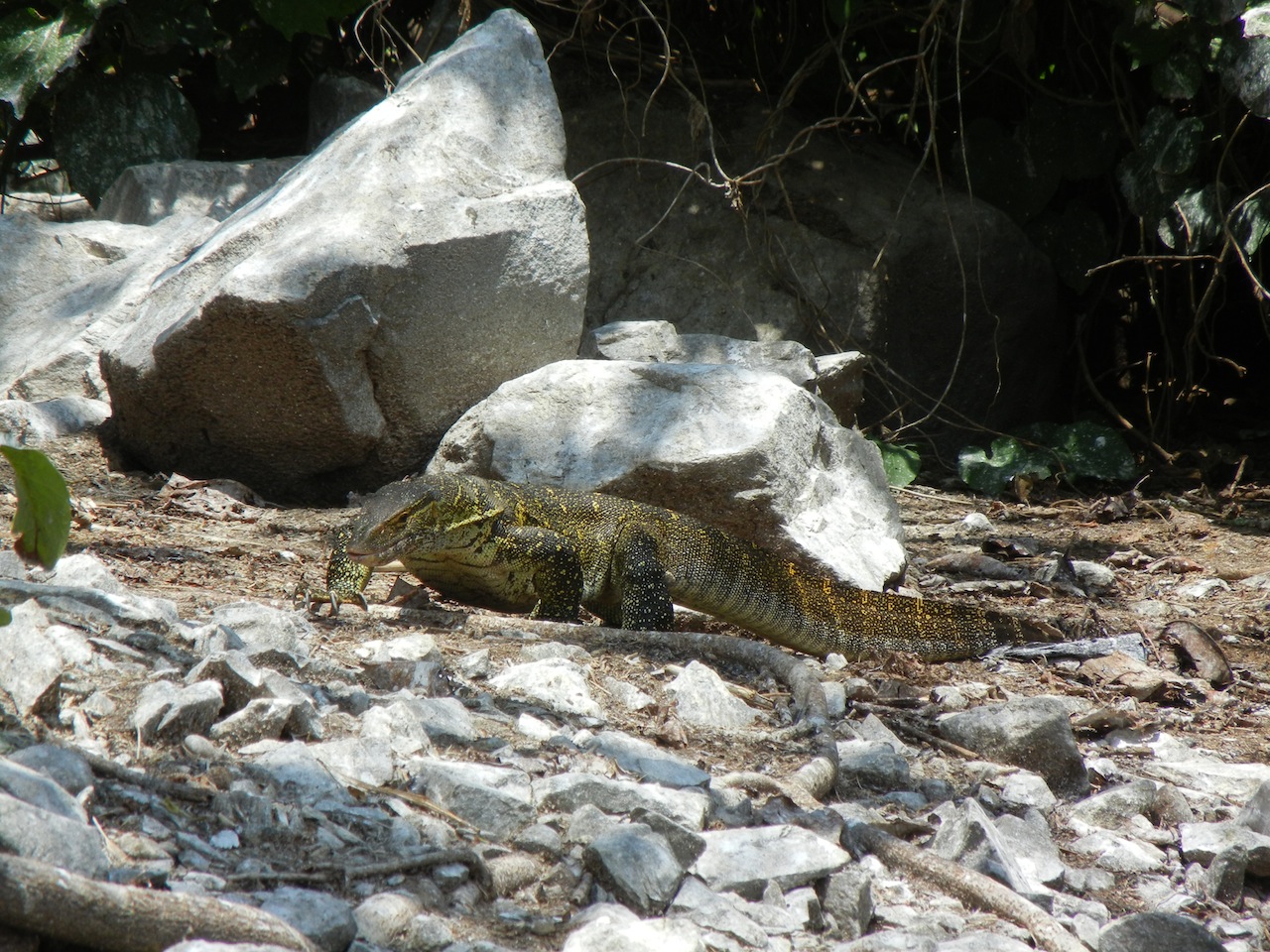
A Monitor Lizard at the Source of the Nile

A Monitor Lizard at the Source of the Nile

KarenBeth and Jeff at the Source of the Nile River

KarenBeth and Jeff at the Source of the Nile River

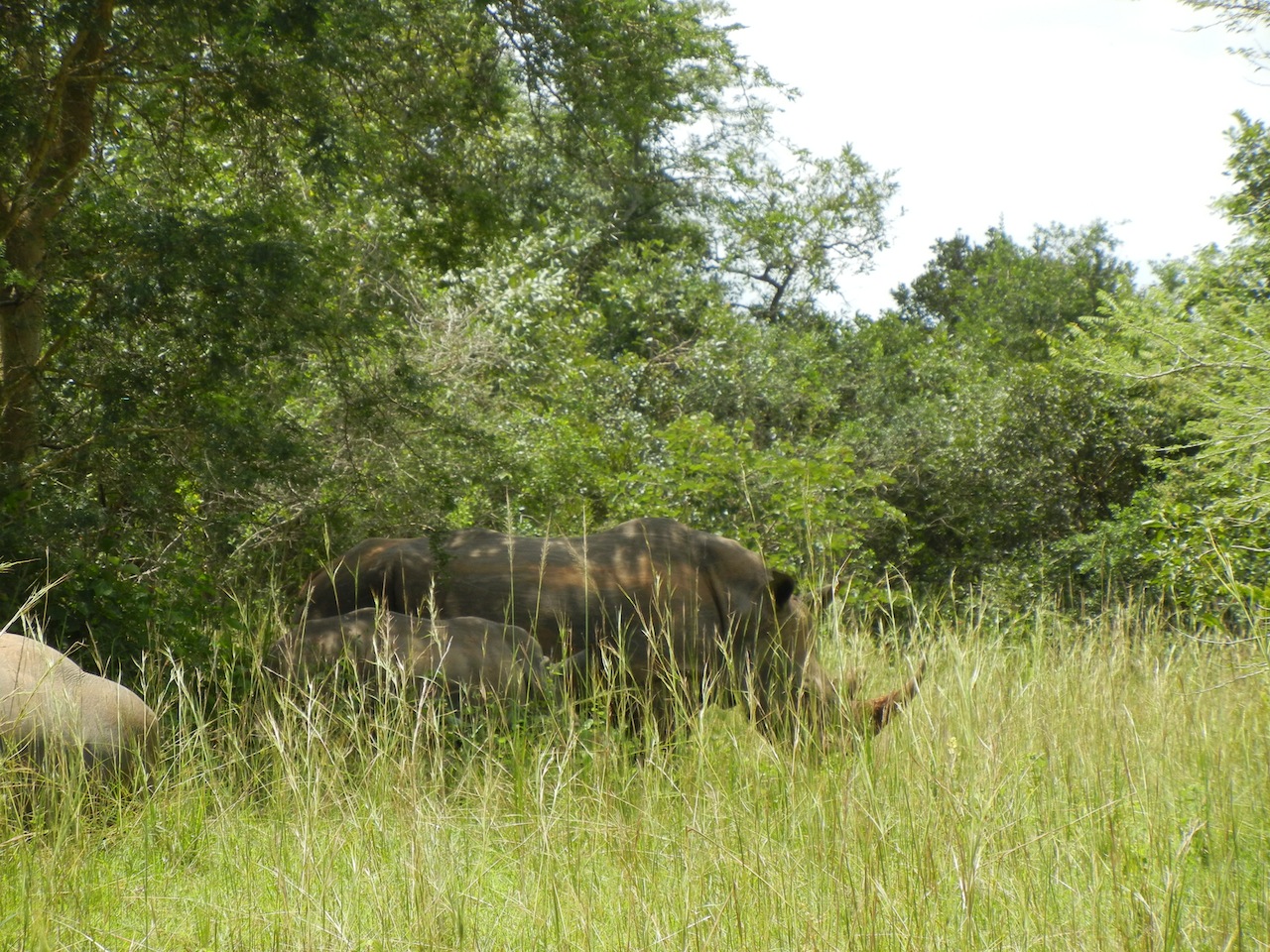
Bright and early Wednesday morning at 7am we were ready and awaiting our driver for the trip to Masindi. Sam, my trusted driver on the Masindi leg of my trips since 2011, drove to Kampala with a friend to pick us up and finally arrived at about 8am after a delay due to traffic. You have probably realized a recurring theme: traffic is a major issue in and around Kampala. Anyway, once on the road, having said goodbye to my Kampala friends, Jeff and I headed for Masindi, but first stop, Ziwa Rhino Sanctuary. White Rhinos, which are the type this sanctuary houses, used to be native to Murchison Falls and other parks in Uganda, but due to poaching they became extinct.

Rhino Trio- Mom and Baby (6 months old) with Dad off to the side

Rhino Trio- Mom and Baby (6 months old) with Dad off to the side

This park is trying to raise and protect a large herd so that they can eventually be released back into their own native habitat. Protecting them, even while in the sanctuary, is no easy feat. Poachers can be ruthless and try many things to gain access to desired animals. The Ziwa Sanctuary has a fleet of armed guards that track the Rhinos and chronicle their behavior day and night both to make sure they are safe, but also to learn more about their lives. For example, they are able to know when mating occurs and if the procedure lasts at least 45min, they know the activity was successful. Well, maybe that was too much information for you, but they are really able to learn a lot about the Rhinos.

The Rhino Mom is standing up nursing her baby

The Rhino Mom is standing up nursing her baby


After Rhino Trekking, we headed on to Masindi where we checked into the hotel where I always stay. It was so cool to be recognized by name and welcomed by the staff there. I also wanted Jeff to meet the people I work with at Masindi-Kitara Medical Center so I had emailed them a couple of weeks ago to check on stopping by. We were greeted very warmly upon arrival and the Business Manger gave Jeff a detailed tour of the facility, which is quite nice compared to the District Government hospitals and clinics. Again, it felt so good to be among friends and I look forward to working with them next April when I bring my US pharmacy students.

One of the last stops for the day was at the Orange Mobile Phone store to get more airtime minutes. The purchase went smoothly, but as I was leaving the store, a diminutive older man yielding a wooden stick that looked like a cane assaulted me. I was pretty much in shock. He only barely touched me with the stick but right away went to strike again. Jeff was thinking quickly and went to intercept and as he did the whole episode came to the attention of the people inside the shop. A man ran out and scared away the one with the stick, although he had to exert some amount of force to do this. All the while the attacker was speaking in a language I didn’t understand so I asked my driver later what he was saying. Sam said this was a guy who is known to be “crazy” and he was shouting something like “You are all going to pay, every last one of you.” Well, to say the least, that was a bit unnerving but it ended well with no one hurt. Despite this, we truly did have a lovely day and ended it with a huge meal at the New Court View, the place where we are staying but also the best restaurant in town. I had the sizzling beef dish that my past pharmacy students know very well and Jeff had the whole deep fried tilapia fish. This fish is local and right out of Lake Victoria. I know how delicious it is, despite seeing the head and tail and all of the fins, as I had it yesterday for dinner at the Jinja Sailing Club. Tomorrow, on to Murchison Falls National Park and our animal safari.
 

Posted in My Safari (My Journey/Adventure) | Tagged , , , , , , | 1 Comment

Roman Catholic Worship Ugandan Style

This in not an official U.S. Department of State (DOS) blog and the views and information presented are my own and do not represent the Fulbright Program or the DOS.

The St. Peter Choir of St. Augustine Church, Makerere University, processes towards the altar carrying gifts of Thanksgiving

The St. Peter Choir of St. Augustine Church, Makerere University, processes towards the altar carrying gifts of Thanksgiving

It’s been an interesting but great weekend. I woke up on Saturday morning with some definite plans in mind. I had to wash some clothes and wanted to do that first thing so I could get them out on the line. My thought was if I can get them out early, hopefully they would dry before the daily rains come. I also had a Pharmaceutical Care Skills lab class to write for Monday and I wanted to walk down to the Tuskey’s shopping center to get some groceries in preparation for my husband’s arrival in Uganda late on Saturday night. Yes, my husband, Jeff, was coming to Uganda for the first time and I was really excited to show him my home away from home where I’ve been doing challenging work that is very fulfilling with people I’ve come to love. So the first item on my “to-do” list went well- I washed and hung out my clothes and low and behold it didn’t rain at all on Saturday and the clothes completely dried outside. In the past few weeks, most of the time the clothes would partially dry but then need to be hung in my room on a line for another day or two. While I was diligently working on the 2nd item, my class preparation, I got a disturbing phone call from the US Embassy. They were advising all Americans in Kampala to “shelter-in-place” due to an active operations by the Ugandan military against a suspected terrorist cell right here in Kampala. I was told to stay at home and not go for groceries. I asked about picking my husband up at the airport in the evening and was told that hopefully it would be cleared and safe by then. By the way, the reason I got the phone call and several emails about this was because I had signed up with the Safe Traveler Enrollment Program (STEP), which is a service by the U.S. State Department where any foreign travel can be registered and if there are security risks, the travelers will be notified. I strongly advise all Americans traveling abroad, even in countries where you might not think there would be trouble, to register. It has been helpful several times for my students and me. Throughout the day I continued to receive updates and it turned out the action was regarding the discovery of an al-Shabaab terrorist cell in Kampala. There were no specific targets and the subjects were apprehended but because there were still heightened security checkpoints, the last message of the day said American should not go out on Saturday night. As already mentioned, though, my husband was flying into Entebbe airport and I couldn’t let him arrive without me to greet him. So, I discussed this with my regular trusted driver and decided to go anyway. Fortunately, aside from some really bad traffic jams, we got to and from the airport without incident and arrived safely back at Edge House by about 1:15am.

The first real Ugandan experience I wanted to share with Jeff was the St. Augustine’s Roman Catholic Church service I’d been to my first full weekend here.

The Choir sings a lively hymn in their bright colored traditional garments

The Choir sings a lively hymn in their bright colored traditional garments

It is on campus and only a quick walk from my house. The service turned out to be more lively and wonderful than the first time I’d been there. First of all it was a Feast Day- the celebration of the Holy Cross, but it was also the day that the choir was celebrating their Thanksgiving to the Church. Today they dressed in Traditional costumes which for the women are very colorful and cheerful, rather than their regular church clothes. The men wore long white gowns with black jackets over them. I’m not sure how they stood the heat today. When it doesn’t rain, it can get pretty hot. Everyone looked so spiffy. There was more music than usual and the choir, which is about 30-40 adults, sang a gorgeous anthem in harmony, accapella. When I looked at their music sheets, I was amazed to see that they only contained the words and not music. They had all memorized their harmonizing parts- amazing! The acoustics in the large church were great and their hymn was a traditional tune with the John 3:16 the basis of the lyrics.

The Choir Director was great!

The Choir Director was great!

At the time of the Offering, the choir left the sanctuary and soon came back in a large procession down the aisle carrying all of their gifts for the church, given in Thanksgiving to God. They carried food items and many household items like mops, brooms, etc. The entire alter was filled by the time they laid everything down. As they processed, they swayed back and forth to the music. The whole service today had an air of joyfulness and we were all swaying and clapping to the rhythm of the hymns- some sung in Luganda and some in English. Afterwards, we all (Monty, my housemate went to the service too) walked to the local Indian place on campus for lunch.

Monty (on left) and Jeff (on right) enjoying a  cold Ugandan brew after a 2 hour worship service at a delicious, and reasonably priced, Indian Restaurant on campus

Monty (on left) and Jeff (on right) enjoying a cold Ugandan brew after a 2 hour worship service at a delicious, and reasonably priced, Indian Restaurant on campus


Posted in Fulbright Specialist Project, My Safari (My Journey/Adventure) | Tagged , , , , | 1 Comment

A Visit to the AMPATH Program in Eldoret, Kenya

This in not an official U.S. Department of State (DOS) blog and the
views and information presented are my own and do not represent the
Fulbright Program or the DOS.

First Things First: The Road Trip

A traditional Ugandan hut along the road to Eldoret, Kenya

A traditional Ugandan hut along the road to Eldoret, Kenya

On Wednesday I had the fun experience of a road trip to Kenya with Professor Odoi and one of the other faculty, Kalidi.  We started off at about 10am and although this was later than originally planned (7am), I think it worked out even better. Although the traffic getting out of Kampala is usually horrible, this seemed to be the quickest ever for me.  Now we did run into traffic jams along the way (referred to simply as “a jam” here), mostly due to road construction, but overall it wasn’t bad.  We drove with the windows open and watched the road go through many small villages with active open air markets and the lush, green countrysides dotted with farms growing bananas, tea, cassava, and other crops.  There are also areas of thick forest. Along much of the way we passed by fields and fields of green stalks which turned out to be sugar cane.  Adobe red dirt roads run parallel
to the highway at times and perpendicular branches lead to homes and villages that can’t be seen from the main road.  The radio played in the background as I worked on a blog post.  The music was a mix of African tunes in a language I didn’t understand with rhythms to make you want to move as well as contemporary soft-pop music.  I had to
smile when the song, Call Me Maybe, by Carly Rae Jepson, came on as it brought me right back to 2 years at during the summer Olympics when the USA swimming team made a lip sync video that quickly became “Trending” on social media. As we drive by the small market intersections, if the traffic slows down, hosts of street vendors approach the vehicle with food items for hungry travelers.  They smell delicious but I abstain because I’m extremely cautious with the food I take so I don’t become ill.  The items include roasted chicken and beef on a stick and roasted bananas, without the peel. I could have also purchased bottled water or soda and regular bananas with the peel.  Since I brought g-nuts with me, like peanuts, I’m fine with these for a snack.

Typical scene along the drive to Eldoret, Kenya (on the Ugandan side of the border)

Typical scene along the drive to Eldoret, Kenya (on the Ugandan side of the border)

We reached the crossing of the Victoria Nile River to enter Jinja via the bridge over the Owens Falls Dam, which provides electricity to much of Uganda, in about 2 hour, which was good timing.  We finally got to the Ugandan-Kenyan border at about 2:30pm. You first have to clear the Ugandan side by getting your passport stamped and the car has to go through a process as well.  Then we went to the Kenyan side and were checked over for signs and symptoms of Ebola. Basically they just looked at us and took our  temperature.  Then I had to fill out the form for the Kenyan Visa, pay my $50 US dollars, and get my Visa stamp.  Finally after we all cleared it turned out that the car had to
have Kenyan insurance so that was an unexpected expense.  But, finally, we got back on the road.  Through the whole thing a guy on a boda-boda walked us through the process which made it much smoother. He demanded some payment at the end but it was worth it, I think.  I’m not sure how you would know what to do without him, if it was your first time.

A Ugandan school along the way

A Ugandan school along the way

The Kenyan side of the border here is basically identical to the Ugandan side except for not seeing as many villagers dressed in traditional tribal wear.  We did have to change some money, though, as they don’t have the same currency as Uganda and I may have some trouble some trouble communicating since Swahili is the national language.  The group we are meeting, though, will speak English.  The road thru Kenya was pretty poor in spots due to massive construction and I think we finally arrive at our destination at 6:30pm, much longer than anticipated. We were expected, though, and had a really nice dinner and conversation with some of the AMPATH pharmacists and then got a really good nights sleep.

The AMPATH Story

Standing in the beautiful Mother-Baby Hospital (right to left: Richard, Susie, Dennis, Kalidi, Rakhi)

Standing in the beautiful Mother-Baby Hospital; the artwork was done by a patient (right to left: Richard, Susie, Dennis, Kalidi, Rakhi)

So, I guess it is time to tell you the reason for this road trip.  We went to visit  Purdue University’s global health pharmacy project in Eldoret.  We wanted to see what we could learn about the way they developed their pharmacy training programs and how they have made significant advances in the practice of pharmacy in Kenya at Moi Referral and Teaching Hospital.  We were hoping to gain information that would help us determine the next steps in our process to advance pharmacy practice in Uganda and investigate possible ways of collaborating. Purdue University School of Pharmacy involvement in Eldoret is part of the AMPATH program, which stands for Academic Model Providing Access to Healthcare. It is a joint program of several medical schools, including Indiana and Brown Universities, and Purdue University School of Pharmacy.  The origins began back in 1988 to develop a Medical School at Moi University in Eldoret, Kenya and evolved to become a massive project to help provide access to HIV medications to improve patient health outcomes.  At first the project mostly involved training for medical doctors but Purdue University School of Pharmacy joined the efforts to train pharmacists as healthcare providers back in about 2007 or so.

Richard Odoi stands in front of the Mother-Baby Hospital

Richard Odoi stands in front of the Mother-Baby Hospital

Fast forward to present day and they now have 2 full time Purdue Pharmacy faculty members placed permanently in Eldoret who run a training program for Kenyan Pharmacy Interns that rivals or surpasses the training of US pharmacy students.  They also run a Residency Program in Global Health for US Pharmacists and Kenyan Pharmacists.  In addition they host Purdue Pharmacy Students 4 times a year for 8 weeks each time for a total of 24 students for a Global Health advanced pharmacy practice experience. They provide many services to the patients at Moi Referral and Teaching Hospital in addition to care for HIV patients including running an anticoagulation clinic, a home blood glucose monitoring clinic for diabetics, a rounding service on the adult medicine wards and in a new Cardiac Care Unit.  They have started some really unique projects, one involving a special program to provide medications at lower cost through a revolving fund pharmacy program so patients get their prescriptions filled and are adherent to regimens.

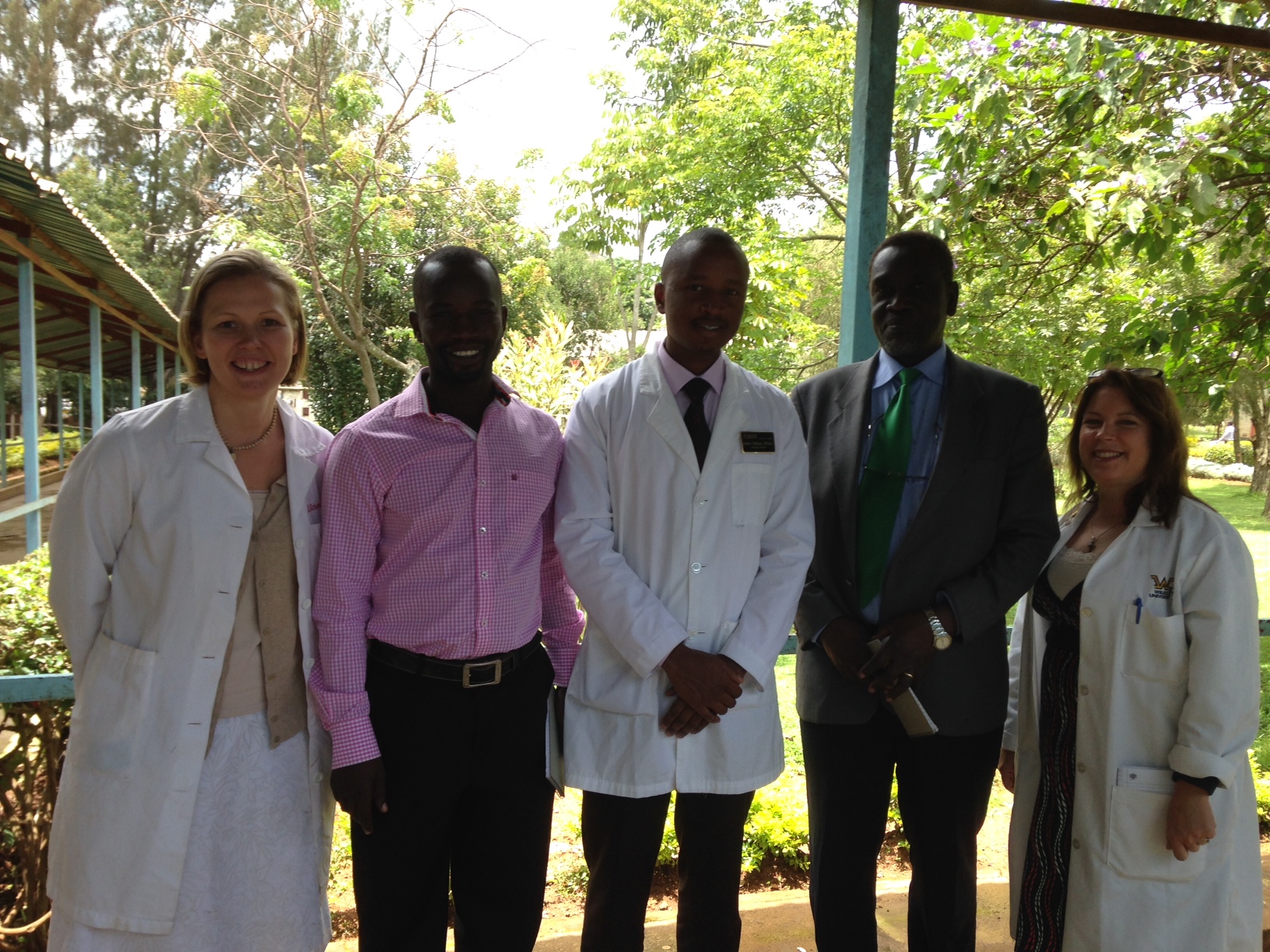
At Moi Referral and Teaching Hospital (Left to Right: Susie, Kalidi, Dennis, Richard, KarenBeth)

At Moi Referral and Teaching Hospital (Left to Right: Susie, Kalidi, Dennis, Richard, KarenBeth)

There is also a micro finance project that somehow rewards patients for keeping their follow up appointments to get their diseases under better control. They are working with a scientist from Notre Dame to test a point-of-care detection program for identifying counterfeit and substandard drugs where the tablet just needs to be scratched across a card and then with water added, the card turns colors and the pattern tells you whether the drug contains any active ingredient.  Rakhi Karwa, one of the Purdue pharmacy faculty, and Mercy Maima, one of the Kenyan Residents gave a really interesting talk to us and the rest of their pharmacy crew about the scope of the worldwide counterfeit problem and this new detection system.  Apparently about 10-30% of drug products may be counterfeit or substandard. This is something that we in the USA are just not routinely aware of but this problem isn’t just for the developing world. Back in 2012 a bunch of counterfeit cancer drugs were detected and had been administered to patients.  There are many other projects that I can’t remember but one is developing a new chronic care management program.

This is some of the AMPATH Pharmacy Staff- the Kenyan Interns and Residents and American Residents (Left to right: Edith, KarenBeth, Tabitha, Benson, Chelsea, Liz, Susie, Blenda, Dennis, Richard, Kalidi)

This is some of the AMPATH Pharmacy Staff- the Kenyan Interns and Residents and American Residents (Left to right: Edith, KarenBeth, Tabitha, Benson, Chelsea, Liz, Susie, Blenda, Dennis, Richard, Kalidi)

Both the Makerere Faculty and I are returning to Uganda filled with new ideas to grow our efforts to train pharmacists to provide a higher level of patient care and improve their health.  This trip was immensely successful and we are more motivated than ever to be successful. Rakhi and her crew gave us much food for thought and we all think this is the beginning of a new collaboration.  One thing that was truly evident and came up over and over again in our conversations is that the primary way forward is to always keep the patient at the center of all of our projects- they will be the reason for our change- and if we are all one in our efforts to help patients, we will succeed. There is still a lot of work ahead and we know our program will take time to show improvements but now with a hop and a skip in our steps we will progress onward.

Posted in Diseases/Health, Fulbright Specialist Project, Ugandan Nature | Tagged , , , , , , , , , , , | Leave a comment

Update Part 2 (from the road to Eldoret)

This in not an official U.S. Department of State (DOS) blog and the
views and information presented are my own and do not represent the
Fulbright Program or the DOS.

Pharmacy Interns: Robert and Mandela

Pharmacy Interns: Robert and Mandela

The great start to my work week continued on Tuesday when I worked with Pharmacy Interns at Mulago National Referral Hospital.  I met with Robert and Mandela up in the 4C pharmacy as we spoke about a patient they had been taking care of with end stage renal disease (the patient’s kidneys shut down for good) who had just been started on hemodialysis. This was going to be the patient case they will present on Thursday at tenon conference.  Like the Makerere Pharmacy students, these interns were very attentive and engaged in our conversation. Although I find they struggle with the same patient care issues that my students at Wilkes do, the solutions are not always as straightforward.  These interns had relied on the estimate of the patient’s renal function written in the chart by the medical team because they didn’t have the patient’s weight, which is necessary to
perform the calculation. In the US, I would just tell my students to go weigh the patient or nicely ask a nurse to do it which would be accomplished very quickly. Here, though, there isn’t a scale to be found so I explained to the students how we have to think “out of the box” and can use our best educated guess by comparing the person’s height and weight to their own height and weight, which they know, and  adjust accordingly. It was a true pleasure to work with Mandela and Robert and I’m sure they will do well with their presentation on Thursday.

A presentation for the Interns on how to be a Preceptor for the Makerere Pharmacy Students

A presentation for the Interns on how to be a Preceptor for the Makerere Pharmacy Students

After this meeting, I gave an educational session to all of the Mulago Pharmacy interns on  how to be a Preceptor for the Makerere students that would soon be coming to the hospital to work with them on Pharmacy Rounds.  This is a fairly new concept because the minimal experiential training at the hospital in the current curriculum is not routinely supervised.  We’ve learned over the years in the USA, how important it is to have students practice and use their skills in the provision of patient care all throughout the Doctor of Pharmacy curriculum.

The Interns were fully engaged in the Preceptor Training Activities. There was a worksheet to fill out as we went through the presentation.

The Interns were fully engaged in the Preceptor Training Activities. There was a worksheet to fill out as we went through the presentation.

It is when using the newly learned skills that the students see how they can help patients and this in turn motivates them and provides a more specific context to didactic learning components.  My personal opinion is that if it were feasible, my pharmacy students would be in the practice setting on a regular basis from the very beginning of pharmacy school
and the didactic components would be reduced in favor of learning by “doing”- the ultimate Active Learning strategy.  We would more clearly tie the practice of pharmacy to the classroom. The “classroom” though, doesn’t need to be in a building. It can be at the patient’s bedside or in the micro lab.  It could be “in the cloud” as students actively
research and learn in a self-directed manor or in the aisles of the community pharmacy helping customers choose the best over the counter Meds (those where a prescription isn’t necessary).   As I left the lecture to the Interns, I was again feeling quite joyful! My work here is progressing along so nicely.

Steven is the Intern Leader and was my right hand man in setting up the sessions and making sure the Interns were prepared to work with me on their cases.

Steven is the Intern Leader and was my right hand man in setting up the sessions and making sure the Interns were prepared to work with me on their cases.

Posted in Diseases/Health, Fulbright Specialist Project | Tagged , , , , , , , , , , , | 1 Comment

The Road to Eldoret, Kenya: Off on Another Journey

This in not an official U.S. Department of State (DOS) blog and the views and information presented are my own and do not represent the Fulbright Program or the DOS.

It has been a couple of really busy days but now, as I’m on the road to Kenya (more about that in my post for tomorrow), I will try to write a short or not-so-short update, in 2 Parts due to the length.

Part 1
My 3rd Pharmaceutical Care Skills Labs all day on Monday went really well. As much as I am here to teach, mentor, and provide a role model for pharmacists that are actively involved in improving patient care, I am constantly motivated and energized by the students I’m working with. These Makerere University Pharmacy students are clearly hungry for the clinical skills I am teaching them. I have their rapt attention, even during the lecture sections. The best part, though, is to see them role-play the scenarios. They really get into it and are able to help me to better understand the common barriers and responses of Ugandan patients. This leads to the questions I ultimately want them to answer and situations I want them to be able to manage involving helping real patients to better understand their medications which leads to better overall health. Although some Pharmaceutical care content could be taught in a large lecture classroom, the beauty of small groups working together to enact scenes from real life helps them to learn how to manage real patients. People don’t always listen to your advice and often patients think they know what they need. But, as a healthcare professional, just giving the patient what they asked for is not always in their best interest. This week’s lab was using patient care skills in the outpatient treatment of malaria. I chose this disease state because I knew every student would have life experience with this disease- just about everyone growing up in Uganda would have had a personal experience with this nasty disease, and may have had many episodes. Now they are in a professional program to learn to be a Pharmacist, so although they have some knowledge from the past, it is time to put this into perspective, use evidenced-based medicine, and learn about the importance of trying to make a definitive diagnosis of malaria using rapid drug testing in the outpatient setting, rather than just treating someone who has the symptoms. Treating for malaria when it is another infection can delay the right treatment and patients can deteriorate and then need more costly care in the hospital or with expensive antibiotics. I was trying to make the point that it is now time for them to learn not to just follow the common practices they are familiar with such as dispensing antimalarials on patient request when the diagnosis hasn’t been confirmed. Another problem with doing this is the emergence of resistant malarial parasites which is already occurring. If they don’t start to “be the change” now, there may be a time when malaria becomes even more difficult to treat, especially for poor patients when the cheapest drug no longer works.

IMG_0527.JPG
Monday evening I had a lovely dinner at a restaurant that is new to me, Emin Pasha, with one of my good friends in Uganda, Benjamin, whom I’ve known since summer of 2011. He is the head pharmacist of the Uganda Cancer Institute and is one of the most proactive and energetic pharmacists I’ve ever met, including those from the US, in terms of working towards the improvement of patient care. When he noticed that the oncology drugs from the National Drug Stores didn’t seem to be effective, he investigated and successfully advocated for the ability to purchase from suppliers that had superior products. This is not an easy process in Uganda. It took dogged persistence and letter after letter and meeting after meeting before he was successful in significantly increasing the drug budget over the past several years to better serve his patients. Benjamin also develops a personal relationship with his patients whenever possible. He meets with patients to explain the chemotherapy and ease their worries. I’ve know him to go to great lengths to track down a patient to find out why they didn’t come back to get their next dose of chemo because he knew the patient had a curable cancer, if proper treatment is received. It is so sad to see people succumbing cancers that are easily treated in the developed world, like cervical cancer, because of lack of access to good detection and prevention and early treatment strategies here is Uganda. He will even learn to perform tasks that aren’t usual for pharmacists, like dressing changes, when he realizes the nurses are too busy to do it and no matter what antibiotics he gives them, the infection won’t be cured if the wound isn’t clean. I could go on and on about the ways that Benjamin is a great role model for pharmacists in training- he is proof that change is possible, even in this difficult environment. As you can tell, it’s always a joy for me to talk with Benjamin- he also motivates and inspires me to continue my involvement in this endeavor to advance pharmacy practice in Uganda.

IMG_0526.JPG

Posted in Uncategorized | Tagged , , , , , , , , , | Leave a comment

A Sunday Adventure

This in not an official U.S. Department of State (DOS) blog and the views and information presented are my own and do not represent the Fulbright Program or the DOS.

Musician's rehearsing prior to the home worship service

Musician’s rehearsing prior to the home worship service

From the moment I stepped into the house and heard the guitarists rehearsing the music to the first stanza of the opening Psalm {Psalm 139}, I knew I was in the right place at the right time. I was at a Zone worship service and community gathering of the Kampala International Church near Bunga- on the outskirts of Kampala. Now let me back up a bit and tell you the story…


Potluck lunch and fellowship with new friends on the patio as the sun shone brightly

Potluck lunch and fellowship with new friends on the patio as the sun shone brightly

A few days ago, Monty, my housemate, had asked me if I wanted to accompany him to a church and potluck luncheon on Sunday (where everyone brings food to share) on the outskirts of Kampala, well it is actually in Kampala but a bit far from the area around Makerere University where we live. He really couldn’t give me much other details but I was game, as long as I could get back in time to work on my Pharmaceutical Care Skills Lab lesson for Monday. He had recently met a friend of his wife’s family who lives in Uganda and has started a school called Terra Nova, which he visited this week. Alisha was enrolled in Divinity Studies at Duke University and had interned at Monty’s wife’s family church years ago and since then has relocated to Uganda, married a wonderful Ugandan, Abdul, and are raising 2 young girls while running a Christian school in a poor area of Kampala. The gist of the mission of Terra Nova is to work towards the alleviation of poverty by empowering, educating, and encouraging Ugandan children while they grow in the faith of Christ who gives all hope for a better tomorrow. Anyway, Monty was invited to attend church services and in turn invited me.

Driving through Kampala to the worship service

Driving through Kampala to the worship service

Our morning drive started at 9am, even though the church service doesn’t usually start until 10 or 10:30am, because we were far away from that area of Kampala. It had already started to sprinkle rain but we arrived in the general area of the home we were going to in only about 25min because the traffic was so light this Sunday morning. But, when we turned off on the very bumpy red dirt road, it started to rain a bit harder. Our driver had spoken to Abdul on the phone to find the exact location but we were having difficulty finding it. We ended up going down an even narrower rutty road just to have to turn around at the end in a really cramped space. We got back to the intersection of the 2 dirt roads and were told to wait for Abdul and Alisha to find us and direct us further.

A lovely view of Lake Victoria and the beautiful vegetation prior to the storm

A lovely view of Lake Victoria and the beautiful vegetation prior to the storm

As we waited, not quite sure we were really in the right place, the heavens opened up and the rain poured down. It is amazing to see a road that seemed fairly solid go from hard ruts to a muddy mess which is very difficult to traverse without an SUV, 4-wheel drive, which Haji, the driver, doesn’t have. His car is a mini van. It does well on solid rut roads, but when the mud puddles get deep and the road becomes a gooey slippery trail, we all start to be a little concerned about getting stuck.

The storm is rolling in over Lake Victoria near our destination for the church service

The storm is rolling in over Lake Victoria near our destination for the church service

Well, fortunately just about this time, Abdul and Alicia come along and we follow them only about 100 yards to the gated entrance of one of the parishioner’s homes. We couldn’t believe we were only a stone’s throw away. The opening gate revealed a beautiful home, and can you believe it, a 3-vehicle carport – a covered area big enough to fit 3 large cars.

After our arrival, many more cars started to pull in and both Ugandans and expats (this is short for expatriates, people who have left their own country to live and work permanently in other countries, Uganda, in this case) exited and entered the home. Once all were gathered, there were about 30 adults plus many, many children – teenagers to wee ones only a few months old. This turned out to be a once a month gathering of small groups of members of the Kampala International Church who live near each other. They call this their “Zone” service. Basically, one family offers to host in their home and the others of the group that live near each other, travel to that home and worship together in a small, comfortable, and informal setting.

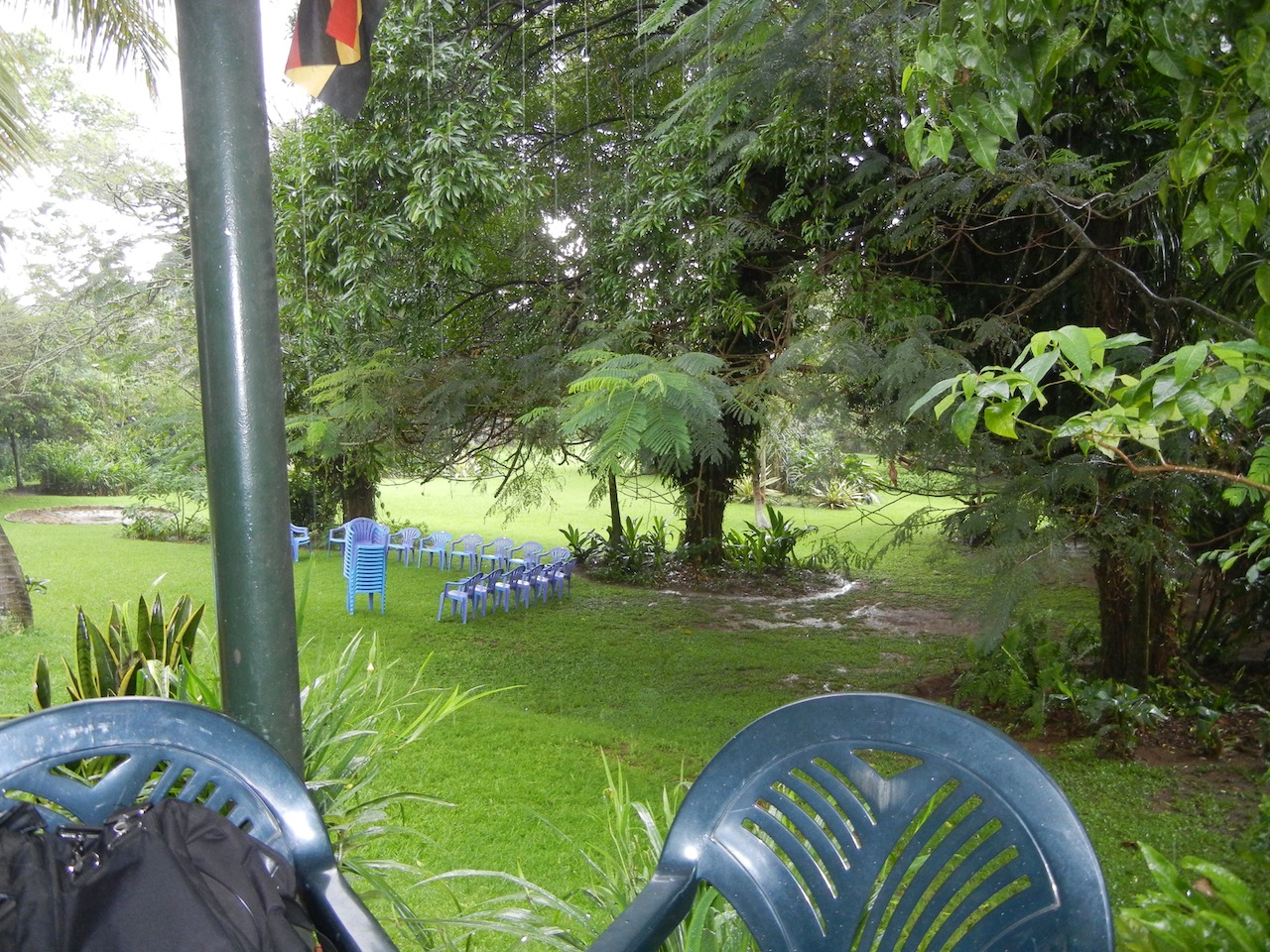
The lawn was beautiful and this would have been a peaceful place to worship if it hadn't been so wet

The lawn was beautiful and this would have been a peaceful place to worship if it hadn’t been so wet

The hosts had set up a bunch of chairs in a semi-circle on the lawn but since the rain was pouring down, we gathered in the living space indoors. There was singing, accompanied by two guitarists and a drummer, using a traditional African bowl drum, Bible readings, and one person is designated to lead the study or learning activity for the day. Today, after Mary read the lesson about how God had used Samuel to find and anoint David to be the successive King to Solomon, she had us divide into groups and do an activity to get to know each other and talk about the spiritual gifts we have in our hearts. Then the smallest in the group, by height, was anointed with water by the tallest in the group, to remember how David was small and humble but was chosen by God for a big purpose. Guess who turned out to be the shortest in my group? Yes, it was I – I was shorter than even the youngest child.

Me and my new friend, Klaus, the Shea Butter and Nut exporter

Me and my new friend, Klaus, the Shea Butter and Nut exporter

After the worship service, the group gathers for lunch and socializing. I met so many different people today and got to learn about all of the interesting work they are doing that brought them to Uganda and is keeping them here. Sometimes the work that initially brought them here is not what they are currently doing because the project ended but because they love this country and the people so much, they seek other employment to stay here. There were people from Belize, Montana, Wyoming, The Netherlands, The UK, Germany, and I’m sure I missed someone’s country of origin. One was an Engineer who also manages a Coffee processing and exporting business, another works for the Ugandan Wildlife Authority, and one gentleman whom I spoke to for quite awhile has started a Shea Butter and Shea Nut exporting business. This endeavor empowers women in one of the war-torn areas of Northern Uganda by helping them to raise money to send their children to good schools through becoming part of a cooperative that harvests fruit from the Shea Tree using a certified Organic process. Shea Butter is a common ingredient in many lotions and creams. One of the younger adults is a Makerere University student studying to become a Laboratory Technologist and another woman works in the biomedical and pharmaceutical field as research consultant. Mary, the leader for today, is a Landscape Architect. Of course one thing that keeps many of them here is the love of a Ugandan spouse and the family they are raising together.

When Monty and I finally headed home a little after 2pm today, I was on another “high” from the great conversations and fellowship with people who are passionate about the country of Uganda and its people. All in all, if I have ever doubted my work here, I no longer do. Today’s experience helped me to realize that God is working through me here in this place and time. He knows my comings and goings and he will guide me through whatever the next step is. I’ll end with words from the Psalm that moved me at the beginning of the service today.

Psalm 139: 1-5  “Lord, you have examined me and you know me. You know everything I do; from far away you understand all my thoughts. You see me, whether I am working or resting; you know all my actions. Even before I speak, you already know what I will say. You are all round me on every side; you protect me with your power.” (The Good News Translation)

Posted in Diseases/Health, Fulbright Specialist Project, My Safari (My Journey/Adventure) | Tagged , , , , , , , , | 1 Comment